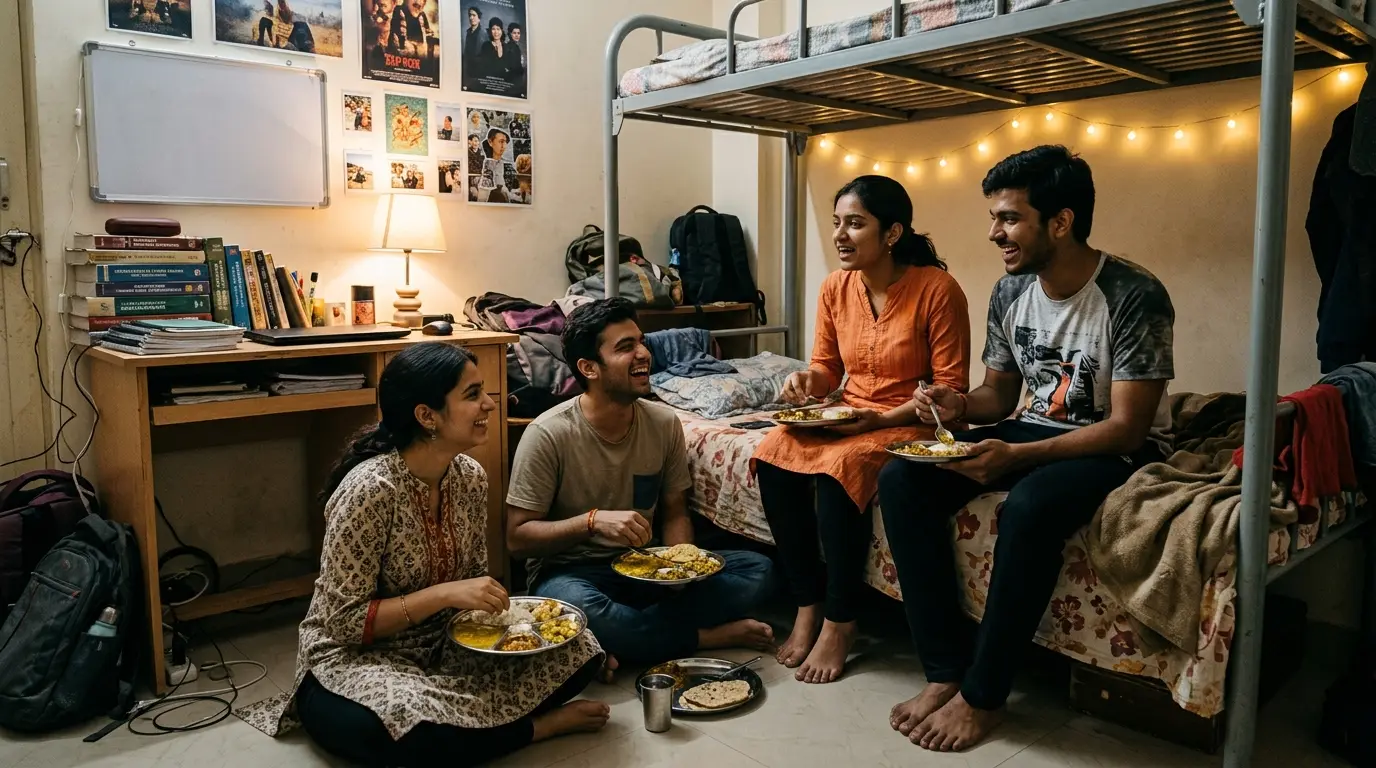
Hostel life in India is mostly a set of small, learnable systems. How you set up a shared room. How you handle a roommate who keeps different hours. How you eat when the mess is shut at 11 pm. How you stop ₹8,000 of planned monthly spending from quietly becoming ₹12,000. Get those right in the first month and the rest of the year runs on autopilot.
This guide walks the whole arc in the order you will live it: choosing between a hostel and a PG, packing, move-in day, the first week, sharing a room, food, laundry, study, health, safety, money, and checking out with your deposit intact. Every section answers its question on its own terms, then points you to the deep-dive. Written for students and first-job professionals in Indian cities, with 2026 rents and rules.
What this guide covers
- Hostel or PG: which one you are actually choosing
- What to pack, and what not to carry
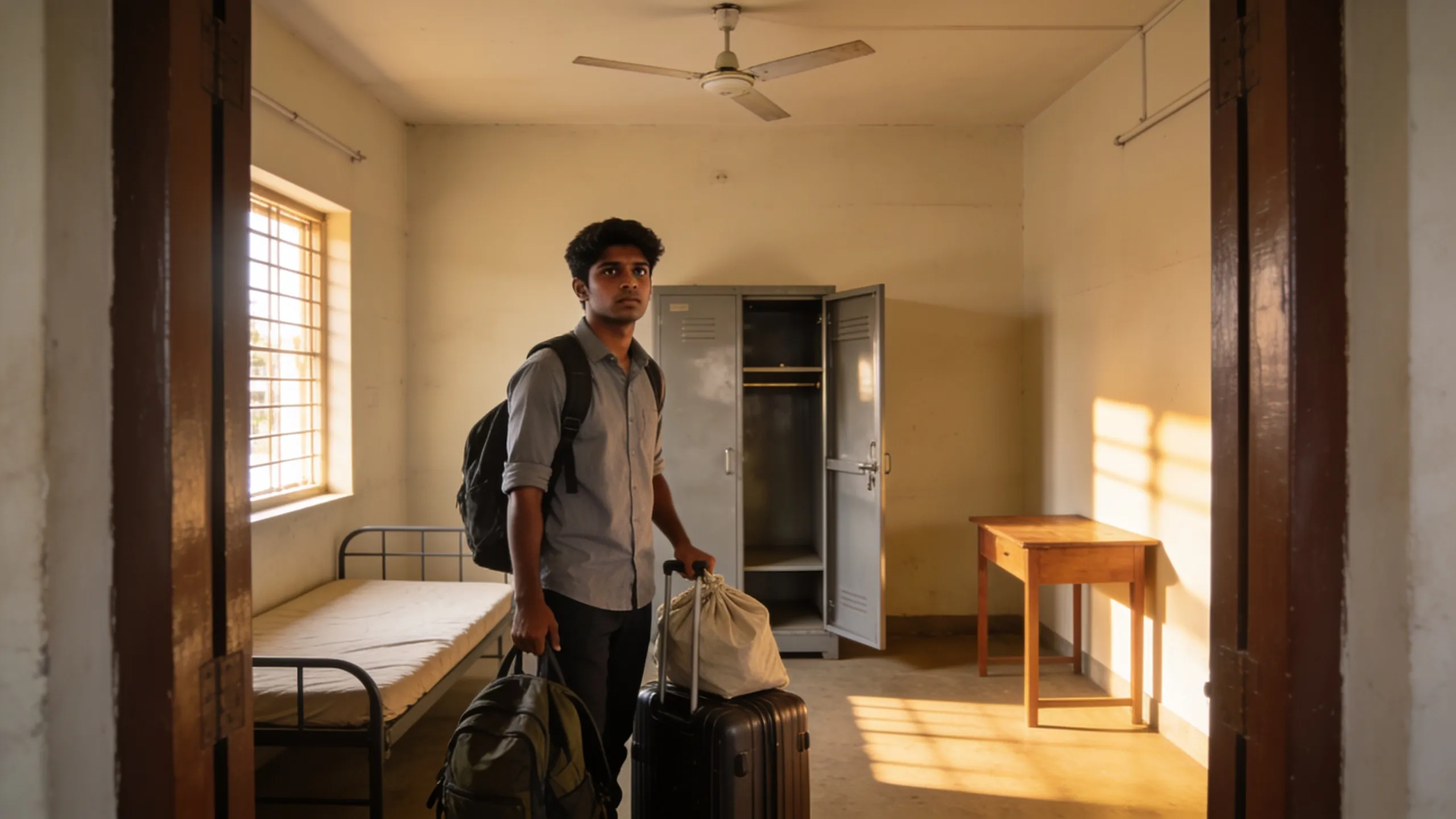
- Move-in day: the first four hours
- The first week, honestly
- Sharing a room without friction
- Keeping a small room usable
- Food: mess, tiffin and the 11 pm problem
- Laundry that does not ruin your clothes
- Studying in a room that was not built for it
- Internet and power
- Staying well: sleep, food, movement, pests
- Homesickness, loneliness and the slow weeks
- Safety: the checks that actually matter
- Money: what hostel life really costs
- Moving out with your deposit intact
- Where to go from here
Hostel or PG: which one you are actually choosing
The words get used interchangeably in listings, and they should not be. A hostel in the Indian sense is usually a larger building with a warden, fixed mess timings, gate hours and rules that apply to everyone. A PG is smaller, often a converted house or a floor of one, run by an owner who lives nearby, with rules that are more negotiable and more personal. Co-living is the branded, higher-priced version with app-based rent, housekeeping and community events built in.
The practical difference is predictability, not amenities. A hostel gives you a system: food at the same time, the cleaner on the same day, complaints to the same person. A PG gives you flexibility: a spare key, a later gate time or a room swap, usually by asking. Students who need structure do better in hostels; working professionals with irregular shifts almost always do better in a PG. Price is not a reliable signal either way, and ₹7,000 buys a triple-sharing hostel bed in one area and a double-sharing PG room three kilometres away.
If you are still weighing this up, the full comparison, including who each format actually suits and where the hidden costs sit, is in hostel vs PG: what is the real difference. If you have not started searching yet, begin with the complete guide to finding a PG or hostel in India, which covers shortlisting, visits and the agreement.
What to pack, and what not to carry
The standard mistake is packing for a bedroom you already have, not the one you are moving into. A hostel room is roughly 10 by 12 feet, shared two or three ways, with one cupboard per person and one plug point that everyone fights over. Volume is your enemy.
Pack in four blocks. Bedding, because most hostels give you a mattress and nothing else: one bedsheet set, a pillow, a light quilt, and a mattress protector if the mattress is second-hand. Clothing for about ten days, because you will wash weekly regardless of how much you carry. Documents, meaning originals plus two photocopy sets plus a phone scan: admission letter, ID proof, address proof, passport photos and prescriptions. Room kit: a padlock, an extension board, a torch, a first-aid pouch and basic medicines.
What to leave at home: a full-size suitcase you will have nowhere to store, more than one pair of formal shoes, decorative items, and any appliance you have not confirmed is allowed. Buy the bucket, bin and mop locally on day two.
The category-by-category version, sized for a shared room, is in what to pack for a hostel, and the buy-it-there list is in the hostel room essentials checklist for India.
Move-in day: the first four hours
Do these four things before you unpack a single bag, in this order.
First, film the room. Walk it slowly on video: walls, ceiling corners, the mattress, the cupboard interior, the fan, the switchboard, the bathroom fittings, the window latch. Narrate what is already broken. This three-minute clip is the reason you get your deposit back a year later, and it is the single most skipped step in Indian hostel life.
Second, claim and clean your space. Take the bed away from the door if you sleep light, wipe the cupboard shelves before anything goes in, and put the mattress protector on before you sit down.
Third, sort power and light: find which socket works, keep the extension board cable off the walkway, and set up one light you can use at midnight without waking anyone. Fourth, walk the building for the water point, the mess, the laundry area, the warden's room and the fire exit, and save the warden's and owner's numbers.
The full hour-by-hour version, including what to do with the mattress and how to lay out the cupboard so it stays usable, is in how to set up your hostel room on day one.
The first week, honestly
Week one is loud, disorienting and mostly about logistics. You will not know when the mess shuts, where hot water comes from, who to ask about the WiFi password, or whether the corridor noise stops at midnight. None of that is a sign the place is wrong. It is a sign you have been there for four days.
The shape is fairly consistent. Days one and two are admin and unpacking, with a strange evening. Days three to five are when the routine details land: mess timings, the bathroom queue, the fact that the water is cold after 8 am. Days six and seven are usually the first dip, especially the first Sunday.
Two things help more than anything else. Fix your wake-up time by day three, because a fixed morning stabilises everything downstream. And eat in the mess at the same time as the same people for the first week, which is how hostel friendships actually start without anyone having to be outgoing.
The day-by-day version is in first week in hostel: what to expect. If your head is full of things older cousins told you, run them past hostel life myths vs reality in India first.
Sharing a room without friction
Almost every serious hostel complaint traces back to three things: noise after 11 pm, borrowed items, and whose turn it is to clean. All three are solvable, and all three get much harder to solve after week three, because by then the behaviour has become the norm and asking for a change reads as an accusation.
Have the conversation in the first week, when it is still framing rather than confrontation. Agree four rules out loud: lights and calls after a set hour, whether food and toiletries are shared, how cleaning rotates, and what happens with guests. Put them in the group chat so nobody has to remember who said what.
When something does go wrong, raise the behaviour rather than the person, raise it in private, and ask for one specific change. "Can you take calls in the corridor after eleven" works. "You are so inconsiderate" does not. Escalate to the warden only after a direct request has failed twice.
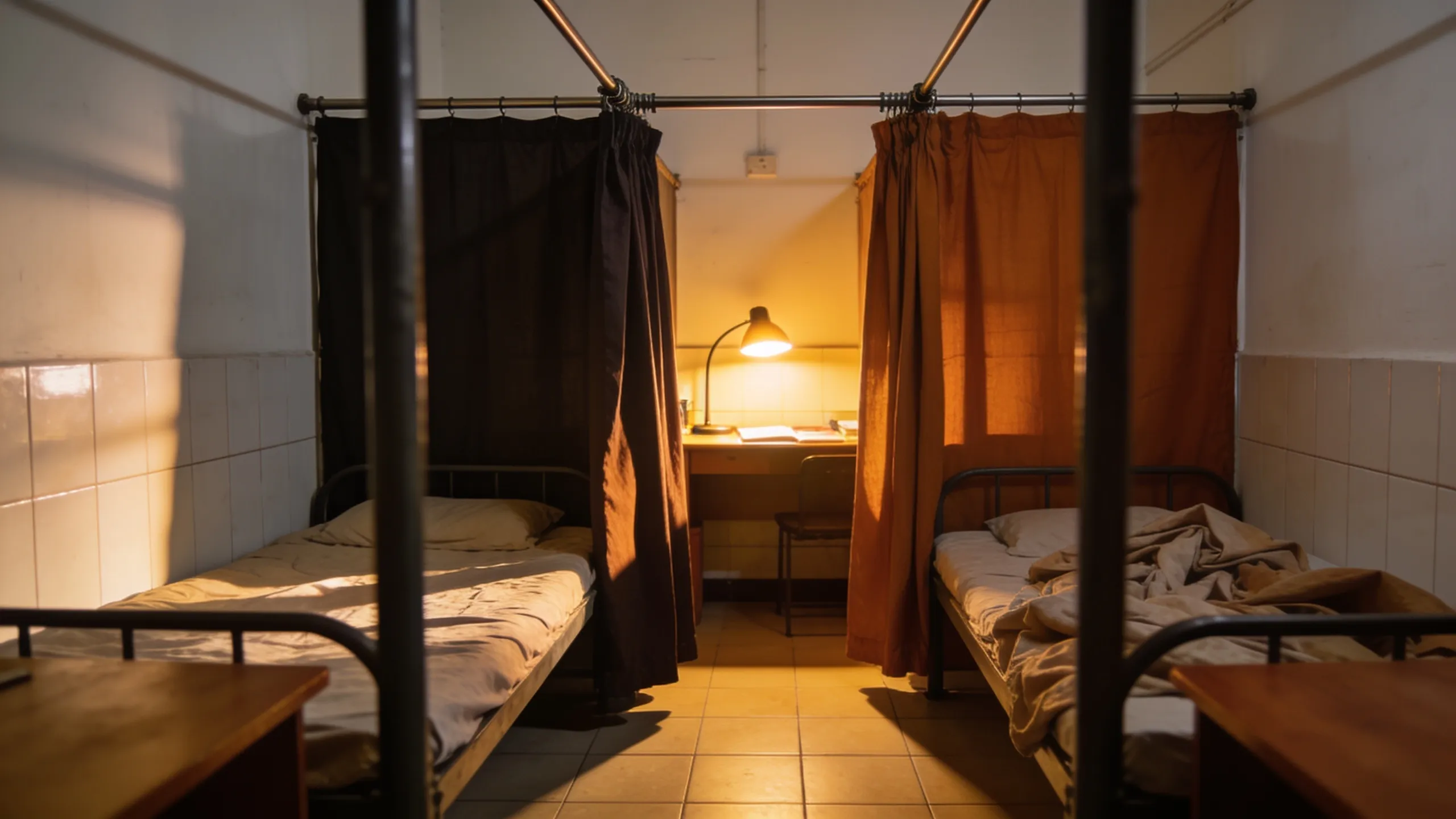
The full playbook, including scripts for the awkward conversations and what to do about a roommate who never cleans, is in hostel roommate problems and solutions. The unwritten rules nobody hands you on move-in day are collected in the hostel etiquette guide. If the real problem is that you have no personal space at all, privacy solutions for a shared hostel room covers dividers, curtains and bed-level fixes.
Keeping a small room usable
Organisation in a hostel is not about buying storage. It is about deciding where each category of object lives, once, and then never having to decide again. Students who do this spend about ten minutes a day on tidying. Students who do not spend an hour every fortnight in panic mode and still cannot find their charger.
Three rules carry most of the weight. Go vertical, because floor space is shared and wall and under-bed space is not: over-door hooks, a hanging organiser, flat boxes under the bed. Give every daily-use item one fixed home, especially keys, ID card, charger and earphones, which are the four things students lose most. And keep one surface permanently clear so there is always somewhere to put things down.
Cleaning works the same way. A ten-minute daily reset plus one twenty-minute weekly deep clean beats any monthly effort, because dust, hair in the drain and crumbs under the bed are what turn into a problem if left.
The systems and the habits that keep them running are in hostel room organisation hacks and storage ideas, and the actual schedule is in the hostel room cleaning routine.
Food: mess, tiffin and the 11 pm problem
Food is what students complain about most and what quietly wrecks the most budgets. The mess covers two or three meals at a fixed time for a fixed price: efficient, monotonous. A tiffin service is more flexible at roughly ₹2,500 to ₹4,000 a month. Ordering in is the expensive default people slide into when the first two fail.
The realistic setup is layered. Use the mess for whatever it does well, usually lunch. Keep a fixed backup for the meals it does badly. And stock a small shelf for the gap between the mess closing and your hunger arriving: oats, poha, peanuts, chana, a fruit, ORS sachets, and anything you can make with hot water alone.
Eating badly for a semester is a planning problem rather than a food problem. The students who eat well are not the ones who cook, they are the ones who decided in advance what happens at 11 pm.
Everything from surviving mess food to eating well on a student budget is in the hostel food survival guide. For the late-night half of the problem, hostel cooking hacks with an electric kettle has twenty-two things you can genuinely make with nothing but boiling water, assuming your house rules allow a kettle at all.
Laundry that does not ruin your clothes
Nobody teaches this, and the first month is where most damage happens: colours bleed, collars grey, wet jeans sit on a bed and start to smell, and a favourite shirt comes back from the dhobi two sizes smaller.
The version that works in a hostel is boring and cheap. Wash weekly on a fixed day rather than when you run out of clothes, because a fixed slot means you always have somewhere to hang things. Separate whites, colours and denim at the point of putting them in the bucket. Soak for twenty minutes instead of scrubbing, which does most of the work with none of the fabric damage. And never leave anything damp in a closed cupboard.
On cost, you get three options: laundry included in rent, a per-kilo dhobi at roughly ₹40 to ₹70 a kilo, or doing it yourself for the price of detergent. Per-kilo is worth it for bedsheets and jeans, rarely for daily clothes.
The full routine, including drying in a room with no balcony and what to do in monsoon, is in hostel laundry tips for students in India.
Studying in a room that was not built for it
A hostel room is a bedroom, a dining room, a social space and a study, all in the same ten by twelve feet, shared with people on a different schedule. Willpower does not solve that. Zoning does.
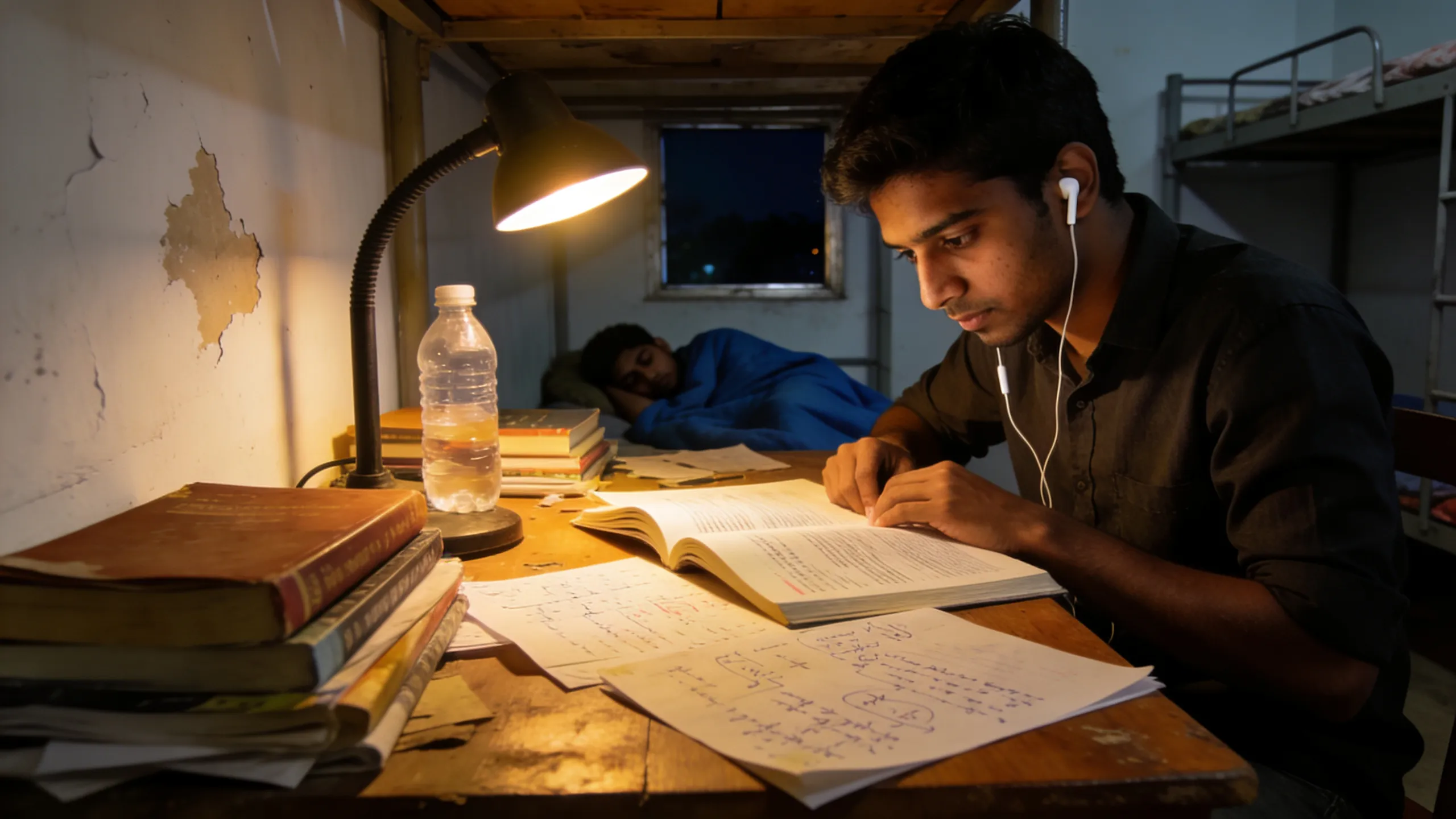
Build one corner your brain associates only with work: desk facing a wall rather than the door, a dedicated task light so you are not dependent on the room tubelight, phone charging on the other side of the room, and a physical cue such as a pair of headphones. Then work in fixed blocks rather than open-ended sessions, because a room with three people in it will interrupt an open-ended session every time.
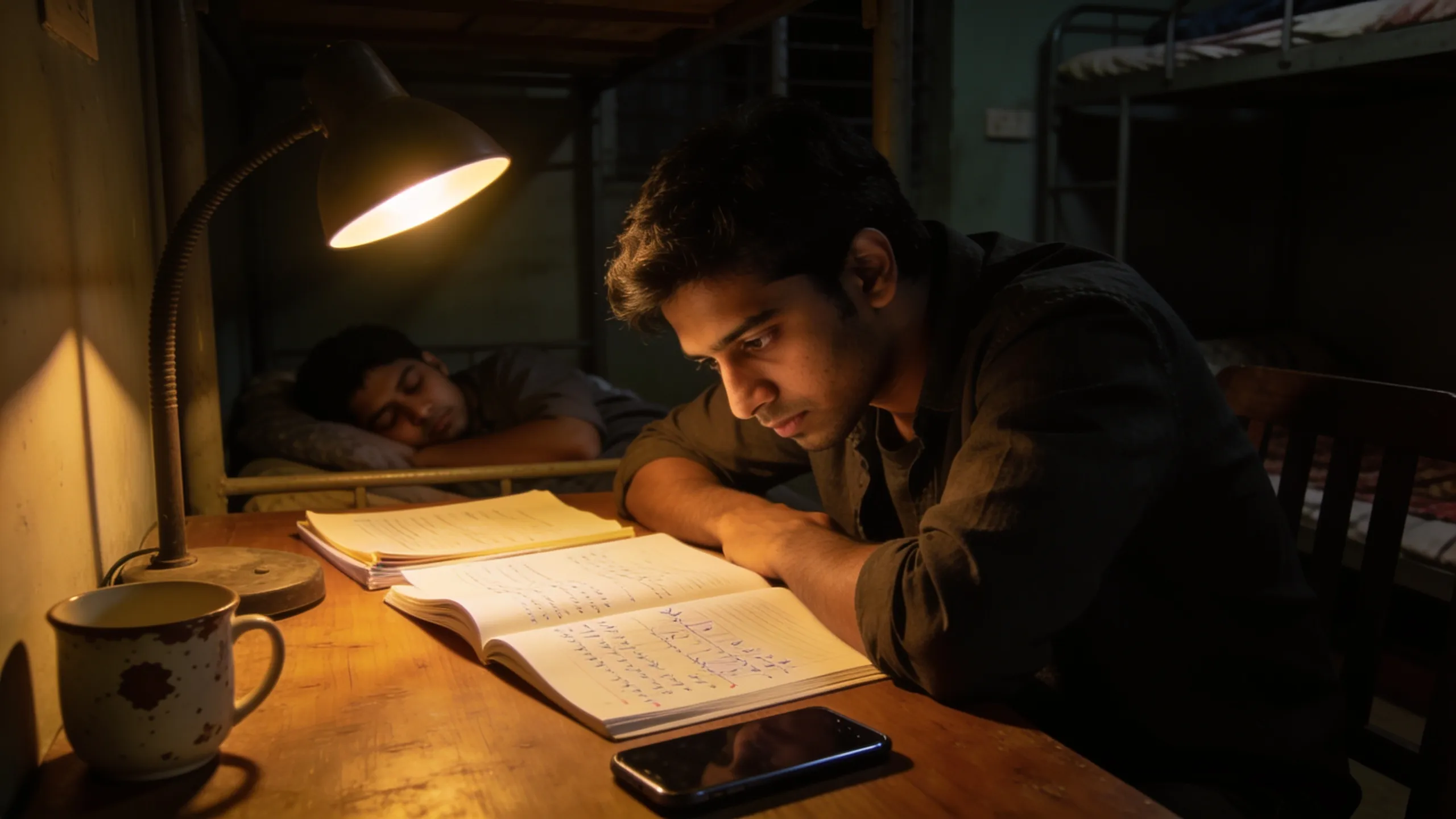
Settle the schedule question early too. If your roommate sleeps at 11 pm and you study till 2 am, you need a library, a common room or an agreement. Choose in week one rather than negotiating in exam week.
The full system for focus in a shared space is in how to study in a hostel effectively, and the physical setup, from desk placement to lighting, is in hostel room study corner setup.
Internet and power
Two infrastructure problems dominate hostel life, and both are worth solving in week one rather than during a submission deadline.
WiFi first. Almost every listing says high-speed WiFi and almost none means it at 9 pm, when the whole building is streaming on one connection. Before you buy anything, check whether the speed is bad all day or only in the evening. Evening-only slowness is congestion rather than a fault, and no amount of complaining fixes it. The practical answer is a personal mobile data plan sized for the hours the WiFi is unusable, plus tethering as a fallback for calls and submissions.
Power second. One or two sockets per room is standard and everything else runs through an extension board, so get a surge-protected one with spacing for bulky adapters, and check the house rules on high-draw appliances before you plug in a kettle or an iron.
What to try, in what order, before spending money is in hostel WiFi slow: fix tips for India. Room gear, from boards to lamps, is compared across our product reviews for hostel rooms.
Staying well: sleep, food, movement, pests
Hostel health problems are rarely dramatic. They are cumulative: five hours of sleep, one real meal a day, no movement, and a bathroom shared by fifteen people. Three months of that shows up as constant low-grade illness rather than anything you can name.
Protect four non-negotiables and most of it takes care of itself. A consistent sleep window, even a short one, because irregular sleep does more damage than short sleep. One balanced meal a day with protein in it, which the mess usually provides if you eat the dal. Twenty to thirty minutes of movement, which fits inside a hostel room without equipment. And hygiene items that never get shared: towel, razor, nail cutter, bathroom slippers.
Then there is the Indian hostel constant, which is pests. Cockroaches arrive wherever food waste sits overnight and bed bugs arrive with second-hand mattresses. Neither is a reflection on you, and both need a building-level response rather than a can of spray in one room.
The full routine covering food, sleep, hygiene and the doctor question is in how to stay healthy in a hostel in India. Twenty minutes of exercise inside a shared room is in hostel room workout with no gym. For the pest side, getting rid of cockroaches and pests in a hostel room covers what actually works. And if you are staying through June to September, monsoon hostel survival tips deals with damp walls, clothes that will not dry and the smell that comes with both.
Homesickness, loneliness and the slow weeks
Two different things get confused here. Homesickness usually hits in the first fortnight, is sharpest in the evenings, and fades as the new place becomes familiar. Loneliness often arrives later, around month two or three, once the logistics are solved and you notice that knowing where the mess is does not mean you know anyone in it.
Both respond to structure rather than to effort. Fix a call window with home instead of calling whenever you feel low, because open-ended contact keeps you emotionally at home while you live somewhere else. Build one repeating shared activity, which for most people is a fixed mess time, a gym slot or a Sunday walk. And accept that the first month of any friendship in a hostel is proximity, not chemistry. The people you end up close to are usually the ones you happened to keep bumping into.
If a low mood lasts more than two or three weeks, stops you attending classes, or changes your sleep and appetite, that is worth talking to a counsellor about. Most Indian campuses have one, and using them is unremarkable.
The first-fortnight version is in dealing with homesickness in a hostel, and the month-three version, including what to do with an empty Sunday, is in loneliness in hostel: how to cope.
Safety: the checks that actually matter
Most hostel safety advice is either fear-based or vague. The useful version is a short list of things you can verify with your own eyes in ten minutes, and a short list of habits you keep for the year.
Verify on the visit: a main gate with someone actually at it after 10 pm, CCTV that is switched on rather than merely installed, a fire exit that is not padlocked or used as storage, an electrical board that is not a bundle of loose wire, and a lock on your own cupboard. Ask who else holds a key to your room, directly.
Keep as habits: a padlock you own, documents never left loose, one trusted person who knows roughly where you are on a late night, some cash that is not in your wallet, and never posting your live location or your hostel's entrance publicly.
The general version for every student is in hostel safety tips every student should know. Women and their parents should also work through the complete guide to hostel life for girls in India, which covers boundaries, gate timings and the safety systems that hold up day to day.
Money: what hostel life really costs
Rent is between half and two-thirds of your monthly cost, never all of it. Across the 833 stays currently listed on Hostel360, monthly rent runs roughly ₹3,900 at the tenth percentile to ₹11,500 at the ninetieth, with a median close to ₹7,000. Around that sits everything people forget when they compare two listings.
| Head | Typical monthly range | Notes |
|---|---|---|
| Rent | ₹3,900 to ₹11,500 | Varies by city, area and sharing count |
| Food beyond the mess | ₹800 to ₹2,500 | The single biggest overrun for most students |
| Laundry | ₹0 to ₹600 | Often included; per-kilo dhobi otherwise |
| Mobile data | ₹250 to ₹500 | Needed wherever the building WiFi is congested |
| Local transport | ₹500 to ₹2,000 | Falls sharply if you pick an area near your campus |
| Electricity, if metered | ₹300 to ₹1,200 | Ask whether it is included before you sign |
Two habits do most of the work: track spending weekly rather than monthly, and split fixed, flexible and emergency money at the start of the month rather than the end. The full framework, including how to adapt the 50/30/20 rule to a student income, is in student budget planning for hostel life.
Moving out with your deposit intact
Moving in gets all the attention. Moving out is where the money is lost, usually ₹2,000 to ₹5,000 of a deposit against vague wear and tear, and almost always because the resident has no record of what the room looked like when they arrived.
Work backwards from your last day. Give written notice at the interval your agreement specifies, normally thirty days, by message or email so there is a timestamp. Settle electricity and mess dues in writing and ask for the final figure before you hand over the keys, not after. Clean the room and remove your own hooks and tape. Then film the handover exactly as you filmed the move-in, with the owner or warden present if possible, and ask for the refund date in writing.
If a deduction is unreasonable, you have more standing than most residents realise. A security deposit is a refundable advance rather than a fee, and a blanket "non-refundable deposit" line does not survive contact with a written record and a rent receipt.
The step-by-step checkout list is in hostel checkout and moving out checklist for India, and what the law actually says about deductions and timelines is in hostel and PG deposit refund rules in India.
Where to go from here
If you have not chosen a place yet, the search is a separate job with its own pitfalls, covered end to end in how to find a PG or hostel in India: shortlisting, the inspection visit, red flags, the agreement, deposits and negotiating rent.
If you have the city but not the area, rents and student clusters differ sharply between and within Indian cities, and that is mapped in student accommodation in India: the city guide. For Jaipur, where our listing depth is greatest, go straight to hostels and PGs in Jaipur. Everything referenced above also sits in one place under hostel life guides.