
In my years working with student communities, the single most common question parents ask me is about safety, and they're right to. When a daughter moves to a new city for college or her first job, every family runs through the same loop: Is the building secure? Will someone be there if something goes wrong at 2 AM? Is the neighbourhood safe after dark?
I've visited women's hostels where the security felt genuinely reassuring, and others where I wouldn't let my own daughter stay. The difference shows up in the details, the lock on the main gate, whether the warden actually lives on-site, whether the fire extinguisher has been serviced this year or is gathering dust from 2019.
This girls hostel safety checklist is built from those visits, from complaints we've received at Hostel360, and from conversations with hundreds of women students across Bangalore, Delhi, Pune, Mumbai, and Hyderabad. Print it or share it with your parents before you pay a single rupee as deposit.
Category 1: Physical Security, Who Gets In and Who Doesn't
Physical access control is the foundation of everything. If anyone can walk into the building unchecked, nothing else on this list matters.
Here's what to verify:
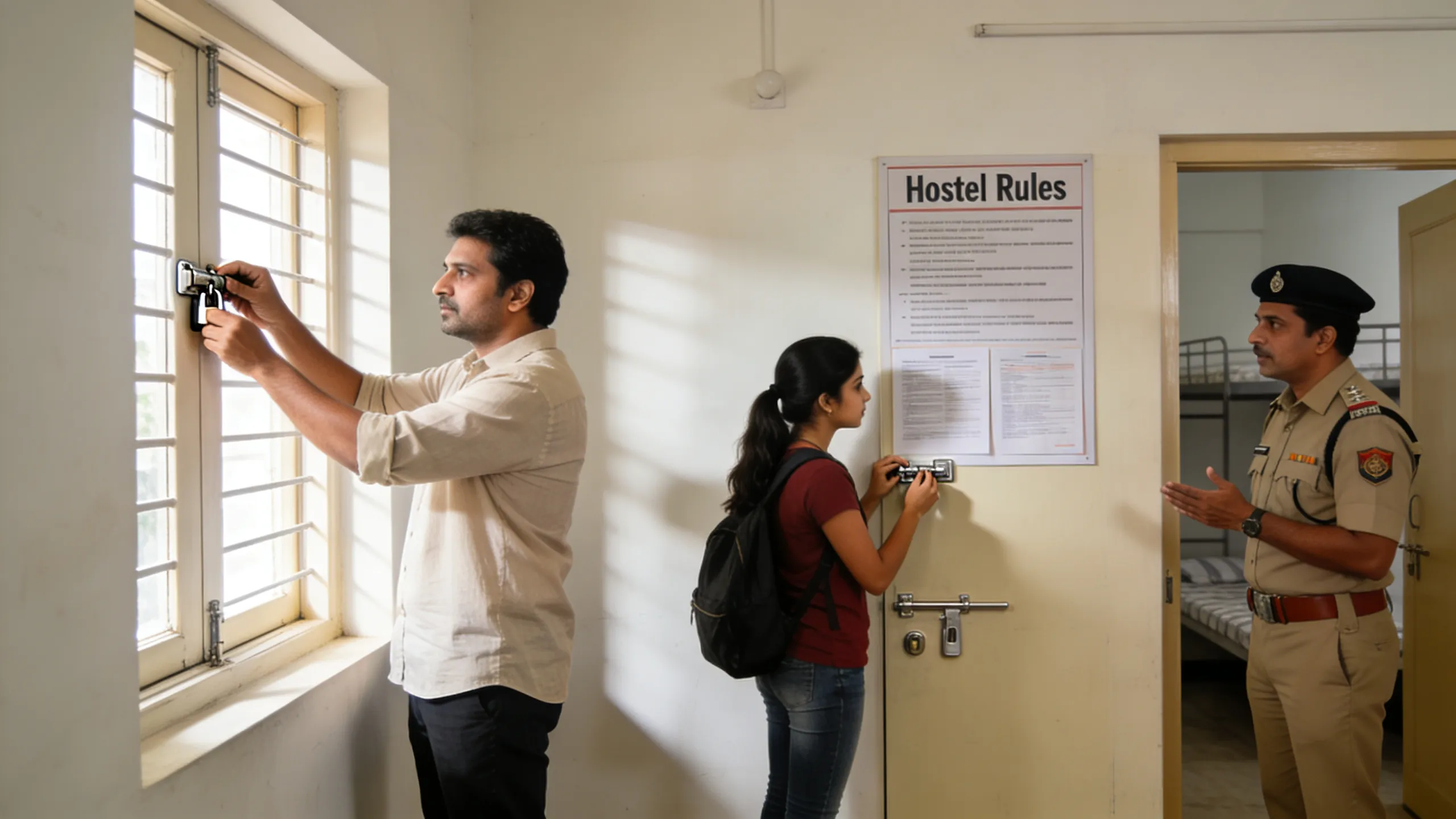
- ☐ Single controlled entry point. The building should have one main entrance for residents and visitors. Side doors, service entrances, and terrace access should be locked or monitored. I've seen PGs in Bangalore where the back gate opens directly onto a public lane, anyone could walk in.
- ☐ CCTV cameras at all entry/exit points and common areas. Check that cameras are actually recording, not just mounted for show. Ask the warden: "Can you show me yesterday's footage?" If they can't, the system isn't working.
- ☐ Visitor log and ID verification. Every visitor, delivery person, friend, relative, should be logged with name, phone number, purpose, and time in/out. Male visitors should never be allowed beyond a designated meeting area on the ground floor.
- ☐ Boundary wall with no easy climb-over points. UGC guidelines specifically recommend boundary walls that can't be scaled easily, topped with barbed wire or similar deterrents. Walk the perimeter if you can.
- ☐ Well-lit corridors, stairways, and parking areas at night. Visit the hostel after sunset during your inspection. A building that looks fine at 11 AM can feel very different at 11 PM.
- ☐ Locks that actually work. Test the room door lock. Check if there's a deadbolt or chain latch you can use from inside. If the lock is flimsy, ask for replacement before you move in, or bring your own.
- ☐ Terrace and roof access restricted. The terrace should be locked and accessible only through the warden. Open terrace access is a security and safety risk.
Many PGs in cities like Pune and Hyderabad operate from converted flats with no boundary wall, no guard, and shared building access. If you're considering such a setup, be extra careful about who else can enter.
Category 2: Warden Presence, The Person Who Matters Most
A good warden changes everything. A bad one, or an absent one, makes every other safety feature pointless.
- ☐ Female warden who lives on the premises. "Available on call" is not the same as being physically present. The warden should sleep in the building. Period. If the hostel has a male owner or manager, there must still be a female warden for a women's hostel.
- ☐ Warden's room is on the same floor as residents (or ground floor near entrance). A warden housed in a separate building two streets away isn't going to help at 1 AM.
- ☐ Warden's phone number shared with all residents and parents. You should be able to reach her directly, not through a front desk or a call centre.
- ☐ Night duty coverage. Who handles emergencies between 11 PM and 6 AM? Is there a night guard? Is the warden reachable? Ask this question directly.
- ☐ Warden conducts regular room checks and headcounts. This isn't about policing, it's about knowing who's in the building and who isn't, especially at night.
Talk to the current residents if you can. Ask them: "If you had a problem at midnight, what would you do?" Their answer will tell you more than any brochure.
Category 3: Fire Safety, The One Everyone Ignores
Fire safety compliance in Indian hostels is abysmal. The Surat coaching centre fire in 2019 killed 22 students, and investigations repeatedly find that most student accommodations lack basic fire infrastructure. Every hostel must have a Fire No Objection Certificate (Fire NOC) from the local fire department. UGC guidelines mandate fire detection systems, sprinklers, and at least one fire drill per semester.
- ☐ Fire NOC displayed or available on request. Ask for it. If they don't have one, that's a dealbreaker.
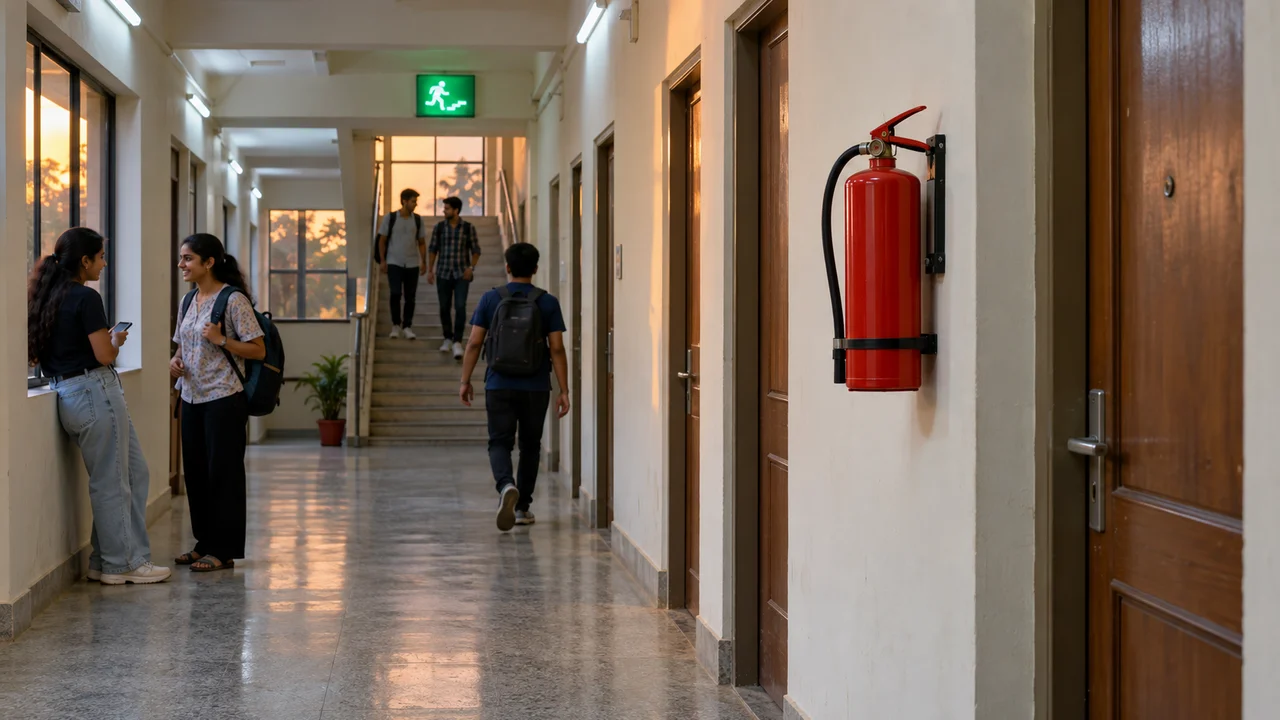
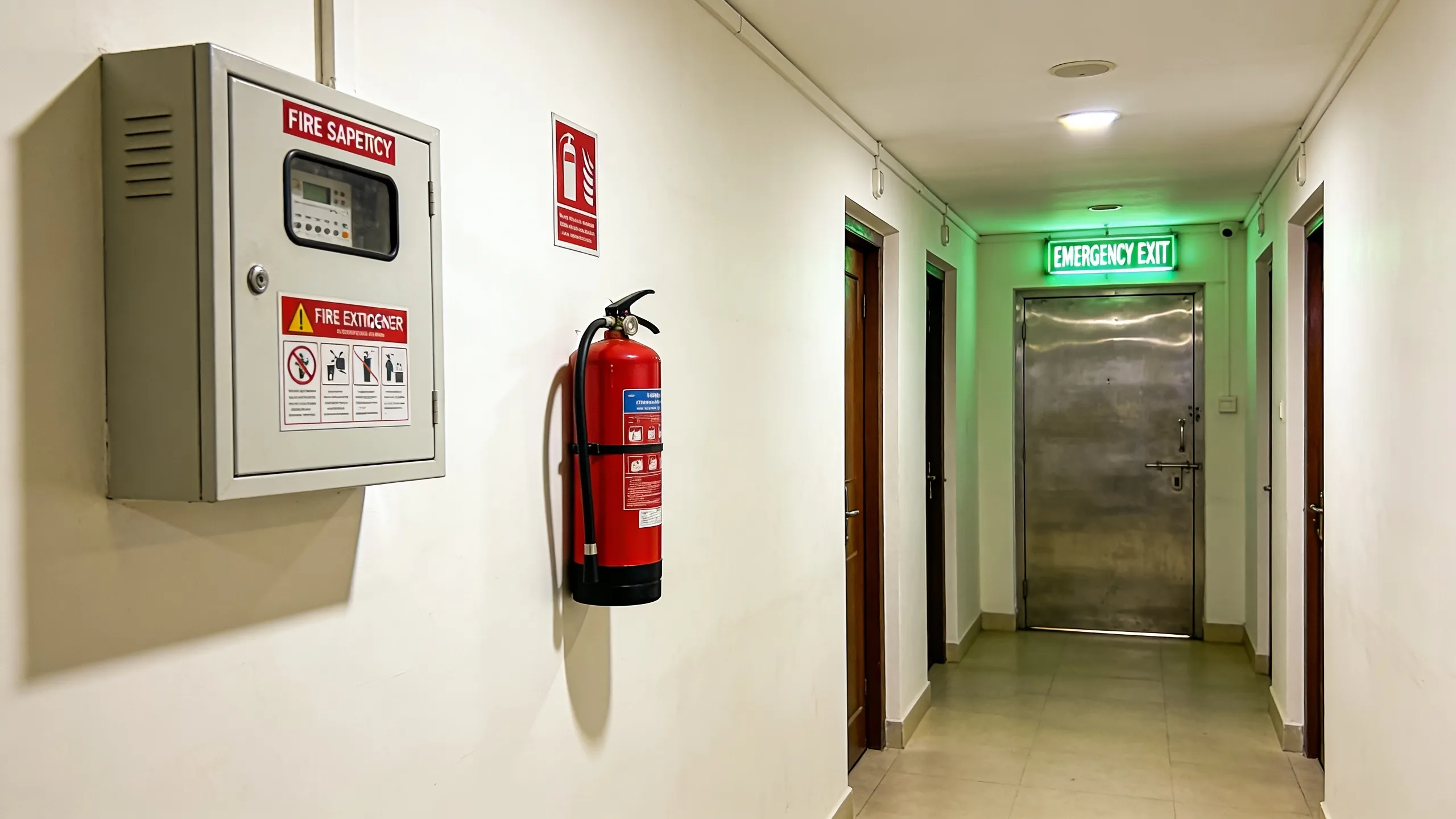
- ☐ Fire extinguishers on every floor, within expiry date. Check the tag on the extinguisher, it shows the last service date. If it's more than a year old, it may not work when you need it.
- ☐ Smoke detectors installed and functional. Press the test button. If there isn't one or it doesn't beep, the system is dead.
- ☐ At least two clear emergency exits. Both must be unblocked and unlocked from the inside during occupied hours. If you see a fire exit padlocked shut or blocked by furniture, that's a massive red flag.
- ☐ Emergency evacuation map displayed on each floor. It should show your location, the nearest exits, and the assembly point outside.
- ☐ Stairways free of clutter and storage. Corridors and stairs are escape routes, not storage rooms.
- ☐ No overloaded electrical points in rooms. Multiple extension boards daisy-chained together are how electrical fires start. Check the wiring in your room, exposed or frayed wires are dangerous.
My rule of thumb is simple: if you can't find two ways out of the building within 30 seconds, don't move in.
Category 4: Document and Valuables Safety
This catches people off guard more often than you'd expect. You're sharing a room with someone you met last week, and your Aadhaar, PAN card, and laptop are just sitting on your desk.
- ☐ Personal locker with a sturdy lock for every resident. Not a shared cupboard, a personal, lockable space. Bring your own padlock if needed.
- ☐ Never hand over original documents to the hostel owner. Some PG operators ask to "hold" your Aadhaar or college ID as security. This is not legal. Give photocopies only. If they insist on originals, walk away.
- ☐ Rent agreement in writing with clear terms. Deposit amount, refund policy, notice period, monthly rent, included services, all in writing. Verbal promises mean nothing when disputes happen.
- ☐ Digital backups of all important documents. Scan your Aadhaar, PAN, admission letter, rent agreement, and deposit receipts. Upload to Google Drive or DigiLocker. If your bag gets stolen, you'll still have everything.
- ☐ Avoid keeping large cash in your room. Use UPI for daily expenses. Keep only emergency cash (₹500-1000) in your locker.
Parents: photograph every document you give the hostel, agreement, deposit receipt, ID copies. Store them in a shared family folder online.
Category 5: Digital Safety, Threats That Don't Need a Physical Key
Cyberstalking complaints from women students have been rising across India. Under Section 354(D) IPC and Section 67 of the IT Act, it's a punishable offence, but prevention beats filing a complaint after the damage is done.
- ☐ Don't use shared hostel Wi-Fi for banking. Switch to mobile data or use a VPN for financial transactions.
- ☐ Disable location sharing on social media. Don't tag your hostel or post real-time stories showing your building. Stalkers don't need much to find you.
- ☐ Enable two-factor authentication on all accounts. Email, Instagram, WhatsApp, banking apps, all of them.
- ☐ Be cautious in hostel WhatsApp groups. Members change constantly. Don't share personal details in group chats.
- ☐ Keep devices password-protected. Fingerprint or face unlock on your phone. Strong password on your laptop. Auto-lock after 30 seconds.
- ☐ Don't share room keys, access cards, or OTPs with anyone. Social engineering happens in hostels too.
If someone is harassing you online, screenshot everything, save chat logs with timestamps, and report to the platform and local cyber cell. Don't delete the evidence.
Category 6: Transport and Neighbourhood Safety
Your hostel could be perfectly secure inside, but if the walk from the bus stop feels unsafe after 8 PM, that's a serious problem.
- ☐ Well-lit route from the nearest bus stop/metro to the hostel. Walk it after sunset before signing anything. Check for street lights and shops that stay open late.
- ☐ Auto/cab availability after 9 PM. Can you get an Ola or Uber at 10 PM without a long wait in a deserted lane?
- ☐ Neighbourhood has no history of safety incidents. Talk to nearby shopkeepers. Ask auto drivers, they know everything about an area.
- ☐ Hostel is not in an isolated or industrial zone. Cheap rent often means remote location. Not worth the savings.
- ☐ Share your live location with family whenever commuting late. Make it a habit.
The safest hostel in a dangerous neighbourhood is still a bad choice. Location matters as much as the building. Compare a whole area before you shortlist buildings, in Jaipur, for example, that means putting the girls hostels in Pratap Nagar side by side.
Category 7: Harassment Protocols, What Happens When Something Goes Wrong
This is the section most hostels don't want to talk about. But you need to know, before you move in, what happens if you report harassment, from a co-resident, a staff member, or an outsider.
- ☐ Written anti-harassment policy shared with residents. Not a vague "we take safety seriously" on the website. An actual document with defined processes.
- ☐ Internal Complaints Committee (ICC) or designated contact. UGC mandates this for institutions. Your hostel should have a clear escalation path, not just "tell the warden."
- ☐ Confidential complaint mechanism. Can you report something without the whole building knowing? Is there a phone number, email, or anonymous form?
- ☐ Ask current residents about past incidents. "Has there been a safety issue here? How was it handled?" Their answer tells you everything.
- ☐ Background verification of male staff. Guards, cooks, cleaning staff, the hostel should verify anyone with access to the building.
A hostel that gets defensive when you ask about safety protocols is one you should avoid. Good management welcomes these questions.
Category 8: Emergency Contacts and Medical Access
Emergencies don't send calendar invites. Save this information before anything happens.
- ☐ Emergency numbers saved in your phone AND on paper in your wallet:
- National Emergency Number: 112
- Women's Helpline: 181 (24/7, all states)
- Local police station number
- Nearest hospital, name, address, phone
- Hostel warden's personal mobile
- A trusted local contact you can reach at 2 AM
- ☐ First-aid kit accessible to all residents. Not locked in the warden's room.
- ☐ Nearest hospital within 15-minute reach. Know the route. "Nearby" hospitals 40 minutes away in traffic don't count.
- ☐ Medical emergency protocol defined. Who calls the ambulance? Who accompanies the student? Who informs parents?
- ☐ Mental health support. Know about iCall (9152987821) and Vandrevala Foundation (1860-2662-345).
Phones die and get stolen. A paper note in your wallet with emergency numbers doesn't need charging.

The Parent Verification Checklist
This section is for parents. You can't always visit in person, but you can still verify the essentials.
Before paying the deposit:
- Ask your daughter to do a video call walkthrough, entrance, corridors, room, bathroom, terrace access. Ten minutes gives you real information.
- Call the warden directly. Ask about night security, visitor policy, and emergency procedures.
- Search for the hostel on Google Maps reviews and student forums. Look for patterns in complaints.
- Read the rent agreement before signing, especially the deposit refund clause.
- Confirm they're not asking for original documents.
After your daughter moves in:
- Have her share her live location with you for the first few weeks, not out of distrust, but for mutual peace of mind.
- Set up a daily check-in routine. Even a two-word text works.
- Save the local police station number for her area in your phone.
- Encourage her to build a small support network, a senior student, a colleague, someone she trusts nearby.
I speak to parents regularly, and the ones who feel most at ease are those who did their homework upfront. It's not about being overprotective. It's about being informed.
Don't Settle, Find Hostels That Meet the Standard
If a hostel fails on more than two or three items from this checklist, especially the non-negotiables like a resident female warden, working fire exits, and no demand for original documents, walk away. Cheap rent is never worth compromising your safety.
I started working on Hostel360 because I saw how hard it was for women students to find verified, safe accommodation in a new city. We check for the basics on this list so you don't have to start from scratch. Find verified women's hostels on Hostel360 where safety features are listed upfront. If your search is in Jaipur, start with girls hostels and PGs in Jaipur.
For a broader guide covering food safety, water quality, and general hostel prep, read our hostel safety tips for students post.
Stay safe, stay sharp, and don't settle for a place that doesn't take your safety seriously.
Sources & Methodology
- Safety checklists aligned with the advisory guidelines issued by the National Commission for Women (NCW) regarding security protocols in educational and residential accommodations.
- Fire safety recommendations, equipment placement norms, and emergency egress protocols derived from the Bureau of Indian Standards (National Building Code of India).
- CCTV coverage standards, visitor register protocols, and warden ratios compiled through comparative policy reviews of central university hostel guidelines across India.
Data Freshness: Standards reviewed against statutory public safety directives as of September 2024.