

Your PG owner says the deposit is "non-refundable." Your hostel deducted ₹3,000 for "wear and tear" on furniture that was already broken when you moved in. You're not sure if any of this is legal. It probably is not.
Understanding hostel PG deposit refund rules India saves you real money, ₹5,000 to ₹30,000 depending on the city. Most students lose part or all of their deposit simply because they don't know the rules and don't document anything on day one.
This guide covers what the law actually says, what your hostel can and can't deduct, and exactly how to get your money back if they refuse.
What the Model Tenancy Act 2021 Says
The Model Tenancy Act (MTA) 2021 is a central government framework. States can adopt it with modifications. Here's what it says about deposits:
- Maximum deposit for residential premises: 2 months' rent
- Refund timeline: The landlord must refund the deposit within 1 month of vacating
- Deductions: Only for unpaid rent, unpaid bills, and actual damage beyond normal wear and tear
- Interest: Some states require landlords to pay interest on the deposit
Key point: The MTA caps deposits at 2 months' rent. If your PG charged 3 months or more, that itself is a negotiation point. Many PGs in Mumbai and Bangalore charge 2-3 months' deposit, knowing the legal cap gives you apply.
State-Wise Deposit Rules
| State | Max Deposit | Refund Period | Interest Required |
|---|---|---|---|
| Karnataka | 10 months' rent (existing law) | 1 month | No |
| Maharashtra | 3 months' rent | 1 month | No |
| Delhi | 2 months' rent (MTA adopted) | 1 month | No |
| Tamil Nadu | No cap (MTA not adopted) | Varies | No |
| Rajasthan | 2 months' rent (MTA adopted) | 1 month | No |
Note: Karnataka's existing Rent Control Act allows up to 10 months' deposit, which is why Bangalore PGs charge high deposits. This may change as the state considers MTA adoption.
The Day-One Documentation Checklist
The biggest mistake students make: not documenting room condition when they move in. Without evidence, you can't dispute deductions later.
Do this within 24 hours of moving in:
- Video walkthrough, Record a 2-3 minute video of the entire room. Show walls, furniture, bathroom, electrical fittings. Narrate the date and your name.
- Photograph existing damage, Scratches on furniture, stains on walls, broken fixtures, cracked tiles. Close-up shots with good lighting.
- Get the inventory list, Ask the owner for a written list of items in the room. If they don't have one, make your own and email it to them.
- Save the agreement, Photograph every page. Store digitally (Google Drive, email to yourself).
- Save the deposit receipt, If the owner gave you a handwritten receipt, photograph it immediately. If they did not give a receipt, send a follow-up message on WhatsApp confirming the amount paid.
The WhatsApp trick: Send a message like "Confirming I paid ₹15,000 security deposit for Room 203 on [date]. Please confirm." Their reply (or even a blue tick) becomes timestamp-verified evidence.
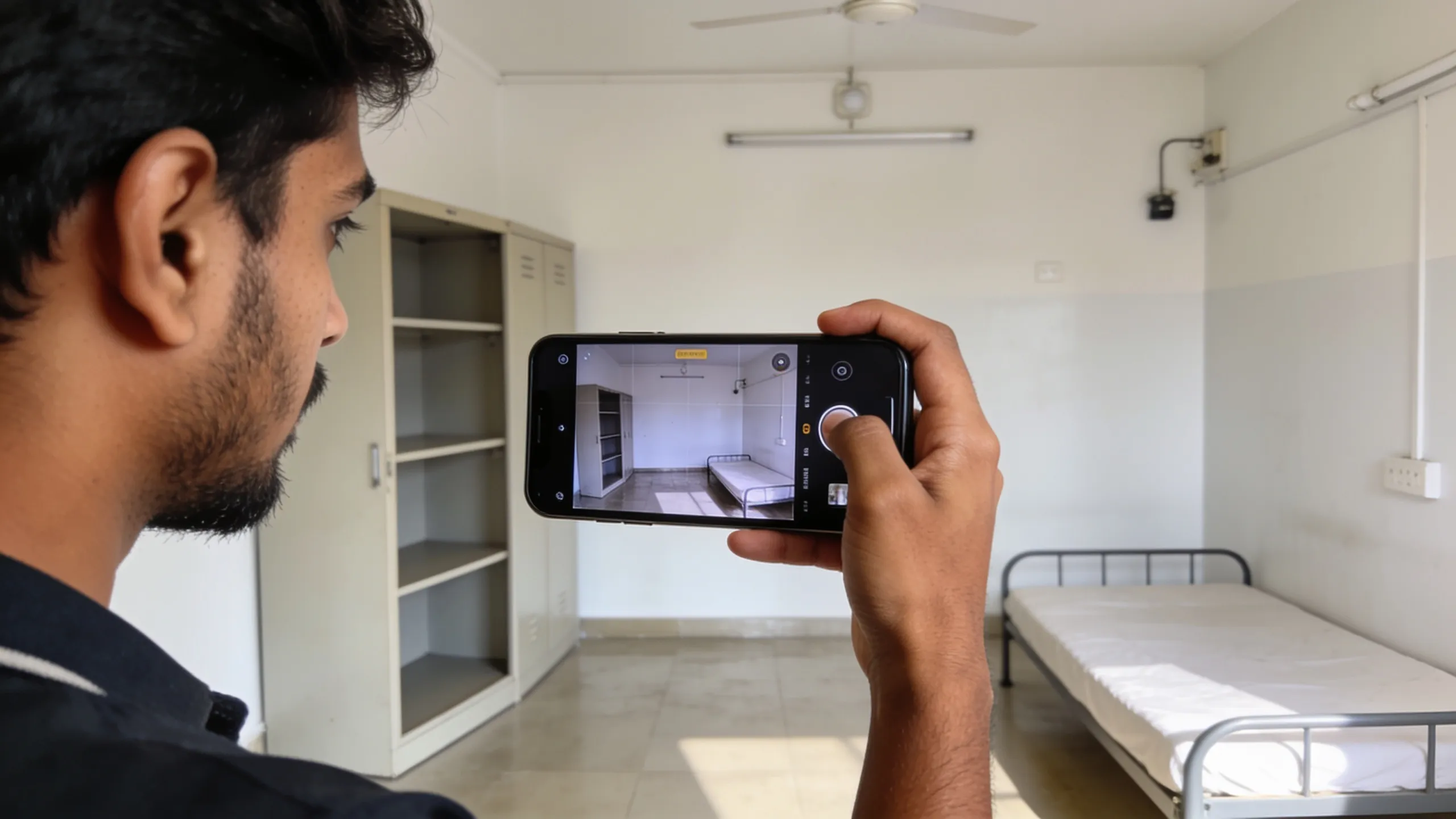 A 2-minute video walkthrough on day one is worth ₹10,000 when you move out.
What Can Be Deducted from Your Deposit
Legitimate deductions:
- Unpaid rent, Any months you owe
- Unpaid utility bills, Electricity, water, maintenance charges
- Actual damage, Broken furniture, holes in walls, stains that were not there when you moved in
- Cleaning charges, If the room is left in significantly worse condition (reasonable cleaning, not deep cleaning)
Not legitimate deductions:
- "Wear and tear" on old furniture, Normal aging of items is not your liability
- Repainting charges, Walls fade with time; this is the owner's maintenance cost
- "Processing fee" for returning the deposit, This is not a real charge
- Damage that existed before you moved in, This is where your day-one photos save you
- Deductions without itemized receipts, They must show you bills for any repair they claim
Common Scams to Watch For
- The delay game, "Come next month for the deposit." Then next month. Then next month. Set a firm deadline in writing.
- Inflated repair costs, ₹5,000 to fix a curtain rod that costs ₹200. Ask for the actual receipt from the repair person.
- Verbal agreements changed, "We said it was non-refundable." If the written agreement says refundable, the written version wins.
- The disappearing owner, Stops answering calls after you leave. This is where escalation becomes necessary.
How to Get Your Deposit Back, Step by Step
Step 1: Written Notice (30 Days Before Moving Out)
Send a written notice to the owner, WhatsApp message or email works. State your move-out date and that you expect the full deposit refund. This creates a paper trail.
Template:
Subject: Notice of Vacating, Room [number], [PG name]
>
Dear [Owner name],
>
I am writing to inform you that I'll be vacating Room [number] on [date]. As per our agreement dated [date], I request the refund of my security deposit of ₹[amount] within 30 days of vacating.
>
I'll hand over the room in the same condition as received, accounting for normal wear and tear.
>
Regards, [Your name]
Step 2: Move-Out Documentation
On your last day, repeat the day-one process:
- Video walkthrough of the room in its current condition
- Photographs of all areas
- Get the owner (or warden) to do a walkthrough with you
- Get written confirmation that the room is in acceptable condition
Step 3: Follow-Up (If Deposit Not Returned in 30 Days)
Send a formal reminder. If ignored, send a legal notice.
Legal notice template:
To [Owner name/PG name],
>
Despite vacating Room [number] on [date] and handing over possession in good condition, you've not refunded my security deposit of ₹[amount] as required under [state law/Model Tenancy Act]. I request immediate refund within 15 days of this notice, failing which I'll be compelled to approach the appropriate legal forum.
You can send this yourself, no lawyer needed for the first notice. The notice itself often triggers payment because owners know the law is not on their side.
Step 4: Escalation
If the notice doesn't work:
- Rent Authority/Rent Court, File a complaint if your state has a Rent Authority under the MTA
- Consumer Court (District Forum), File under the Consumer Protection Act 2019. Filing fee is ₹100-₹200. No lawyer required. Cases under ₹5 lakh go to the District Forum.
- Police complaint, For outright cheating (deposit taken with no intention to return), file an FIR under Section 420 IPC.
Before choosing your next PG or hostel, check the agreement and deposit terms carefully. Learn from this experience.
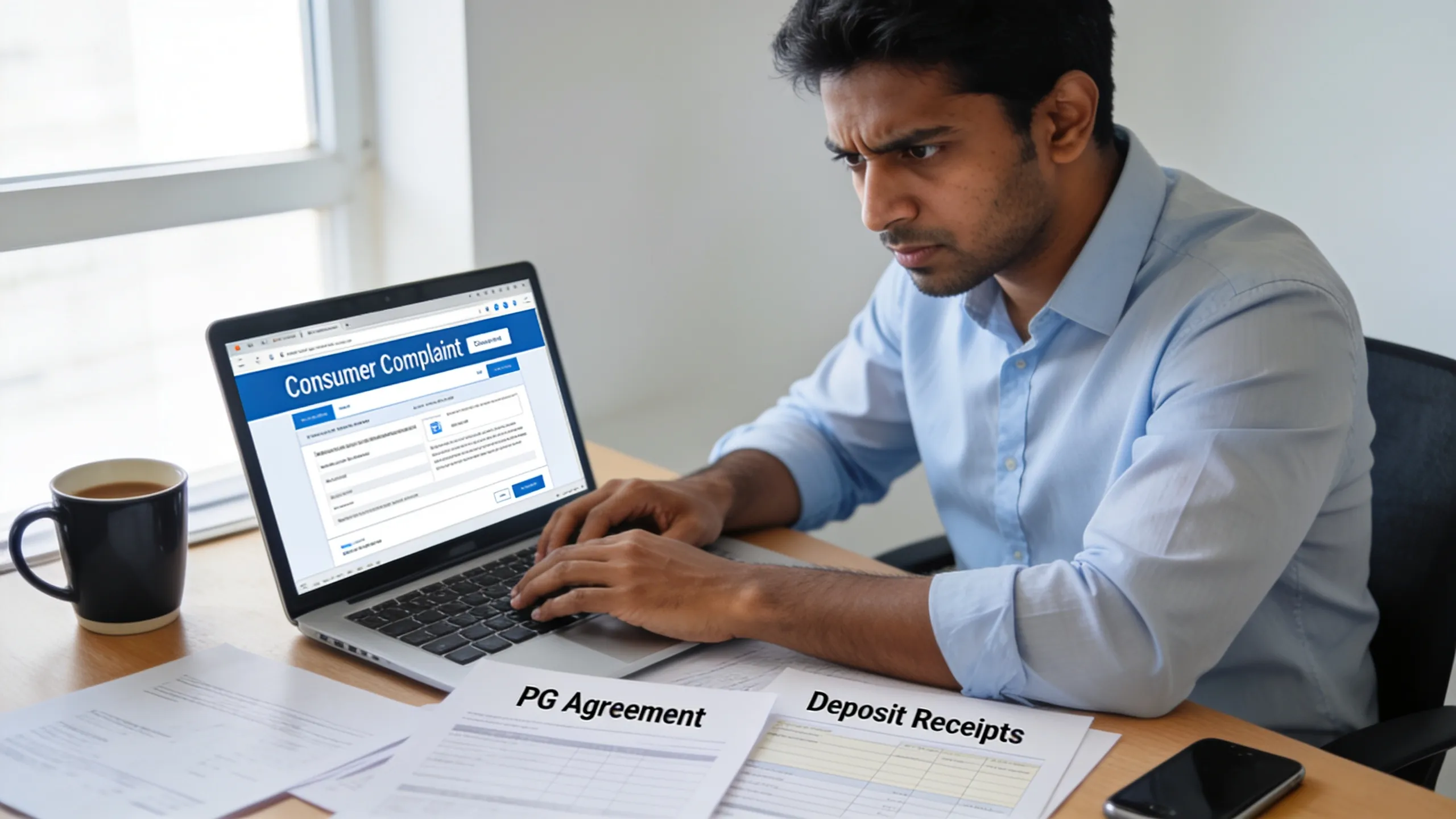 Consumer court filing costs ₹100-₹200 and doesn't require a lawyer for claims under ₹5 lakh.
How to Negotiate Better Deposit Terms Before Moving In
Prevention is cheaper than recovery. When signing up for a PG, negotiate these points:
- Cap the deposit at 1 month, Many PGs accept this, especially during off-season (January-March)
- Get the refund timeline in writing, "Deposit refunded within 15 days of vacating" should be in the agreement
- Ask for an itemized deduction policy, What specific things can they deduct for? Get it written down.
- Pay via UPI/bank transfer, Digital payments create automatic receipts. Never pay cash without a signed receipt.
Our how to negotiate PG rent guide has specific scripts for negotiating deposits, rent, and other charges.
If you're looking at PGs in Bangalore's Koramangala area or similar high-demand locations, deposits tend to be higher. Knowing your rights helps you push back.
---
Looking for PGs with fair deposit policies? Browse hostels on Hostel360, compare deposits, terms, and amenities. No brokerage, ever.