
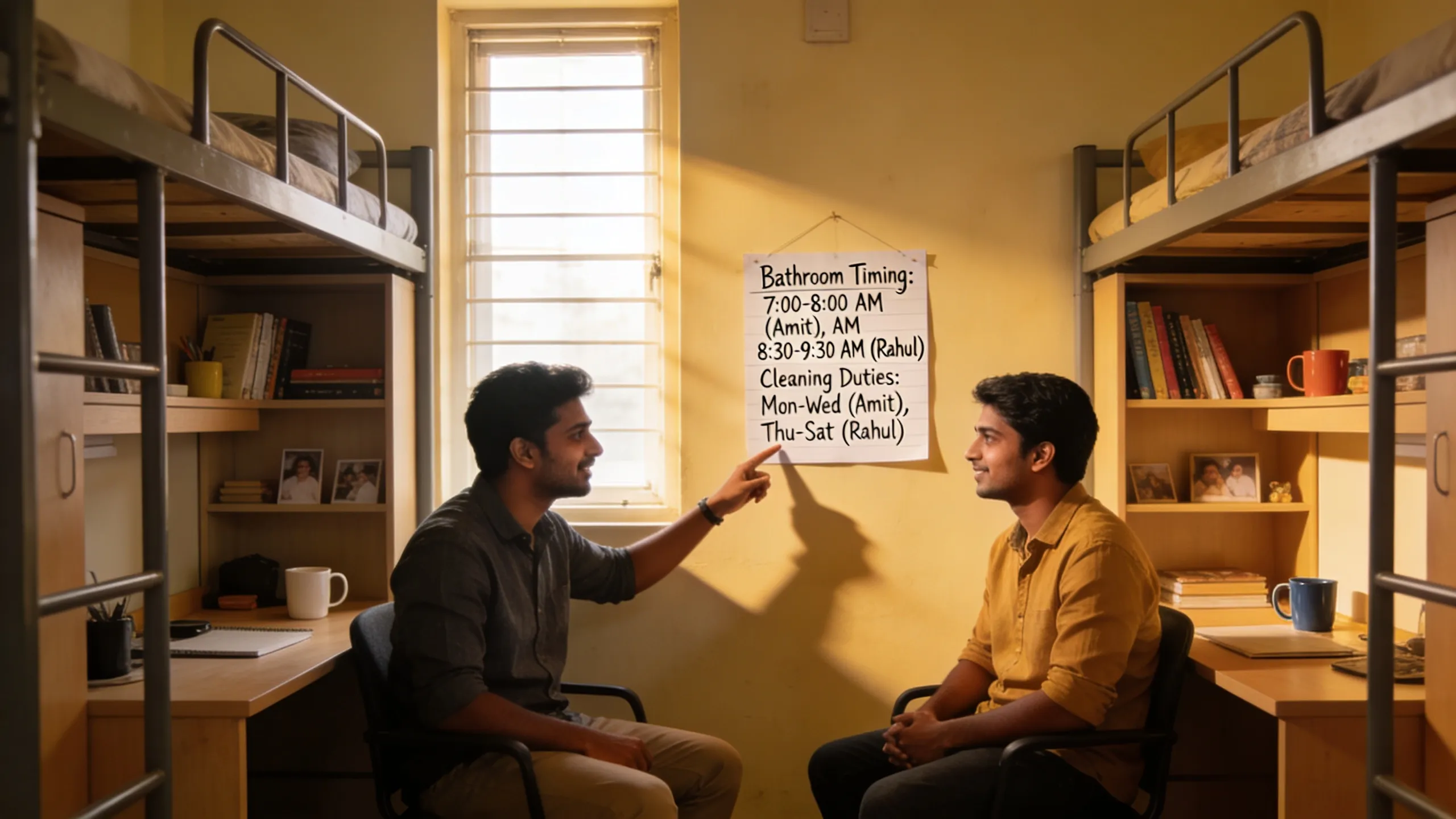
The number one complaint we hear from hostel residents is noise after midnight. Number two is someone using their shampoo without asking. Number three is a tie between dirty dishes left in the sink and bathroom hair on the floor.
I've mediated more roommate disputes than I care to remember, and most of them could have been avoided with one honest conversation on day one. You move in, you smile, you say "I'm pretty chill," and three weeks later you're silently furious because your roommate is on a video call at 1 AM with the speaker on full volume.
After ten years working with hostel communities across India, the rules that actually matter aren't in the hostel handbook. They're the unwritten ones, the stuff everyone expects you to know but nobody bothers to explain.
So consider this your hostel etiquette guide, the one a good senior would sit you down and walk through on your first night. Read it before move-in day, share it with your roommate, and save yourself six months of passive-aggressive Post-it notes.
Key Takeaways
- Have the boring conversation on day one: sleep timings, study habits, noise, and guests. Five awkward minutes prevents six awkward months.
- After 10 PM, earphones are non-negotiable. Noise is the single biggest cause of roommate conflict in Indian hostels.
- Keep showers under 10 minutes during peak hours, roughly 7 to 9 AM and 9 to 11 PM, when 20 people share four bathrooms.
- Always ask before borrowing, return the same day, and replace what you consume. Repeated borrowing stops being borrowing.
- Split shared costs the same day. Money owed between roommates sours faster than anything else, even ₹200.
- Raise small irritations in week two, not month four. Most people genuinely don't know they're causing a problem.
- If a direct conversation doesn't work, go to the warden. That's not being a snitch, it's using the right channel.
1. Room Sharing: The Ground Rules
Treat your shared room as a negotiation, not a democracy, and the whole year gets easier. Your hostel room is probably 10 by 10 feet, shared with one, two, or three people who have completely different habits, sleep schedules, and definitions of clean.
Have the day-one conversation
I tell every new batch of residents the same thing: talk to your roommate on the first day, and not about hobbies. Talk about the boring stuff. When do you sleep? Are you a lights-on-late person? Do you study in the room or the library? Do you need silence to fall asleep?
These questions feel awkward for about five minutes. Skipping them creates six months of awkwardness instead.
Respect the invisible line
There's a boundary down the middle of every shared room, and everyone knows where it is even though nobody drew it. Don't spread your things onto their desk. Don't hang your wet towel on their chair. Don't stack your snack collection on their shelf because yours is full.
And don't sit on someone's bed without asking. In a hostel, your bed is the only genuinely private territory you own.
Keep your side clean
You don't have to be a neat freak, but you do have to be a reasonable human being. Dirty clothes go in a laundry bag, not on the floor. Used plates go to the wash, not under your bed. Bins get emptied before they overflow.
Here's the simple test: if your roommate can smell your socks from across the room, you've crossed the line.
Takeaway: agree on three things in week one, sleep timing, light timing, and cleaning rhythm. Everything else you can figure out as you go.
2. Bathroom Etiquette, the Big One
Shared bathrooms cause roughly a third of all hostel disputes, which makes this the highest-value section in the whole guide. When 20 people share four bathrooms and everyone has a 9 AM class, small habits become large problems fast.
Keep showers short during peak hours
Your 25-minute shower concert holds up the entire floor. Aim for 10 minutes or less during peak windows, roughly 7 to 9 AM and 9 to 11 PM. Save the long, meditative showers for Sunday afternoon when nobody's waiting.
In winter, especially in Delhi, Jaipur, Chandigarh, or Kanpur, geyser capacity becomes the real constraint. A 15-litre geyser serves about three quick showers before it needs 20 minutes to reheat, so the fourth person in line is at your mercy.
Clean up after yourself
This is the rule that gets broken most. Hair in the drain, pick it up. Toothpaste in the sink, rinse it. Water all over the floor, squeegee it. Nobody wants to walk into a bathroom that looks like a crime scene.
The principle is simple: you used it last, so you leave it usable for the next person.
Carry your own toiletries in and out
Don't leave your shampoo, soap, and toothbrush in the shared bathroom. Get a caddy or a hanging toiletry bag, carry your things in, carry them out. Leaving them there is how you end up with a half-empty bottle and no idea who's been helping themselves.
And never use someone else's toiletries without asking. Not their soap, not their face wash, not even their hand sanitiser.
Handle bucket-and-tap bathrooms properly
Plenty of Indian hostels still run on bucket bathing, especially where water supply is timed. If yours does, don't hoard the bucket or the mug in your room, and don't fill your bucket during a supply window when three people are waiting behind you.
Takeaway: a 90-second cleanup after your shower prevents almost every bathroom argument that happens in hostels.
3. Noise, the Friendship Killer
Noise ends more hostel friendships than money, food, or politics combined. I once had a resident come to me in tears because her roommate watched reels on speaker until 2 AM every night. The roommate's defence was "I didn't think it was that loud." It always is.
Headphones are not optional
After 10 PM, earphones are non-negotiable. Music, videos, reels, video calls, gaming, all of it goes through earphones. This is the single most important rule in shared living and the one that's ignored most often.
It doesn't matter how good your phone speakers are. Nobody wants to hear your playlist at midnight.
Quiet hours are real
Most hostels set quiet hours from around 10 PM to 7 AM. Even if yours doesn't enforce them, follow them anyway. No loud corridor conversations, no slamming doors, no group gatherings in someone's room at 1 AM.
If you're a night owl, study in the common room. If you need a late call, step outside. These small adjustments prevent genuinely massive fights.
Alarms and early mornings
Set one alarm. Two at most. Not seven alarms at five-minute intervals starting at 5:30 AM while you sleep through every one of them. Your roommate is awake and furious by the third.
Get up when your alarm rings, or use a vibration-only alarm on a smartwatch or fitness band. This matters even more during exam season, when half the floor is on a completely different sleep cycle from the other half.
Festival and celebration nights
Indian hostels get loud during Diwali, Holi, birthdays, and match nights, and that's part of the fun. The etiquette is to give people notice, keep it in the common room rather than the corridor, and wind down by the time the floor's quiet hours start.
Takeaway: assume you're 30 percent louder than you think you are. Almost everyone is.

4. Common Areas: Shared Means Shared
Shared spaces belong to everyone equally, which means nobody gets to reserve them. That sounds obvious until you watch someone hold the TV remote for three straight hours during exam week.
Don't monopolise shared resources
The washing machine isn't yours for the evening. The study room table isn't reserved because you left a notebook there six hours ago. Use shared things, then move on.
One specific habit drives people to genuine anger: leaving clothes in the washing machine long after the cycle ends. Set a timer on your phone, come back, and clear the drum.
Clean what you use
Used the microwave, wipe it. Spilled tea, clean it. Left snack wrappers on the couch, come on. You're not in a hotel, and the fastest route to becoming the least popular person on the floor is treating shared spaces as someone else's problem.
The fridge rules
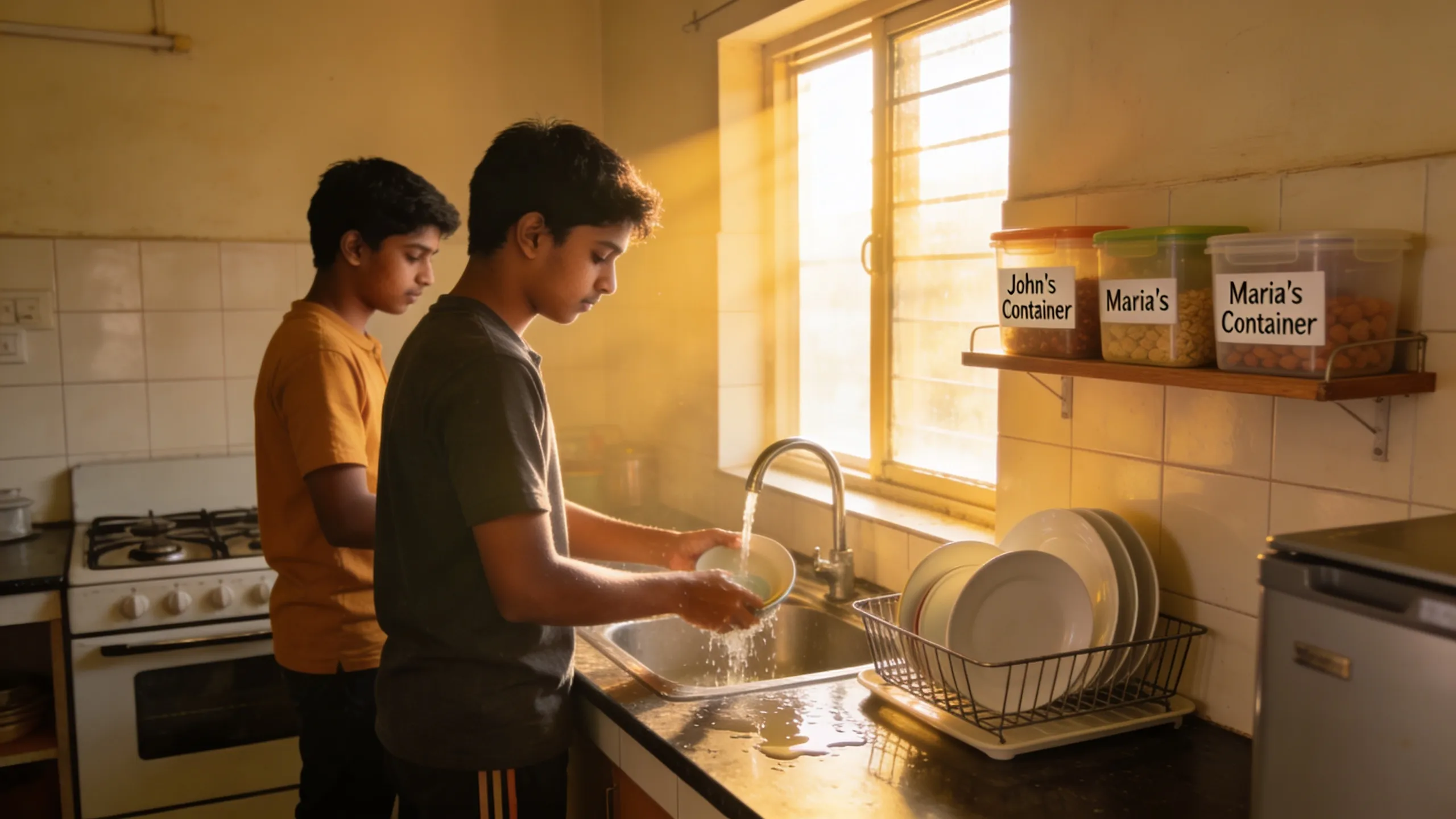
If your hostel has a common fridge, label your food with your name and the date, and don't take more than your fair share of shelf space. The golden rule is simple: don't eat food that isn't yours.
It sounds childish, but food theft is a real source of hostel rage. That biryani someone saved from Sunday lunch? They've been thinking about it all day.
Takeaway: the standard for common areas is "leave it as you'd want to find it," and that standard is higher than most people's default.
5. The Borrowing Problem
Borrowing is normal in hostel life, but repeated borrowing without reciprocity is what breaks friendships. You'll need a charger, an iron, scissors, a stapler, and your neighbour will have one. The etiquette is straightforward.
- Always ask first. Even if the person lent it to you last week. Ask every single time.
- Return it promptly. Same day, ideally within the hour. Not "whenever."
- Return it in the same condition. Don't bend the charger cable, don't leave the iron running until auto-cutoff, and if you borrow food or toiletries, replace them.
- Don't borrow the same thing repeatedly. If you're borrowing someone's iron every week, buy your own for ₹800. Repeated borrowing stops being borrowing and becomes mooching.
- If someone says no, respect it. They don't owe you an explanation.
Takeaway: anything you borrow more than three times is something you should own.
6. Money Between Roommates
Settle shared costs the same day, because money owed between roommates turns sour faster than any other issue in a hostel. Hostel life is full of small shared expenses: a ₹400 Swiggy order, a ₹150 auto split, ₹250 for a shared extension board, a ₹90 chai run.
None of these amounts matter individually. What matters is the pattern. The person who always says "I'll send it later" and never does becomes the person nobody wants to order food with by November.
A few habits that keep it clean:
- Settle by UPI the same evening, not "next week"
- Keep one shared UPI note or a small group for order splits so nobody has to track it mentally
- If you're short this month, say so upfront instead of going quiet
- Don't lend more than you're genuinely willing to lose, especially to someone you'll live with for a year
Takeaway: ₹200 unsettled for a month costs more in goodwill than ₹2,000 settled the same day.
7. Guests and Visitors
Your room is shared space, so inviting someone over affects your roommate whether you think it does or not. This is the rule people most often convince themselves doesn't apply to them.
Always inform your roommate first
Before inviting a friend over, tell your roommate. Not "I'm having someone over, deal with it," but something closer to "a friend's coming around 4, is that okay?" Your roommate might be planning to study, change clothes, or just have some quiet time, and they deserve the option to say "can we do it another day?"
Don't make it a habit
Having a friend over occasionally is fine. Having five friends in your room every evening while your roommate tries to study with earphones in is inconsiderate. Common areas exist for group hangouts, so use them.
Guests follow the rules too
If your friend visits, they follow hostel rules on quiet hours, entry timing, and cleanliness. Sign them into the visitor register if your hostel keeps one, since that's a safety system rather than bureaucracy. If your guest makes a mess, you clean it up.
Takeaway: a two-second message before your guest arrives is the whole etiquette. Nobody minds guests, people mind surprises.
8. Mess and Kitchen Etiquette
The mess runs on timing and volume, so showing up on schedule and taking only what you'll eat is most of the etiquette. If your hostel has a mess hall, you know the drill: fixed timings, a limited menu, and at least one mystery dish per week.
- Show up on time. If you arrive 20 minutes late and complain the food is cold, that's on you.
- Don't waste food. Take what you'll eat. A plate piled with untouched roti and dal is disrespectful to the kitchen staff and to everyone whose mess fees paid for it.
- Clean up after yourself. Return your plate to the designated area and wipe your table if you spilled something.
- Be polite to kitchen staff. They're cooking for 100 or more people three times a day. A thank you costs nothing.
- Raise complaints through the mess committee, not by shouting at whoever's serving. Food quality genuinely improves when feedback goes through the right channel.
If your hostel has a shared kitchen, the rules get stricter. Wash your utensils immediately after cooking, not "later," not "after this episode." Leaving oily pans in the sink is the fastest way to make enemies.
Clean the stove, put things back where you found them, and if you finish something shared, whether it's the last of the sugar or the gas cylinder, tell someone or replace it.
Takeaway: the kitchen rule is one sentence long. Wash it now, not later.
9. Laundry Etiquette
Laundry fights are surprisingly common and almost entirely avoidable with a phone timer. Here's how to stay out of them.
- Don't leave clothes in the machine. Set a timer and collect them the moment the cycle ends.
- Don't remove someone else's clothes roughly. If nobody shows up after 10 to 15 minutes, place them in a clean, dry spot. Never on the floor.
- Dry clothes in designated areas. Not on chairs in the common room, and not on your roommate's furniture.
- Label your clothes. Black t-shirts and grey track pants all look identical. A small initial on the tag settles most arguments before they start.
- Don't use someone else's detergent. A packet costs ₹100. Buy your own.
- Respect the drying line during monsoon. In Mumbai, Pune, or Kolkata between June and September, drying space is the scarcest resource in the building. Take your clothes down as soon as they're dry.
Takeaway: a timer on your phone solves 80 percent of laundry conflict in hostels.
10. Digital Etiquette, the Modern Problem
Never record or photograph people without their consent, which is the one digital rule that's non-negotiable. This category didn't exist a decade ago and it's now a major friction point.
Your roommate's messy desk and sleeping face aren't content for your followers, and posting them without asking is a genuine breach of trust, not a joke. The same goes for recording common-room conversations for a reel.
A few more that come up constantly:
- Keep the hostel WhatsApp group for actual updates, not good morning forwards at 6 AM
- If the Wi-Fi is shared, don't download three seasons of a show while everyone else struggles to load email
- Don't share the hostel Wi-Fi password outside the building, since it slows the network and creates a security problem
- Don't screenshot and forward private roommate conversations to the batch group
Takeaway: ask before you post. If you have to think about whether they'd mind, they'd mind.
11. Conflict Resolution: When Things Go Wrong
Raise problems early and directly, because 80 percent of the time the other person genuinely had no idea. Even if you follow every rule in this hostel etiquette guide, conflicts will happen. You're living with strangers who have different backgrounds, habits, and moods.
Talk directly, not behind their back
If your roommate is doing something that bothers you, tell them. Directly, politely, privately. Not in the group chat, not through a mutual friend, and not through a passive-aggressive status update. Just say "hey, this has been bugging me, can we sort it out?"
In my experience, most people had no clue they were causing a problem. They didn't know their alarm was waking you. They thought you were fine with them borrowing your charger. One conversation fixes it.
Don't let things pile up
The worst roommate blowups I've seen came from three months of small irritations nobody mentioned. The dirty dishes, the loud alarms, the borrowed items, each one minor on its own, but together they build real resentment.
A friendly "could you rinse the sink after you use it?" in week two is far easier than an explosive fight in month four.
Involve a third party when needed
If a direct conversation doesn't work, or if the issue is serious enough that you don't feel safe handling it alone, go to your warden or hostel management. That's exactly what they're there for.
This isn't being a snitch. It's resolving a conflict through the right channel, and early reporting consistently produces better outcomes than months of silence. For anything involving harassment, threats, or safety, skip the direct conversation entirely and go straight to management.
Takeaway: say it in week two. The conversation only gets harder from there.
The One Rule That Covers Everything
If you take away nothing else from this post, take this: treat shared spaces and shared lives the way you'd want others to treat yours.
Before you play music without headphones, ask whether you'd want that during your own exam prep. Before you take someone's food, imagine your dinner disappearing. Before you invite five friends over at 11 PM, picture yourself needing to wake up at 6 AM.
Hostel life is one of the best experiences of your college years. The midnight Maggi, the exam-night study marathons, the Diwali celebrations in the common room, those memories stick for decades. But they only happen when people respect each other, and respect in a hostel is just another word for etiquette.
If you're about to move in and want to be properly prepared, go through our hostel packing checklist. Knowing the rules is one thing, showing up with the right gear is another.
And if you're still looking for a place that feels right, browse verified hostels and PGs on Hostel360. Good etiquette starts with a well-run hostel.