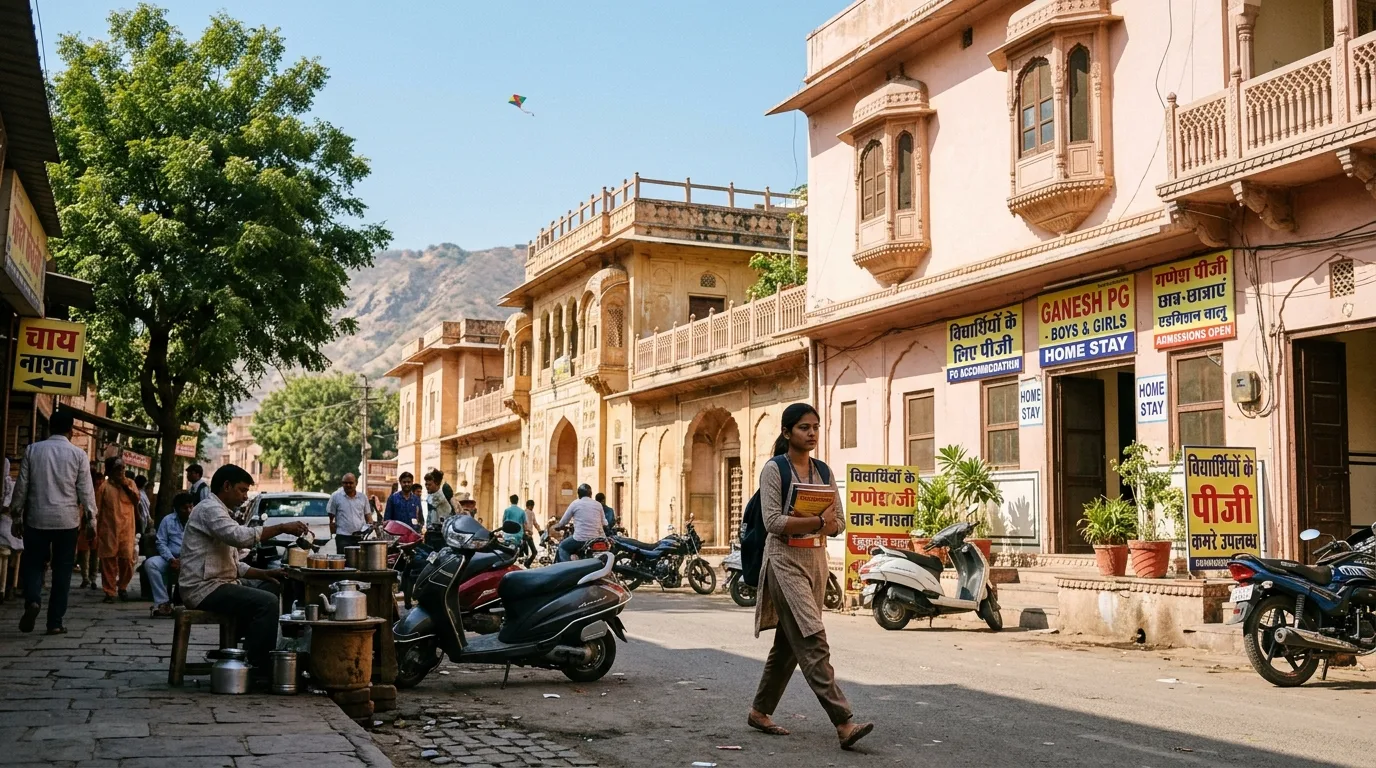

Student accommodation in India is not one market. It is a set of local markets that happen to share vocabulary. A ₹7,000 room is a comfortable double-sharing PG in Jaipur, a tight triple in Bangalore, and barely a bed in Mumbai. Within a single city the gap between two localities eight kilometres apart is often larger than the gap between two cities.
This guide gives the working numbers for the six cities we list in, the localities students actually cluster in, and what to expect from each. Rent figures come from the 833 stays currently listed on Hostel360, so they describe the real supply rather than an aspirational average. Where our coverage is thin, this page says so.
What this guide covers
- How Indian cities differ for students
- Rent bands, city by city
- Jaipur
- Delhi and NCR
- Mumbai
- Bangalore
- Pune
- Hyderabad
- Choosing an area in any city
- What our listings actually cover
- What to do next
How Indian cities differ for students
Four variables explain most of the difference, and only one of them is rent.
The first is what the city is organised around. Jaipur and Pune are education-led, with student housing clustered around campuses and coaching hubs, so supply is deep and competition keeps prices honest. Bangalore and Hyderabad are employment-led, with PG supply built for young IT workers, which means better furnishing, higher rent and rules written for a working schedule rather than a college one. Delhi is both at once, split between the university belts and the coaching corridors. Mumbai is neither: it is a space-constrained market where the shortage sets the price.
The second is transport. In Delhi and Hyderabad the metro rewrites what "nearby" means, so a locality twelve kilometres away on a direct line beats one four kilometres away across traffic. In Bangalore and Pune, road distance is the binding constraint and eight kilometres can be fifty minutes at 9 am. In Mumbai the local train decides everything.
The third is what rent includes. In Jaipur, food is included in the majority of stays. In Bangalore and Hyderabad, food is more often an optional paid add-on. That single difference can be ₹3,000 a month and is the reason two listings at the same rent are not comparable.
The fourth is seasonality. Rents and availability tighten sharply in June and July when the academic year starts, in every city. Searching in April or in October gives you both a better price and a better choice.
Rent bands, city by city
These are the actual monthly starting rents on our listings, not survey estimates. The middle column is the range that the middle half of listings fall into, which is a more useful number than an average.
| City | Stays listed | Typical monthly rent | Median | Food usually |
|---|---|---|---|---|
| Jaipur | 785 | ₹5,200 to ₹8,500 | ₹7,000 | Included |
| Bangalore | 10 | ₹6,500 to ₹9,500 | ₹9,000 | Optional add-on |
| Delhi | 10 | ₹6,500 to ₹8,500 | ₹7,500 | Mixed |
| Mumbai | 9 | ₹9,000 to ₹10,000 | ₹9,000 | Often excluded |
| Hyderabad | 9 | ₹5,500 to ₹7,500 | ₹7,000 | Optional add-on |
| Pune | 9 | ₹5,500 to ₹7,000 | ₹6,500 | Mixed |
Two caveats worth stating plainly. Jaipur's figures are drawn from 785 stays and describe the market properly. The other five cities are drawn from about ten listings each, so treat them as indicative of the student segment rather than as a full market read, and cross-check against the city guide for that city. And every figure here is a starting rent for shared occupancy: a single room is typically 40 to 70 percent higher in the same building.
Jaipur
Jaipur is where our coverage is deepest, with 785 of the 833 listed stays, and it is a genuinely good student city: rents are among the lowest of the six, food is usually included, and the campuses are distributed across identifiable belts rather than scattered.
Six localities carry most of the supply. Mansarovar is the largest with 87 listed stays, sits on the metro line, and works for students at Poornima, JECRC and the Gopalpura-side coaching centres. Jagatpura, with 61, is the engineering belt for SKIT, JECRC and Jaipur National University, and is where the cheapest triple-sharing options are. Vaishali Nagar, with 57, is the west-side option with good markets and a slightly higher rent. Pratap Nagar, with 54, is newer and quieter with strong value. Malviya Nagar, with 38, is the premium student area, close to MNIT and on the metro, and priced accordingly. Raja Park, with 24, is the smaller, more central choice.
| Area | Listed stays | Suits | Browse |
|---|---|---|---|
| Mansarovar | 87 | Metro access, mixed campuses | Mansarovar stays |
| Jagatpura | 61 | SKIT, JECRC, JNU engineering | Jagatpura stays |
| Vaishali Nagar | 57 | West Jaipur, working professionals | Vaishali Nagar stays |
| Pratap Nagar | 54 | Budget, quieter, newer buildings | Pratap Nagar stays |
| Malviya Nagar | 38 | MNIT, metro, premium | Malviya Nagar stays |
| Raja Park | 24 | Central, smaller properties | Raja Park stays |
Start with the area comparison in best areas for students in Jaipur, which puts rent, colleges, transport and safety side by side for eight localities. The wider orientation for anyone moving to the city, including the summer, is in moving to Jaipur for college.
Then go to the level that matches your situation. By locality: PG in Mansarovar, PG in Jagatpura and PG in Malviya Nagar. By campus: PG near MNIT, PG near Manipal University Jaipur and PG near Rajasthan University. By budget or requirement: PG in Jaipur under ₹5,000 and PG in Jaipur with food. And by who is staying: boys hostel in Jaipur and girls hostel in Jaipur.
To browse live availability, start at all hostels and PGs in Jaipur, or filter directly to girls stays in Mansarovar and boys stays in Jagatpura. The paying-guest view of the same inventory is at PG in Mansarovar and PG in Malviya Nagar.
Delhi and NCR
Delhi is really three student markets stacked on one map. The university belts around North Campus, which means Kamla Nagar, GTB Nagar, Vijay Nagar and Kingsway Camp, are dense, walkable and priced for students. The coaching corridors, principally Mukherjee Nagar for civil services and Old Rajinder Nagar for the same, run on a different rhythm with longer hours and more single rooms. And the south of the city, from Hauz Khas and Green Park to Munirka, Ber Sarai and Katwaria Sarai, serves JNU, IIT Delhi and South Campus, with rents that climb quickly the closer you get to the main roads.
The variable that matters most in Delhi is the metro. A PG two hundred metres from a station on your line is worth ₹1,000 a month more than one that needs an auto at both ends, and the difference compounds every winter morning. Check the actual walking distance rather than the "near metro" claim, which in listings routinely means two kilometres.
Budget-wise, ₹6,500 to ₹8,500 covers most shared student options on our listings, with food more often excluded than in Jaipur. Single rooms in Mukherjee Nagar and Old Rajinder Nagar during peak coaching season are the exception and can cross ₹15,000.
The ground-level version, including deposit practices and what "near metro" really means, is in finding a PG in Delhi. The locality-by-locality breakdown, with rents and college distances, is in best areas for students in Delhi. If your college is Delhi University North Campus, the Kamla Nagar, GTB Nagar and Vijay Nagar comparison is worked out in PG in North Campus Delhi University.
Live listings are at hostels and PGs in Delhi, and you can narrow to GTB Nagar, North Campus or Kamla Nagar.
Mumbai
Mumbai is the most expensive of the six and the one where the area decision is most consequential, because the constraint is the local train rather than the kilometre. A ₹7,500 bed that needs two train changes is worse every single day than a ₹9,000 bed you can walk to, and the difference is measured in hours per week rather than rupees per month.
The student clusters are legible. Andheri, split sharply between East and West, is the largest and the most connected, and the two sides have genuinely different price and character. Powai serves IIT Bombay and the surrounding tech offices. Dadar and Prabhadevi sit central and suit CA, CS and law students who need to reach class hubs and coaching centres. Thane and Bhandup West are the value end, at the cost of commute. Bandra and Lower Parel are workplace-driven and priced for salaries rather than stipends.
On our listings, Mumbai starts around ₹8,000 and clusters between ₹9,000 and ₹10,000, with food more often excluded than included, so budget another ₹3,000 to ₹4,000 for eating.
Start with best hostels and PGs in Mumbai for students for the area framework, then affordable PG in Mumbai under ₹10,000 if the budget is the binding constraint. The East versus West question is settled in student hostels in Andheri. Long-prep students should read hostels in Mumbai for CA students, and women should start with girls hostel in Mumbai.
Live listings are at hostels and PGs in Mumbai, with Andheri, Dadar West and Vile Parle as the usual starting points.
Bangalore
Bangalore's PG market is built for young working professionals first and students second, which shapes everything. Rooms are better furnished than the Jaipur equivalent, WiFi is genuinely expected to work, food is usually an optional add-on rather than included, and rules are written around office hours. Rents on our listings run ₹6,500 to ₹9,500 with a median of ₹9,000, which makes it the joint most expensive of the six alongside Mumbai.
Geography follows employment. Koramangala, HSR Layout and BTM Layout form the startup triangle and carry the densest PG supply. Electronic City and Bellandur serve the large campuses to the south and east, at lower rent and longer commutes. Whitefield is its own self-contained market. Indiranagar is central and expensive. For students rather than professionals, Basavanagudi, Banashankari and JP Nagar are the calmer, cheaper south-side options near the older colleges.
The Bangalore-specific trap is the commute. Distance on a map means very little here; check the actual travel time at 9 am and 7 pm before committing, because a locality that looks close can be an hour each way in practice.
The area-level comparison for students and freshers is in best areas for PG in Bangalore. What each budget band actually buys, from ₹6,000 to ₹15,000, is broken down in PG in Bangalore for IT freshers.
Live listings are at hostels and PGs in Bangalore, with Koramangala, Bellandur and JP Nagar as the main clusters.
Pune
Pune is the best-value student city of the six on our listings, with rents running ₹5,500 to ₹7,000 and a median of ₹6,500. It is also the most genuinely education-led after Jaipur, which means supply is built for students and priced for them.
The city splits cleanly. The old education belt, Kothrud, Karvenagar, Erandwane, Deccan Gymkhana and Shivajinagar, serves the university and the traditional colleges, is walkable, and is where most student PGs sit. The IT belt, Hinjewadi, Wakad, Baner and Balewadi, is newer, built for professionals, and priced slightly higher. The east, Viman Nagar, Kharadi, Kalyani Nagar and Magarpatta, serves the airport-side offices. And the south, Katraj, Dhankawadi and Sinhagad Road, is the budget end with a longer commute into the centre.
Two Pune-specific notes. Monsoon here is serious and damp is a real problem in ground-floor rooms, so check the walls in a June viewing. And the two-wheeler is the default mode of transport, so ask about parking before you sign.
The locality breakdown, from Kothrud and Karvenagar to Viman Nagar and Hinjewadi, is in best areas for students in Pune.
Live listings are at hostels and PGs in Pune, with Kothrud, Karvenagar and Koregaon Park as the main clusters.
Hyderabad
Hyderabad sits at the affordable end alongside Pune, with listed rents of ₹5,500 to ₹7,500 and a median of ₹7,000, and it has the advantage of a metro that genuinely changes the commute maths.
The IT corridor dominates the PG market: Gachibowli, Madhapur, HITEC City and Kondapur form a continuous belt of professional-grade PGs with optional food and app-based rent. Ameerpet is the coaching capital, dense and cheap, built around short courses and long study hours. Kukatpally is the value residential option with metro access. Begumpet and Nampally sit central and older, and suit students at the city-centre institutions.
The local quirk worth planning for is that the IT corridor and the university side of the city are far apart and connected badly at peak hours. Choose the side your daily commitment is on and do not assume you will cross the city often.
The full area guide, including the university side of the city rather than only the IT corridor, is in best areas for students in Hyderabad. For the IT corridor specifically, PG in HITEC City and Gachibowli covers the Madhapur, Kondapur and Gachibowli triangle.
Live listings are at hostels and PGs in Hyderabad, with Gachibowli, Madhapur and HITEC City as the main clusters.
Choosing an area in any city
The method is the same everywhere, and it takes about an hour on a map before you look at a single listing.
Fix the one location you must reach on a weekday. Set a travel time you will still tolerate in July rain and January fog, which for most people is 30 to 40 minutes door to door. List every locality inside that ring. Then compare those localities on four things: rent band, whether food is typically included, how the last kilometre works after 9 pm, and whether daily needs like a chemist, a laundry and an ATM are within walking distance. Only then start opening listings.
Two errors repeat across every city. Choosing on rent alone and paying the difference back in autos. And choosing a locality on a Saturday afternoon visit, when the thing that will actually shape your year is what that street is like at ten on a Tuesday night.
If you are comparing formats rather than areas, the co-living premium question is answered in co-living in India. Once you have a shortlist, run it against hostel red flags and warning signs before paying anything, and use how to negotiate PG rent in India when you are ready to close.
What our listings actually cover
Being straight about this is more useful than pretending otherwise. Hostel360 currently lists 833 stays. Of those, 785 are in Jaipur, which is where we started and where the coverage is deep enough that filtering by area, gender and budget returns a real choice. Delhi and Bangalore have 10 listings each. Hyderabad, Pune and Mumbai have 9 each.
What that means for you. In Jaipur, use the listings as your primary search tool and the guides for context. In the other five cities, use the guides as your primary tool, because the area analysis and rent bands hold regardless of how many properties we have on the platform, and treat the listings as a small verified set to start from rather than the whole market. We are adding inventory city by city, and the city guides are updated as it lands.
The full set of city guides, including the ones added since this page was written, sits under city guides.
What to do next
If you have picked a city but not an area, go to that city's section above and read its area guide before you look at listings. That single step prevents the most expensive mistake in this whole process.
If you have an area and are ready to search, the full method, from shortlisting through the inspection visit to the agreement, the deposit and the rent negotiation, is in how to find a PG or hostel in India. If you want to know what the money actually looks like month to month once you are there, start with student budget planning for hostel life.
And once the search is over and the living begins, the day-to-day, from roommates and mess food to laundry, study and getting your deposit back, is covered end to end in the complete guide to hostel life in India.