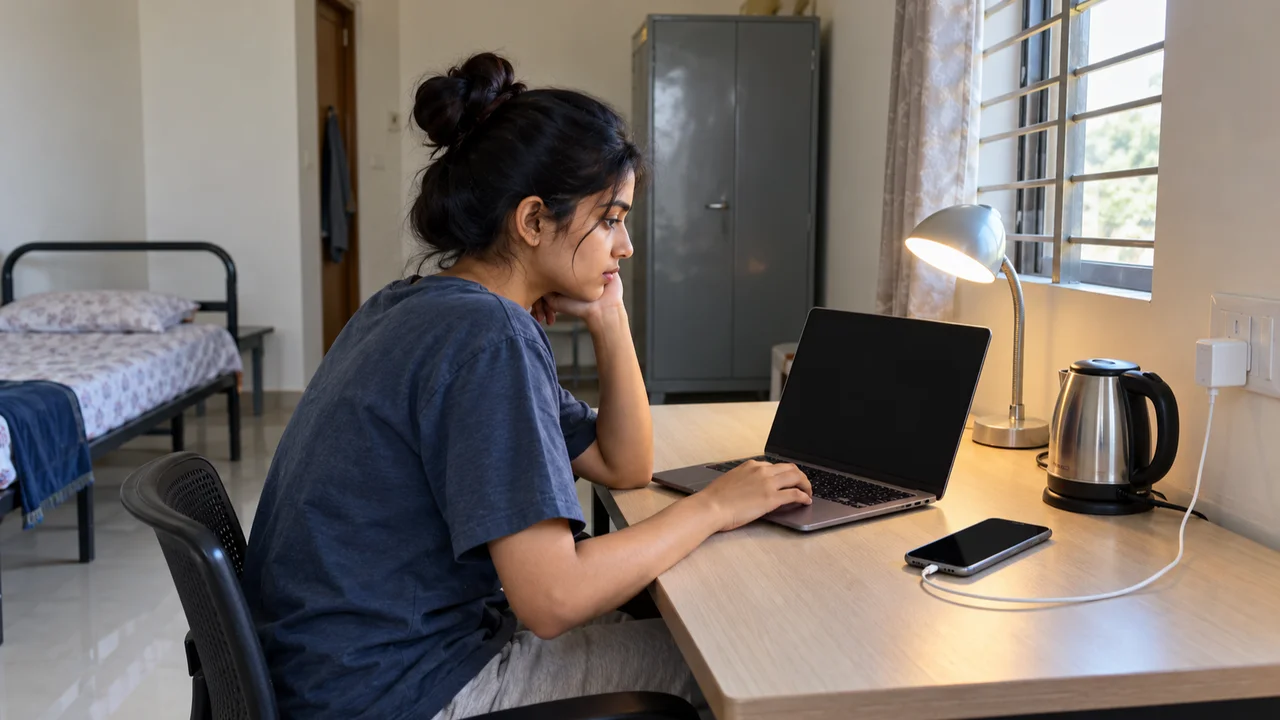
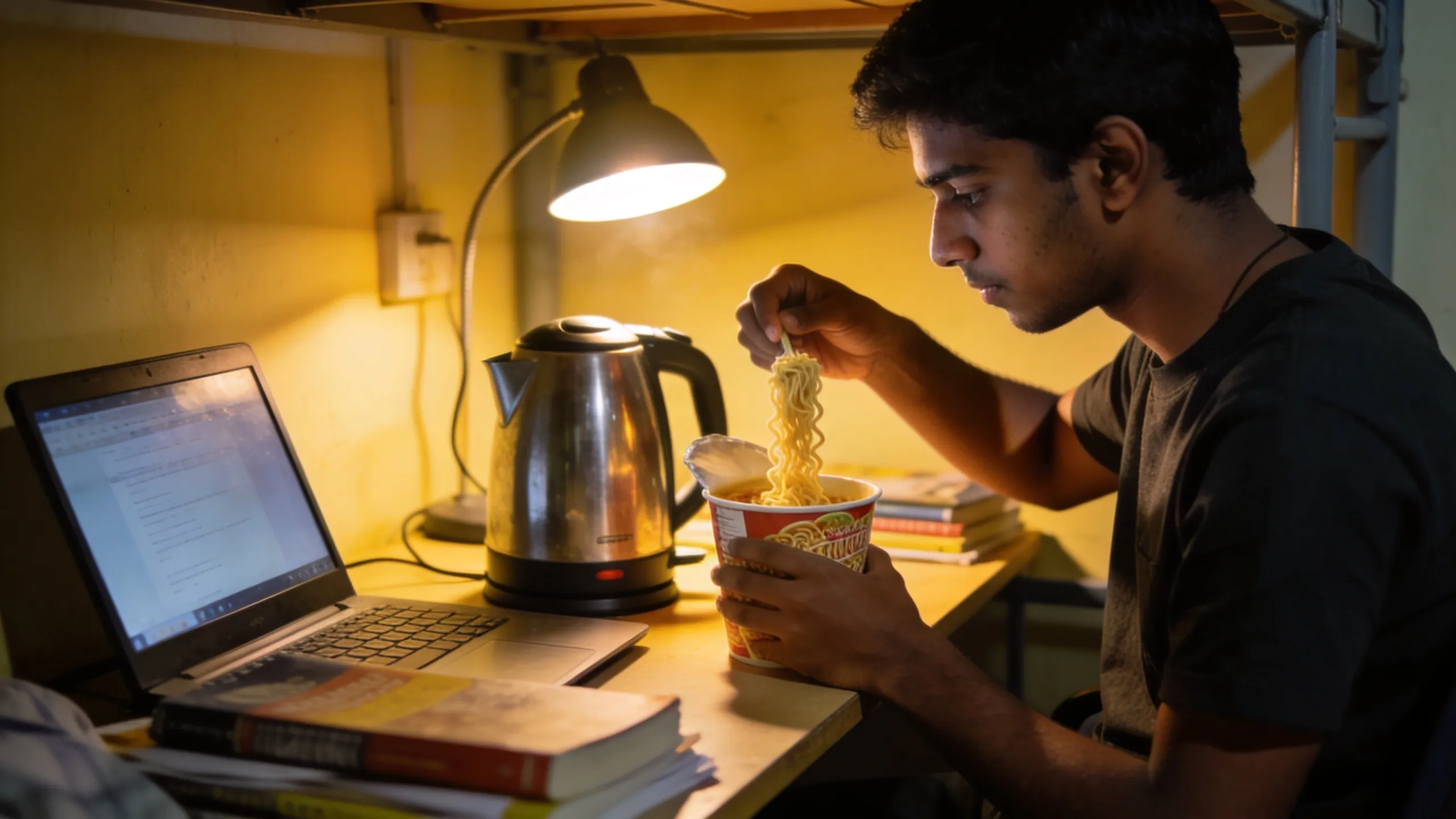
It is 11:47 PM. Mess is closed, your assignment is not, and your stomach is making more noise than your roommate's keyboard. If that scene feels familiar, this guide is for you. The truth is simple: the hostel cooking hacks electric kettle India students use every day are not fancy recipes. They are quick, cheap, safe meals you can make in one corner of your room.
This is a practical cooking guide, not a motivation speech. You get 22 kettle meals with real ingredients and timings, the wattage rules that keep you out of trouble with both the warden and the MCB, a pantry starter kit with a monthly grocery budget in rupees, and storage tips for rooms without a fridge. Every recipe here costs ₹8 to ₹35 a serving and takes under 15 minutes. For the nights you don't want to cook at all, keep this hostel food survival guide handy for mess strategy and tiffin planning.
Key Takeaways
- A 1.2-1.5L stainless steel kettle rated 600-1000W handles roughly 80% of hostel cooking: breakfast, snacks and basic meals.
- Stay at or under 1,000W on a 5-amp socket and unplug everything else first. Overloaded sockets, not kettles, cause most trips.
- The ₹840 pantry kit covers about two weeks of meals. A full month of light kettle cooking runs ₹1,800 to ₹3,000.
- Every recipe here costs ₹8 to ₹35 and takes under 15 minutes.
- Swapping three weekly delivery orders for kettle meals saves ₹1,200 to ₹2,400 a month.
- Never heat oil, milk or thick pastes in a kettle, and rinse it while still warm after every cooking session.
- Check your hostel's written appliance policy first. A confiscated kettle helps nobody.
Why an electric kettle is the best appliance in a hostel room
A kettle is the only cooking device that is cheap, allowed almost everywhere, and capable of a real meal. It is not just for chai. In a no-kitchen hostel setup it doubles as your backup breakfast counter, your exam-week dinner tool, and your "mess miss ho gaya" recovery plan.
Here is why it works so well:
- Fast: most meals are ready in 5 to 15 minutes, boiling time included.
- Low effort: one vessel, one spoon, one mug.
- Budget friendly: a kettle meal costs ₹15 to ₹35 against ₹120 to ₹250 on delivery apps.
- Predictable: you control the spice, the salt and the portion size.
- Beginner-safe when used correctly: far less risky than a hot plate or an immersion rod.
The thing students underestimate is routine. When a hot meal is always ten minutes away, you skip fewer meals, and skipping fewer meals shows up in how you feel in a 2 PM lecture.
Takeaway: the kettle is not a Maggi machine. Treat it as a small stove and it earns its shelf space.
Pick a kettle that can actually cook
Three specs decide whether your kettle can cook or only boil water. Most models sold as "travel kettles" are built for 500 ml of water and nothing else.
- Capacity 1.2 to 1.5 litres: enough water for pasta, rice or dal in a single go.
- Wide mouth, stainless steel body: a spoon and a sponge need to fit inside, and steel handles food far better than plastic.
- 600 to 1000W: hostel sockets are usually 5-amp, which tops out near 1,100W at 230V. A 600W kettle takes 8 to 9 minutes to boil a litre, and 1000W does it in 5 to 6. A 1,500W kettle will trip the MCB or heat the wiring, and that is exactly how appliance bans start on a floor.
Budget ₹700 to ₹1,500 for a kettle that survives two years of this. If you want specific models compared on wattage, boil time and price, our electric kettle and cooking appliance buyer's guide has the shortlist.
Takeaway: wide mouth and steel body matter more than brand. Skip anything under 1 litre or over 1,000W.
Safety rules: what not to do when cooking without a kitchen
Read this section before you cook anything. Nearly every kettle that dies early, and every appliance ban on a hostel floor, traces back to one of these nine mistakes.
- Do not deep-fry or heat oil in a kettle. Oil crosses boiling-water temperature fast, wrecks the thermostat and becomes a fire risk.
- Do not cook thick pastes or boil milk directly. Both stick to the base and scorch onto the heating element permanently.
- Do not leave the kettle unattended. Not for "just two minutes," and especially not when there is food inside rather than water.
- Do not overload the socket. Kettle plus iron plus extension board on one plug is how fuses blow. Unplug everything else before you switch the kettle on.
- Do not cook where appliances are prohibited. Some hostels allow kettles for water only. Rules first, recipes second.
- Do not heat closed containers. Pressure builds up, lids crack, and boiling liquid goes everywhere.
- Do not use damaged cords or loose plugs. Replace them the day you notice, not the week after.
- Do not fill above the max line or below the min line. Both can kill the kettle, and the min line is the one people ignore.
- Do know where the fire extinguisher is and keep the warden's number saved. The same hostel safety habits that apply to everything else in your room apply here.
If your hostel bans kettles outright, do not try to hide one. A single-pan portable induction cooktop used in a permitted common area is a far better investment than a confiscated appliance and a warning letter.
Takeaway: oil, milk and unattended kettles account for almost every hostel kettle disaster. Avoid those three and you are fine.
Clean the kettle every single time you cook in it
This is the difference between a kettle that lasts two years and one that dies in four months. Food residue bakes onto the heating plate, slows boiling and makes your next chai taste like last night's Maggi.
- Rinse it while still warm, before the starch sets.
- Once a week, half-fill with water, add a spoon of baking soda or the juice of half a lemon, boil once and let it stand 10 minutes.
- Wipe the inside with a soft sponge and rinse twice.
- Never use steel wool on the heating plate, and never dip the base or the plug in water.
If you cook most nights, a second ₹700 kettle kept only for food pays for itself in hygiene. Your chai kettle stays clean, and your food kettle can be replaced without drama.
Room etiquette matters as much as technique
You are cooking in shared air. A strong tadka at midnight starts roommate wars faster than almost anything else. Keep the window open, wipe spills immediately, and clean the kettle after every use. If your floor has strict smell or noise rules, save the aromatic recipes for weekends.
For the shared-room habits that save friendships, this hostel etiquette guide is worth ten minutes.
Your hostel pantry: stock these first
About ₹840 of groceries covers roughly two weeks of kettle meals on top of your mess plan. Keep these in your room and you can make most of the recipes below without stepping out. Prices are typical D-Mart or BigBasket rates and shift a little by city.
| Item | Cost | Lasts |
|---|---|---|
| Maggi (pack of 12) | ₹180 | 2 weeks |
| Instant oats (500g) | ₹90 | 10 servings |
| Poha (500g) | ₹40 | 8 servings |
| Rava/sooji (500g) | ₹45 | 8 servings |
| Instant pasta (pack of 4) | ₹80 | 4 meals |
| Eggs (tray of 6) | ₹48 | 6 meals |
| Tea bags (25 pack) | ₹90 | 25 cups |
| Instant coffee (50g) | ₹120 | 20 cups |
| Salt, red chilli powder, turmeric | ₹60 total | 2 months |
| Peanuts (250g) | ₹50 | 2 weeks |
| Moong dal (250g) | ₹40 | 5 servings |
Add a large steel mug, a deep heat-safe bowl with a lid, and a long spoon and your setup is complete. If you are still building your room from scratch, the hostel room essentials checklist covers everything else.
Takeaway: buy the whole kit in one trip. Half a pantry means you order in anyway.
Breakfast: 6 recipes you can make half-awake
These six take under 10 minutes each and cost ₹10 to ₹25, which makes them realistic for an 8 AM class.
1) Masala oats bowl, ₹15
Ingredients: 4 tbsp instant oats, 1 cup water, salt, turmeric, chilli flakes, onion flakes or chopped onion, optional peanuts and lemon.
Steps:
- Boil 1 cup water in the kettle.
- In a heat-safe bowl, add oats, salt, turmeric, chilli flakes and onion.
- Pour in the boiling water, stir, and cover for 3 to 4 minutes.
- Add peanuts for crunch and a squeeze of lemon before eating.
2) Kettle poha cup, ₹20
Ingredients: 3/4 cup thick poha, hot water, salt, pinch of turmeric, roasted peanuts, lemon.
Steps:
- Rinse the poha in a sieve for about 2 minutes and drain. Do not let it sit and go mushy.
- Add the poha to a bowl with salt, turmeric and peanuts.
- Pour just enough boiling water to moisten, then cover for 4 minutes.
- Fluff with a fork, squeeze lemon over it, and add sev if you have it.
It is not tadka poha, but it fills you up and tastes genuinely decent.
A pattern worth copying: students who eat breakfast consistently almost never "decide" to. They pick one recipe that takes seven minutes and make it while brushing their teeth. The fix for skipped breakfast is lower friction, not more discipline.
3) Quick upma mug, ₹18
Ingredients: 3 tbsp roasted rava or instant upma mix, 1.5 cups water, salt, turmeric, ghee sachet, optional curry leaf powder or chutney podi.
Steps:
- Dry-roast the rava on a steel plate first if you can. It stops the upma turning pasty.
- Boil the water in the kettle with salt and turmeric.
- Add the rava slowly to a large mug while pouring and stirring together.
- Cover for 4 to 5 minutes until fluffy, then top with ghee and podi for South-style flavour.
Texture depends entirely on the rava-to-water ratio. Practise it twice and you will have it.
4) Boiled eggs with chaat masala, ₹16 for two
Ingredients: 2 eggs, water, chaat masala, black salt or pepper.
Steps:
- Place the eggs in the kettle carefully and add enough water to cover them.
- Bring to a boil, then leave them sitting in the hot water for 10 minutes.
- Drain, cool under the tap and peel.
- Sprinkle chaat masala and black salt.
Some kettles auto-cut before the eggs are done. If yours does, switch it on for a second boil rather than trying to extend the first one.
5) Bread and melted cheese dip, ₹25
Ingredients: 4 bread slices, 2 cheese slices or 2 tbsp cheese spread.
Steps:
- Boil water in the kettle.
- Rest a steel bowl over the kettle mouth to make a rough double boiler.
- Add the cheese and let it melt in the steam, stirring once.
- Dip the bread. Add chilli flakes or oregano from a leftover pizza sachet.
Surprisingly good at 7 AM when the mess has not opened yet.
6) Instant coffee that doesn't taste terrible, ₹10
Ingredients: 1 tsp instant coffee, hot water, milk powder or tetra pack milk, sugar or jaggery.
Steps:
- In a mug, mix the coffee and sugar with 1 tsp warm water into a paste.
- Add hot water slowly while stirring.
- Add a milk powder slurry or a splash of milk.
- Stir hard for 20 to 30 seconds for better body.
Beats the lobby vending machine easily. Add a pinch of cocoa for a budget mocha.
Takeaway: pick two breakfast recipes and rotate them. Variety at 7 AM is a fantasy nobody actually lives.
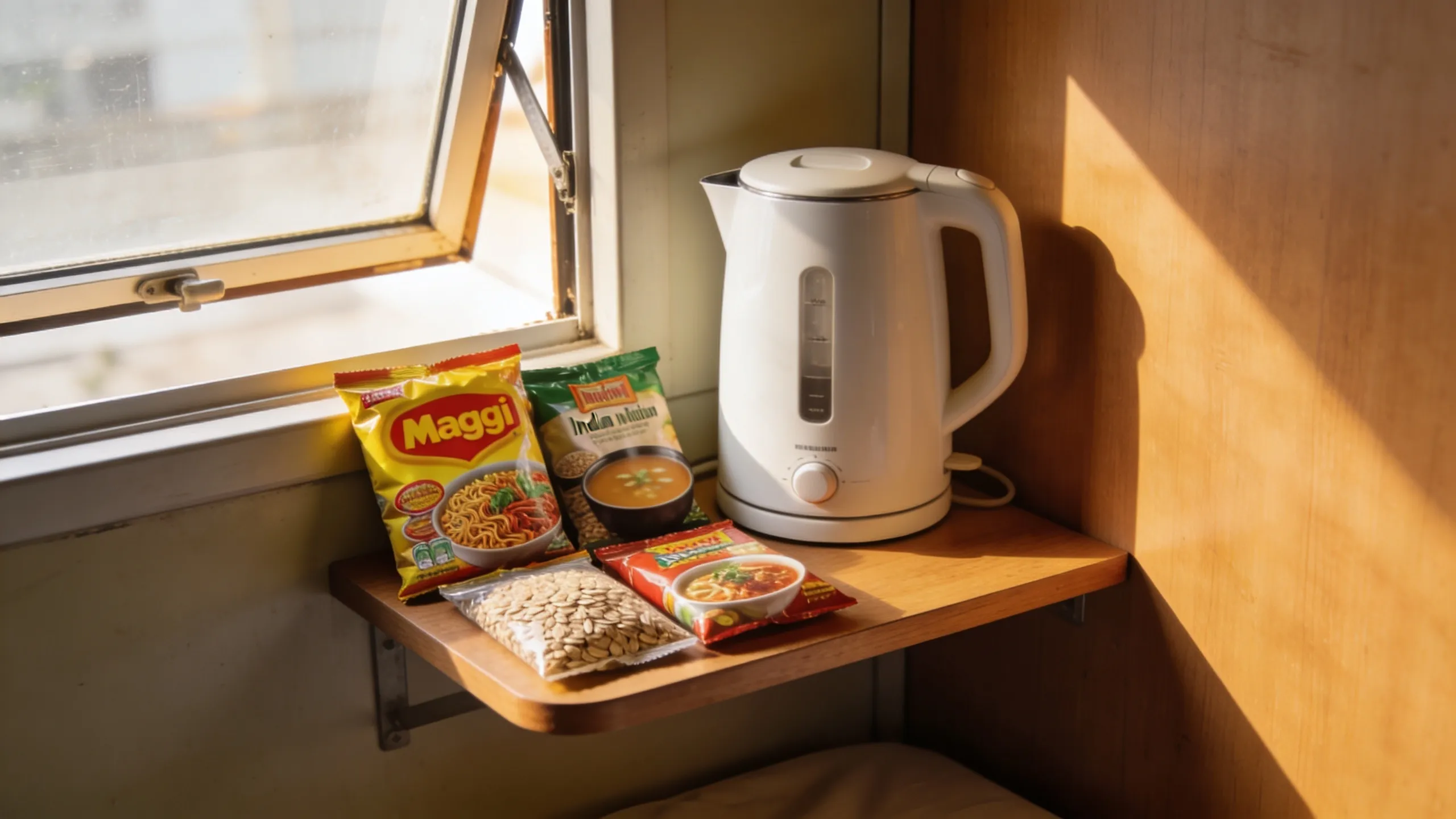
Lunch and dinner: 11 kettle meals you can actually live on
These eleven cost ₹12 to ₹35 and cover you on the nights the mess closes early or you get back too late. They are not chef recipes. They are practical, filling and exam-week friendly.
7) Classic Maggi, done right, ₹15
Ingredients: 1 Maggi pack, water, tastemaker.
Steps:
- Boil water in the kettle, then add the noodles and tastemaker to a heat-safe bowl.
- Use slightly less water than the packet says. Soupy Maggi is a crime.
- Cover for 3 to 4 minutes and stir once.
Variation: for a cold-night noodle soup, do the opposite. Use 50% more water, extra salt and pepper, and a squeeze of lemon. Drink the broth and eat the noodles on the side.
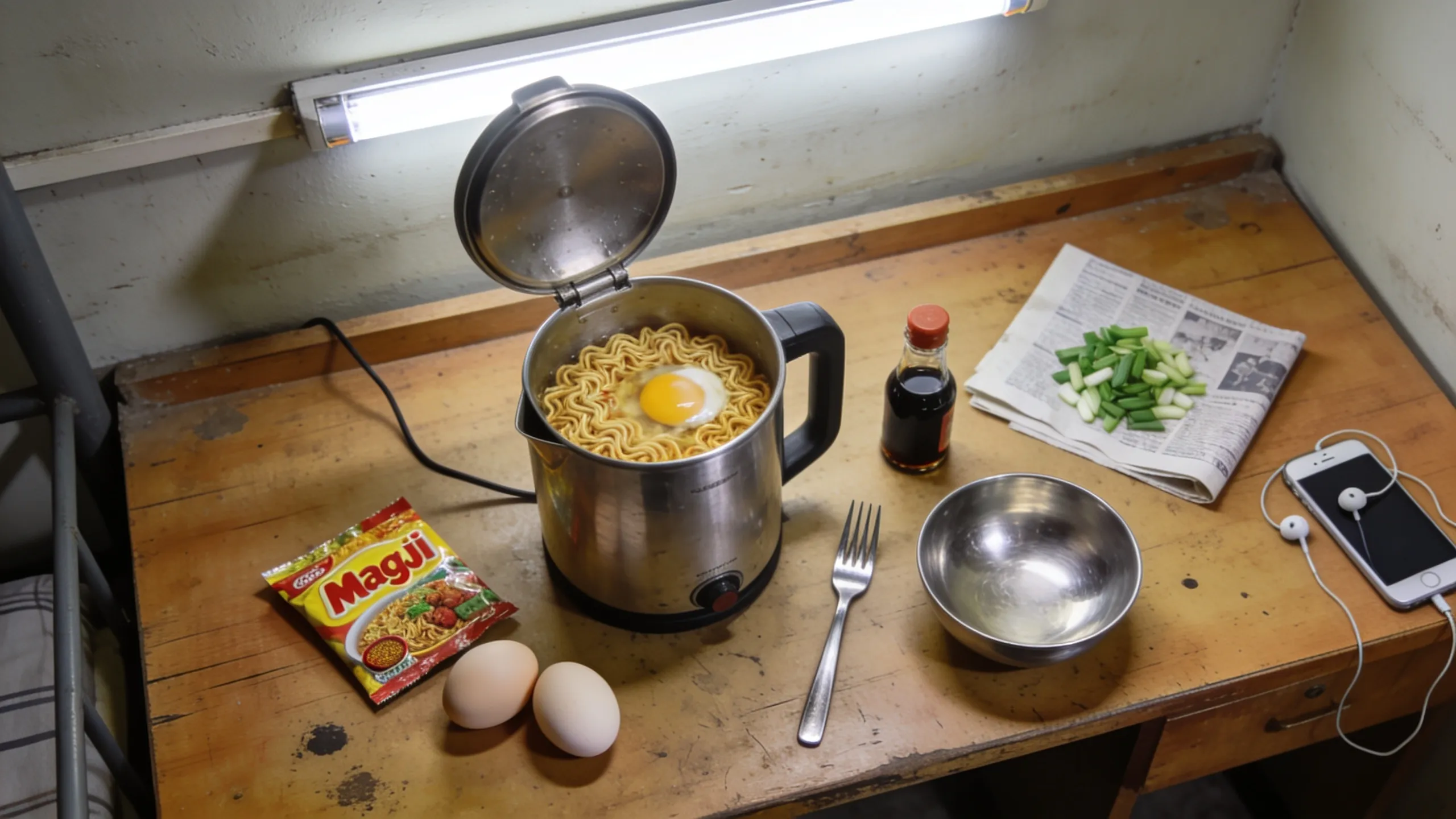
8) Egg Maggi protein upgrade, ₹25
Ingredients: 1 Maggi pack, 1 egg or a few tofu cubes, roasted chana or peas, black pepper, masala.
Steps:
- Boil water in the kettle and add Maggi plus tastemaker to a heat-safe bowl.
- Crack the egg into the bowl and stir quickly, egg-drop style, or add tofu cubes instead.
- Cover for 4 minutes until the noodles soften.
- Finish with black pepper and chilli oil for North-style, or podi and ghee for South-style.
Do this in the bowl, never inside the kettle. Egg cooked directly on the heating plate is exactly the residue that kills kettles.
9) Cheese Maggi, ₹30
Ingredients: 1 Maggi pack, 1 cheese slice or 2 tbsp cheese spread.
Steps:
- Cook the Maggi with slightly extra water this time.
- Add the cheese while the noodles are still hot and stir until it melts.
- Eat immediately. The extra water is what keeps it from going thick and gluey.
10) Ramen upgrade, ₹35
Ingredients: 1 instant ramen pack, 1 boiled egg, spring onion, a few drops of soy sauce.
Steps:
- Cook the ramen with its seasoning in boiling kettle water.
- Halve a boiled egg and place it on top.
- Add chopped spring onion and a few drops of soy sauce.
This turns a ₹20 ramen pack into something you would happily eat twice a week.
11) Cup noodle egg-drop meal, ₹30
Ingredients: 1 cup noodles, 1 egg, spring onion flakes.
Steps:
- Open the cup noodles and add the seasoning.
- Pour boiling water up to the line.
- Beat the egg separately, then pour it in slowly while stirring.
- Cover for 3 minutes and top with onion flakes.
12) Instant rice pulao cup, ₹30
Ingredients: instant rice cup or rice flakes, mixed veg sachet, salt, garam masala, roasted peanuts.
Steps:
- Add the rice base and veg to a bowl.
- Pour boiling water to the level marked on the pack.
- Add salt and masala, then cover for 6 to 8 minutes.
- Fluff and top with roasted peanuts.
13) Plain boiled rice, ₹12
Ingredients: 1/2 cup rice, 1.5 cups water, pinch of salt.
Steps:
- Wash the rice twice and add it to the kettle with the water and salt.
- Bring to a boil, switch off, and leave covered for 15 minutes.
- Drain any extra water and fluff with a fork.
Pair it with pickle, curd or dal from the mess. Basic, but it stretches your food budget in the tight last week of the month.
14) Moong dal khichdi, ₹25
Ingredients: quick-cook moong dal and rice in a 1:1 ratio, or an instant dal-rice mix, salt, turmeric, ghee.
Steps with an instant mix, 12 minutes:
- Mix the dal base, rice base and turmeric in a deep bowl.
- Add boiling water and salt.
- Cover for 10 to 12 minutes, stirring once midway.
- Add ghee and pickle before serving.
Steps with raw dal and rice, 20 minutes:
- Wash 1/4 cup rice and 1/4 cup moong dal together.
- Add to the kettle with 3 cups water, salt, turmeric and a little ghee.
- Bring to a boil, switch off, and leave covered for 15 minutes.
- Stir. The consistency should be thick and porridge-like.
This is the meal to know when you are ill, hungover, or simply done with mess dal. It is also the one that gets you through exam week without a stomach ache.
15) Dal soup, ₹20
Ingredients: 3 tbsp moong dal, 2 cups water, salt, turmeric, pinch of hing.
Steps:
- Soak the dal for 30 minutes. Skip this and it will not soften.
- Boil in the kettle with water, salt, turmeric and hing for 12 to 15 minutes.
- Mash lightly with a spoon.
- Drink as soup or mop it up with bread.
High protein, almost zero effort, and the cheapest real meal on this list.
16) One-pot pasta, ₹30
Ingredients: penne or fusilli, salt, ketchup, cheese, chilli flakes.
Steps:
- Break the pasta into smaller pieces so it stays submerged.
- Boil in salted kettle water for 8 to 10 minutes.
- Drain, then mix in ketchup, cheese, salt and chilli flakes.
Not Italian. Still works at 1 AM.
17) Soup meal bowl, not just soup, ₹30
Ingredients: instant tomato or sweet corn soup sachet, oats or crushed khakhra, boiled egg or roasted chana, black pepper.
Steps:
- Make the soup with boiling water in a large mug.
- Add 2 tbsp oats or crushed khakhra for body.
- Add boiled egg slices or roasted chana.
- Finish with black pepper and rest for 2 minutes before eating.
This turns a light sachet soup into an actual meal. Two upgrades worth knowing: drop in finely chopped carrot or beans and let them sit in the boiling soup for 5 to 7 minutes, or top it with crushed papad or toasted makhana for bite.
Takeaway: khichdi and dal soup are the two worth learning properly. Everything else on this list is a variation on boiling water.
Snacks and drinks: 5 fixes for odd hours
Snacks decide your monthly food budget more than main meals do. Replacing random chips with these five is where the real savings come from.
18) Chai and roasted chana combo, ₹8 a cup
Ingredients: tea bag or tea premix, hot water, sugar, milk powder, roasted chana, peanuts.
Steps:
- Steep the tea bag in hot water for 3 minutes. Two bags and less water for a stronger cup.
- Add sugar and milk powder.
- Mix roasted chana, peanuts and a pinch of salt in a bowl.
- Sip and snack together for better fullness.
Barely a recipe, but it is the single most effective thing that stops impulse ordering at 10 PM.
19) Steam-style besan mug snack, ₹15
Ingredients: 4 tbsp besan, salt, chilli powder, pinch of eno, water, chopped onion and coriander.
Steps:
- Mix besan, spices, onion and water into a thick batter.
- Add the eno last and stir once.
- Pour the batter into a steel mug and stand the mug in a covered bowl of hot water.
- Let it steam-set for 8 to 10 minutes, refilling with fresh boiling water as needed. Cut and eat with chutney.
Pakora vibes without deep-frying anything.
20) Peanut chaat, ₹15
Ingredients: roasted peanuts, onion, tomato, green chilli, lemon juice, salt, chaat masala.
Steps:
- Chop the onion, tomato and chilli fine.
- Toss with peanuts, salt and chaat masala.
- Finish with lemon juice.
No heat needed at all, which makes it the one snack you can make on a floor where appliances are banned. High protein, five minutes, ideal between study sessions.
21) Hostel hot chocolate, ₹20
Ingredients: 2 tbsp cocoa or drinking chocolate powder, milk powder, sugar, hot water.
Steps:
- Make a paste of cocoa and sugar with 1 tsp warm water.
- Add a milk powder slurry.
- Pour hot water slowly while whisking with a spoon.
- Add a tiny pinch of cinnamon if you have it.
A genuine mood lifter at 11 PM during exam week.
22) Lemon honey warm water, ₹10
Ingredients: warm water, lemon juice, honey, pinch of black salt.
Steps:
- Boil the water and let it cool slightly. Honey in boiling water turns bitter.
- Add lemon juice and honey.
- Add black salt, stir, and sip slowly.
Useful after heavy Maggi nights.
One more hack: flip the kettle lid over, rest a bread slice on the hot metal, and press lightly for about 30 seconds a side. It is not real toast, but with butter and jam it does the job when you have no toaster.
Takeaway: the biggest budget leak for most students is not dinner, it is three "small" ₹180 snack orders a week. Replace those and you save roughly ₹1,800 a month without feeling deprived.
Toolkit, budget and storage
Other tools worth having beyond the kettle
Buy based on your room rules first and convenience second. A banned appliance is not a hack.
- Manual mini chopper: quick onion and chilli chopping with no electricity risk.
- Sandwich maker: better for low-smell hot meals than any pan-cooking workaround.
- Deep bowl with a lid: safer for mixing and resting than an open mug.
- Steel mug and long spoon: essential for boiling-water recipes.
- Small measuring spoon set: stops the oversalting that ruins upma and khichdi.
If your current place bans everything, the real fix is a room where cooking is allowed. Ask about the appliance policy when you compare PGs in Jagatpura or wherever you are looking, and get the answer in writing.
What kettle cooking costs against the alternatives
A kettle meal costs ₹15 to ₹35. The same hunger solved on Swiggy costs ₹120 to ₹250. That gap is the entire argument.
| Meal option | Average cost | Time |
|---|---|---|
| Hostel mess (if included) | ₹0 (prepaid) | Fixed schedule |
| Kettle-cooked meal | ₹15-₹35 | 5-15 minutes |
| Street food or canteen | ₹40-₹80 | 10-20 minutes |
| Swiggy or Zomato order | ₹120-₹250 | 30-45 minutes |
Skip ordering in just three times a week and you save roughly ₹1,200 to ₹2,400 a month. On a typical student budget that is not a rounding error, it is most of a month's rent in Jaipur.
Monthly grocery list for hostel cooking
A full month of light kettle cooking alongside regular mess meals runs ₹1,800 to ₹3,000. The starter kit above gets you going, and this is what a steady month looks like.
| Item | Monthly qty | Estimated cost |
|---|---|---|
| Instant oats | 1 kg | ₹180-₹220 |
| Poha | 1 kg | ₹80-₹120 |
| Instant upma/rava mix | 500 g | ₹90-₹180 |
| Maggi/instant noodles | 12 packs | ₹180-₹240 |
| Soup sachets | 10 packs | ₹120-₹250 |
| Eggs | 30 eggs | ₹200-₹240 |
| Roasted chana + peanuts | 1.5 kg total | ₹220-₹380 |
| Tea and coffee premix | 1 pack each | ₹200-₹400 |
| Milk powder | 500 g | ₹220-₹320 |
| Spices, salt, lemon | mixed | ₹150-₹250 |
| Honey, cocoa, extras | mixed | ₹180-₹350 |
| Airtight containers | one-time | ₹250-₹500 |
Split your shopping this way:
- Monthly staples: oats, poha, noodles, tea and coffee premix, soup sachets, spices.
- Weekly top-ups: eggs, lemons, milk packs, onions.
If you struggle to track food spending, this student budget planning guide gives you a simple monthly method that takes about five minutes a week.
Making kettle meals actually balanced
A kettle is limited, but it is not junk food by default. The fix is add-ons, not new recipes. Pair noodles with an egg or roasted chana. Stir oats into soup for fibre. Make peanuts or chana your default snack instead of chips.
Keep breakfast consistent with poha, oats or eggs rather than skipping it and eating double at lunch. That single habit steadies your energy through afternoon classes more than anything else on this page.
Storage without a fridge
No fridge is normal in most Indian hostels. What you need is a rotation system, not panic buying.
- Use small airtight jars for oats, poha, chana and noodles once the packet is open.
- Label the purchase date with tape and a marker.
- Follow the 7-day rule for perishables like cut lemon, open milk packs and chopped onion.
- Keep the food shelf dry and raised, never directly on the floor, to avoid moisture and ants.
- Buy eggs and dairy weekly, not monthly.
- Use silica gel pouches in the shelf corner, never inside the food, if you are in a humid city like Chennai or Mumbai.
- Clean crumbs nightly. Ants do not wait for the weekend.
On shared shelves, agree on boundaries early: whose container is whose, and what is fair game to share.
Takeaway: airtight jars and a weekly egg run solve 90% of no-fridge problems.
Your 20-minute setup for tonight
Do just four things today: clean your kettle, buy oats, eggs, Maggi and roasted chana, set up two airtight jars, and pick one breakfast recipe from this guide. That is enough for your first week.
Then add one dinner recipe and one snack. Keep it simple. Consistency beats variety in hostel life, especially during classes and submission weeks.
If you are moving this semester, check the appliance policy before you sign anything. This PG selection checklist covers what else to ask. You can compare hostels in Jaipur, shortlist Malviya Nagar PG options, or browse budget-friendly Mansarovar listings on Hostel360 with zero brokerage and direct owner contact.