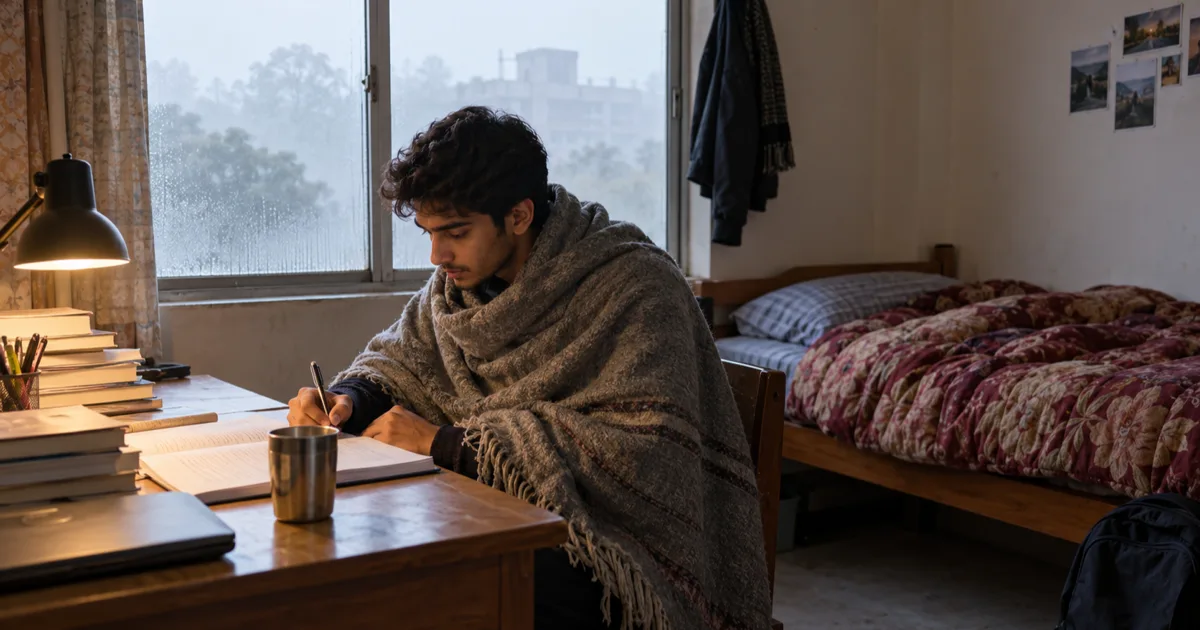
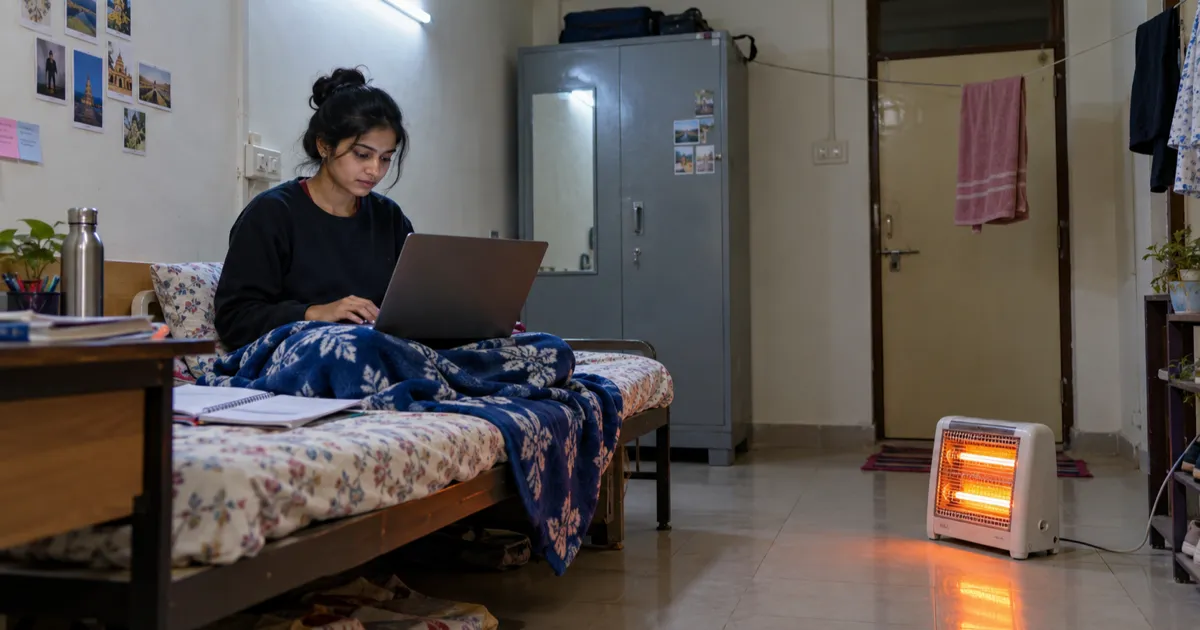
To keep a hostel room warm without a heater, stop the heat leaving before you think about adding any: block the gap under the door, shut and cover the window, and put something between you and the floor. Then warm your body and bed with layers, a cap and socks, because a cold room is far easier to live in when you are not losing heat yourself. This guide answers how to keep room warm without heater power by showing where a typical room leaks heat, which cheap fixes work, and what a heater would have cost you instead.
It's for students in hostels that ban heaters and PGs that charge extra for them. For the full season plan, from cold wave alerts to heater rules, see our winter hostel tips guide first.
| Key number | Value | Scope / data checked |
|---|---|---|
| Heat lost through a bare single-glazed window | About 111 W | 1.92 m2 window, 10°C gap, BEE Eco-Niwas Samhita values |
| Same window behind a sealed curtain (best case) | About 54 W | Calculated with BEE's still-air-layer value |
| Lowest plains minimum in IMD's 23 January 2026 release | 4.4°C at Ludhiana | IMD press release, January 2026 |
| 800W heater, 6 hours a night for 30 nights | 144 units = Rs 612 to Rs 1,015.20 | Punjab domestic rates, FY 2026-27 |
| Indoor temperature UK health agency advises | At least 18°C in rooms you use a lot | UKHSA keeping warm guidance |
Where does a hostel room lose heat in winter?
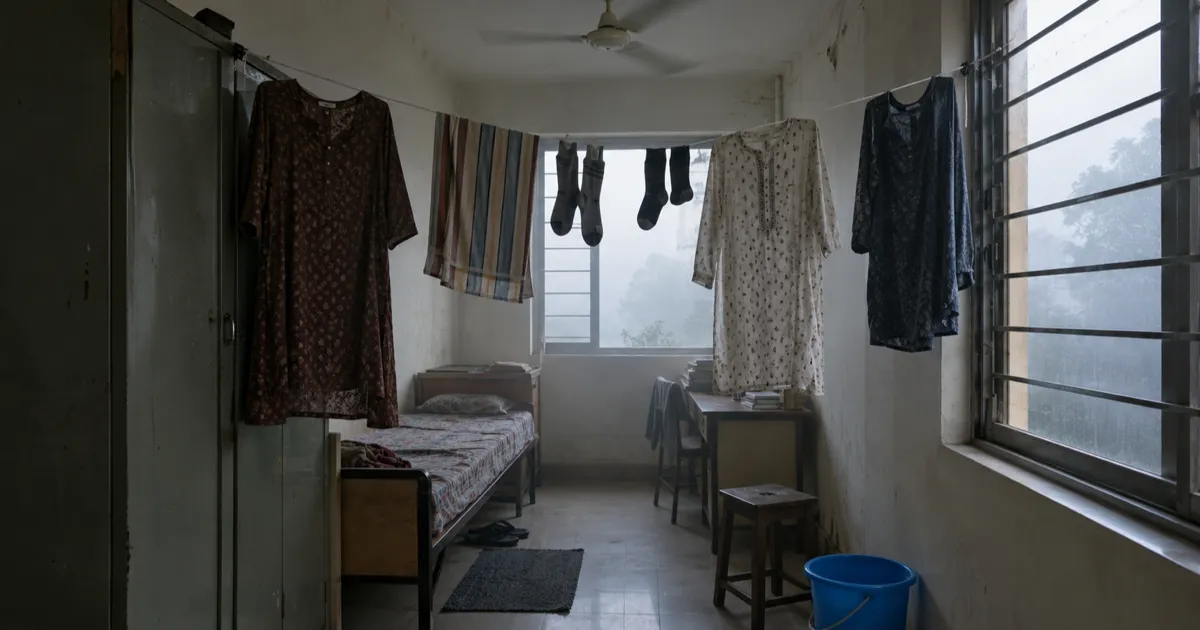
Mostly through the window, then through gaps around the door and window frame, then into a cold stone or tile floor. Single glass lets heat through about seven times faster than an AAC block wall of the same size, so one bare window can drain more warmth than a whole wall.
Engineers measure this with a U value: the watts that pass through one square metre of a wall or window for every degree of difference between inside and outside. BEE's Eco-Niwas Samhita 2024, the energy code for Indian homes, caps the walls and windows of new cold-climate buildings at 1.8 W/m2.K, because a lower figure means less heat lost and less energy spent on heating. Most hostels were built long before that code, and it shows in the windows.
Worked example: one window, one night
The worked example in BEE's Eco-Niwas Samhita 2018 uses single clear glass with a U value of 5.80 W/m2.K, a 200 mm AAC block wall at 0.78 W/m2.K, and a 1.20 m x 1.60 m window. Assume your room sits at 15°C and it's 5°C outside, a 10°C gap. That's not an extreme night: IMD's press release of 23 January 2026 reported 4.4°C at Ludhiana as the lowest minimum on the plains.
Heat loss = U x area x temperature difference
- Bare window: 5.80 x 1.92 m2 x 10 = about 111 W, all night
- Same area of AAC wall: 0.78 x 1.92 x 10 = about 15 W
- Same area at the code's cold-climate limit: 1.8 x 1.92 x 10 = about 35 W
Over a 10-hour night, that bare window lets out about 1.11 kWh of heat. Gaps under the door and around old frames add cold air on top, felt as a draught at ankle height. The floor matters less for air temperature but a lot for comfort, because feet and mattresses lose heat to it by direct contact.
How do you keep a room warm without a heater?
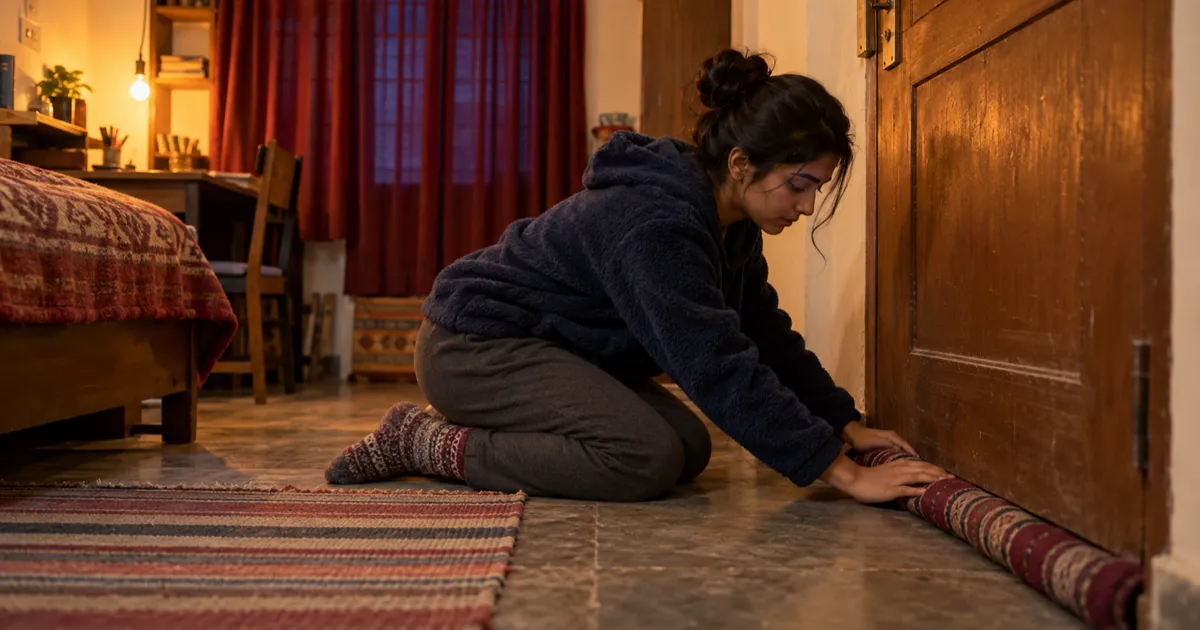
Work from the biggest leak down: close the window and cover it with a thick curtain at night, block the door gap with a draught stopper, lay a rug or mat on the floor, and move your bed away from the window wall. None of these needs electricity or a warden's permission.
The UK Health Security Agency's keeping warm guidance lists the same first steps for any cold home: cut draughts with cheap excluders around doors, and keep bedroom windows shut at night. Here's how they translate to a hostel room.
- Draught stopper for the door. A rolled towel works for a night. For the season, a fabric tube as wide as the door, filled with sand or old cloth, stays put. Add foam strip along the frame if your warden allows it.
- Curtains that cover the frame. Thick cotton or a lined curtain, hung so it overlaps the window on all sides and reaches the sill. Our ideas for privacy in a shared hostel room include tension rods and clip curtains that need no drilling.
- Open the curtains to the sun. If your window gets direct sunlight, keep the curtain open while the sun is on the glass and close it before sunset, so the heat that came in during the day stays in.
- Something on the floor. A dhurrie, yoga mat or folded blanket under your chair and beside the bed. NDMA's frostbite prevention list in its cold wave guidelines includes a plain instruction: insulate yourself from the ground.
- Move the bed. The math above shows why: sleep against an inside wall, not under the window. A layer under the mattress keeps the cold in the frame from reaching you.
- Air the room briefly, by day. A few minutes with the window open around midday clears damp, stale air. Our tips to dry clothes indoors through a hostel winter explains why wet laundry indoors makes a room feel colder.
Comparison: what each fix targets
| Fix | Heat loss it targets | What the source or our math shows | Electricity used |
|---|---|---|---|
| Thick curtain, sealed at sides and sill | Window conduction | Bare window about 111 W; curtained best case about 54 W (BEE values) | None |
| Window shut at night | Cold air entering | UKHSA advises keeping bedroom windows closed at night | None |
| Draught stopper for door | Air leaking under the door | UKHSA advises draught excluders around doors | None |
| Rug, mat or folded blanket | Contact with a cold floor | NDMA: insulate yourself from the ground | None |
| Bed on an inside wall | Radiant chill from glass | Glass loses about 7 times more than AAC wall per m2 (BEE values) | None |
The curtain figure comes from treating a sealed curtain as a still layer of air. BEE's code gives a 50 mm unventilated air layer a thermal resistance of 0.18 m2.K/W, so the window's U value becomes 1 / (1/5.80 + 0.18) = 2.84, and its heat loss 2.84 x 1.92 x 10 = about 54 W. That's a best case. A loose curtain with air flowing behind it saves far less, so the overlap at the edges matters more than the fabric. Our hostel room decoration ideas can help you pick one you'll actually want to look at all winter.
How do you stay warm in a cold room without heating?
Dress in several loose layers with a windproof outer one, cover your head, neck, hands and feet, keep moving, and eat and drink something warm often. NDMA notes that most body heat is lost through the head, neck, hands and toes, so a cap and woollen socks do more than another sweater. Our winter clothes list for North Indian hostels sets out how many of each to pack.
NDMA's guidelines add a detail worth knowing when you pull on a fourth layer: tight clothing reduces blood circulation, so loose and lightweight beats one thick, snug jumper. Its prevention list for hypothermia also asks you to wear a cap and socks, keep active, eat properly and often, and get plenty of rest. The UKHSA guidance suggests not sitting still for more than an hour or so, which suits long study sessions: stand, stretch or walk the corridor once an hour.
Bed is where a cold room hurts most. If your hostel allows them, a low-watt option such as one of the electric blankets for a single hostel bed warms you rather than the air, for a fraction of a heater's power. Students who'd rather plug in nothing can compare a hot water bag with a heating pad.
One firm rule: never burn anything in a shut room for warmth. The Delhi health directorate's cold wave public health advisory warns against burning candles or wood in closed, unventilated rooms, because of carbon monoxide poisoning. Our hostel fire and electrical safety guide covers the rest.
How much does skipping a heater save?
Between about Rs 600 and Rs 1,000 a month for an 800W heater in a Punjab PG. Run 6 hours a night for 30 nights, it uses 144 units, which costs Rs 612 at Punjab's lower domestic rate and Rs 1,015.20 at the higher one for FY 2026-27, before fixed charges and fuel surcharge.
We used Punjab because its tariff order names student housing directly. Under the PSERC Tariff Order for FY 2026-27, effective 1 April 2026, the domestic schedule covers paying guests using electricity for residential purposes and hostels attached to government and aided colleges. For a connected load above 2 kW and up to 7 kW, energy costs Rs 4.25 a unit up to 300 kWh and Rs 7.05 a unit above that. PSPCL then bills its fuel and power purchase adjustment surcharge (FPPAS) over and above these rates.
0.8 kW x 6 hours x 30 nights = 144 units
- At Rs 4.25: 144 x 4.25 = Rs 612
- At Rs 7.05: 144 x 7.05 = Rs 1,015.20
- Over a 90-night winter, December to February: 432 units, or Rs 1,836 to Rs 3,045.60
In a shared PG on one meter, other residents' use decides which rate your heater's units fall into, so plan for the higher one. Here's the same month for other heater types, using wattages from Havells' room heater range:
| Heater (setting used) | Watts | Units in 30 nights | At Rs 4.25 | At Rs 7.05 |
|---|---|---|---|---|
| Carbon, low setting (Havells Walthero) | 500 | 90 | Rs 382.50 | Rs 634.50 |
| Halogen, middle setting (Havells Inclino) | 800 | 144 | Rs 612 | Rs 1,015.20 |
| Quartz (Havells Ember) | 1200 | 216 | Rs 918 | Rs 1,522.80 |
| Blower (Havells Heat King) | 1800 | 324 | Rs 1,377 | Rs 2,284.20 |
The window math puts a rupee value on the curtain too. Over 90 ten-hour nights, the bare window loses about 100 kWh of heat, the same energy a heater would burn to replace it: Rs 426 to Rs 707 at Punjab rates. Behind a sealed curtain it's about 49 kWh, or Rs 208 to Rs 346. If you do end up needing a heater, see our picks of the best room heater for a hostel room under common wattage caps.
What should you do before the first cold night?
Learning how to keep a room warm without a heater starts with one evening in late October or early November spent finding your room's leaks. Measure the door for a draught stopper and the window for a curtain, buy or stitch both before the cold arrives, and ask the warden what you may fit.
To find the leaks, hold your hand at the bottom of the door and along the window frame, and note which wall the bed is on. Then check whether foam strips, tension rods or a rug are allowed before you buy them.
When summer comes back, the same room needs the opposite treatment, and our tips to beat the heat in a hostel room without AC reuse the curtains you hang now.