A winter clothes list for hostel life in North India should match your city's actual nights: Dehradun and Chandigarh need thermals worn day and night, while Jaipur needs lighter layers you can peel off at noon. Use IMD's December to February normals to decide, then pack 2 or 3 thermal sets and 5 pairs of woollen socks for a 90-day winter. This list covers the winter essentials for hostel life and how many of each item to bring, city by city.
It sits under our winter hostel survival guide, which covers heaters, rules and running costs. For everything that isn't winter clothing, use our general hostel packing list and the hostel room essentials checklist.
| Key number | Value | Scope / source |
|---|---|---|
| Coldest January nights of the four | Dehradun, 6.6°C normal minimum | IMD 1991-2020 normals |
| Coldest January days of the four | Chandigarh, 18.2°C normal maximum | IMD 1991-2020 normals |
| Biggest January day-night swing | Jaipur, 14.1°C (22.5 minus 8.4) | Calculated from IMD normals |
| Wettest winter | Dehradun, 114.4 mm over Dec to Feb | Sum of IMD monthly normals |
| Length of a December to February term | 90 days | 1 Dec 2026 to 28 Feb 2027 |
How cold is each city from December to February?
All four cities have January nights between 6°C and 9°C, but they differ in ways that change your bag. Dehradun is coldest at night and wettest, Chandigarh has the coldest days, Delhi sits in the middle with real cold wave spells, and Jaipur warms fastest, with February nights averaging 12.0°C.
We pulled the normal mean minimum and maximum for each winter month from the India Meteorological Department's own station records: the IMD Jaipur climatological table, the IMD Chandigarh climatological table and the IMD Dehradun climatological table, all for 1991-2020. Delhi's figures are the Safdarjung normals quoted in IMD New Delhi's monthly summaries for December 2025, January 2026 and February 2026.
| City (IMD station) | Dec min / max | Jan min / max | Feb min / max | Dec-Feb average min | Dec-Feb rain |
|---|---|---|---|---|---|
| Dehradun | 7.6 / 21.7°C | 6.6 / 19.7°C | 9.2 / 22.5°C | 7.8°C | 114.4 mm |
| Chandigarh | 8.0 / 22.1°C | 7.2 / 18.2°C | 10.4 / 22.6°C | 8.5°C | 97.4 mm |
| Delhi (Safdarjung) | 8.4 / 22.8°C | 7.5 / 20.1°C | 10.6 / 24.2°C | 8.8°C | 48.5 mm |
| Jaipur | 9.9 / 25.1°C | 8.4 / 22.5°C | 12.0 / 26.1°C | 10.1°C | 19.9 mm |
The average minimum is simply (Dec + Jan + Feb) / 3. For Dehradun that's (7.6 + 6.6 + 9.2) / 3 = 7.8°C; for Jaipur, (9.9 + 8.4 + 12.0) / 3 = 10.1°C. Here's what the numbers mean for packing:
- Dehradun vs Jaipur at night: 8.4 minus 6.6 = 1.8°C colder in January, and 12.0 minus 9.2 = 2.8°C colder in February. Dehradun stays below 10°C at night for all three months; the other three cities climb above it in February.
- Chandigarh by day: its January maximum of 18.2°C is 4.3°C below Jaipur's 22.5°C. Afternoons won't rescue you, so the sweater stays on all day.
- Jaipur's swing: 22.5 minus 8.4 = 14.1°C between a January afternoon and night, the widest of the four. That favours light, removable layers over one heavy coat.
- Rain: Dehradun averages 7.7 rainy days over the three months and Chandigarh 6.6, against 1.8 in Jaipur. Wet clothes in winter are a real problem in the first two.
Normals are averages, and single nights go lower. Chandigarh's table shows the lowest reading in an average January is 3.4°C, and Safdarjung fell to 2.9°C on 15 January 2026, during cold wave conditions on 11-15 January.
Winter clothes list for hostel, city by city
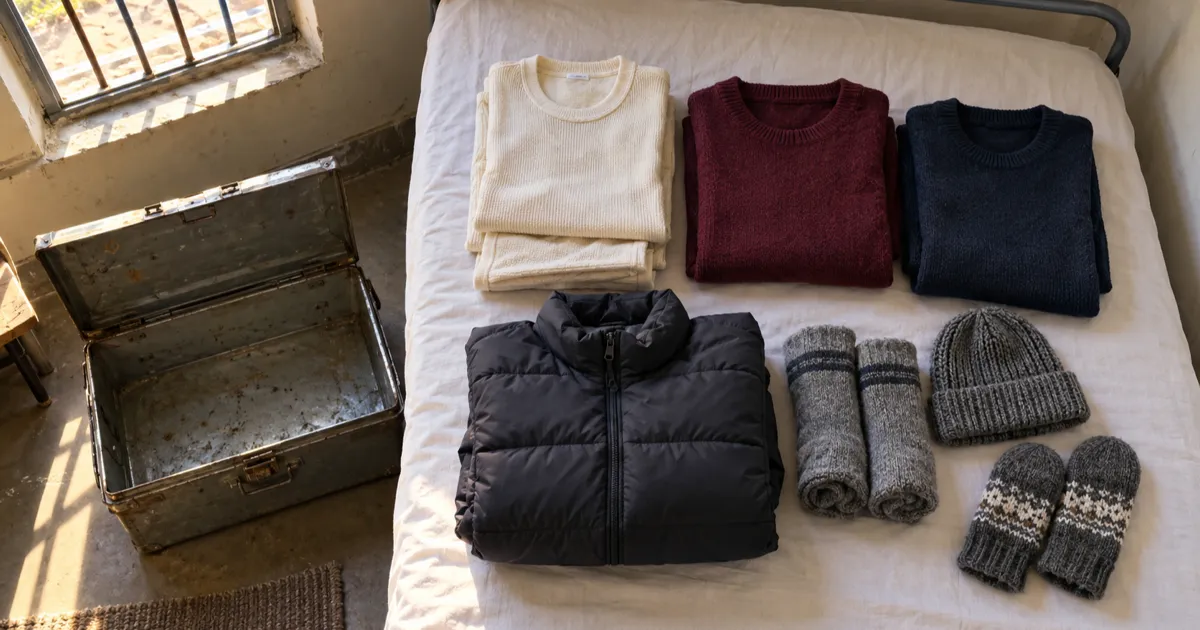
Start from one base kit that works everywhere, then add the city extras. The base kit is two thermal sets, two sweaters, one jacket, five pairs of woollen socks, a cap, a muffler and mittens. Dehradun and Chandigarh add a third thermal set and rain cover; Jaipur can drop the heavy jacket.
Every list below assumes you wash once a week. If you're choosing a neighbourhood as well, our guides to the best student areas in Delhi, student areas in Jaipur and where students live in Chandigarh help.
Dehradun: coldest nights, most rain
- 3 thermal sets (worn day and night from mid-December)
- 2 sweaters plus 1 fleece or hoodie
- 1 padded jacket with a hood, ideally water-resistant
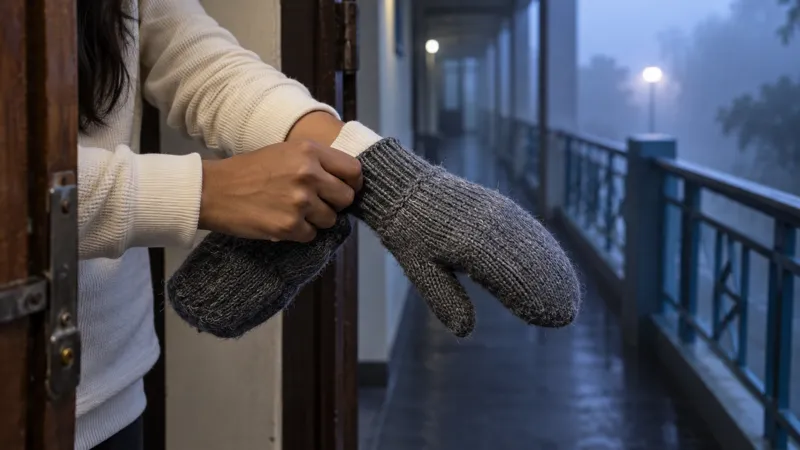
- 5 pairs of woollen socks, 1 knitted cap, 1 muffler, 1 pair of mittens
- Closed shoes plus a spare pair for wet days, and an umbrella: January brings 43.5 mm of rain and February 57.9 mm on average
Chandigarh: cold days and damp mornings
- 3 thermal sets, since an 18.2°C January afternoon won't warm you through
- 2 sweaters, 1 windproof jacket
- 5 pairs of woollen socks, 1 cap, 1 muffler, 1 pair of mittens
- 1 rain layer: the morning relative humidity in January averages 87%, and damp air makes the cold feel sharper
Delhi: middle temperatures, sharp cold wave spells
- 2 thermal sets, plus a third if you're out before 8 AM daily
- 2 sweaters, 1 padded jacket for cold wave weeks
- 5 pairs of woollen socks, 1 cap, 1 muffler, 1 pair of mittens
- 1 shawl or stole for the room, which doubles as a blanket layer
Jaipur: warm afternoons, cold nights
- 2 thermal sets, mostly for nights; with a 12.0°C February minimum, you can put them away earlier than anywhere else on this list
- 2 sweaters or 1 sweater and 1 fleece, 1 mid-weight jacket
- 4 pairs of woollen socks, 1 cap, 1 light muffler or stole
- Gloves are optional; Jaipur averages 0.6 rainy days in January, so skip the rain layer
How many thermals, sweaters and socks do you need?
Work it out from your wash cycle, not from guesswork. With one wash a week, divide 7 days by how many times you wear an item before washing, then round up. Thermal wear for students worn day and night needs 3 sets; worn only at night, 2 sets; woollen socks need 5 pairs.
The math for a 90-day winter (31 days of December, 31 of January, 28 of February):
- Thermals, day and night: 3 wears per set before washing. 7 / 3 = 2.3, so round up to 3 sets.
- Thermals, nights only: about 3.5 nights per set. 7 / 3.5 = 2 sets.
- Woollen socks: 2 wears per pair. 7 / 2 = 3.5, round up to 4, plus 1 spare for the day a pair gets soaked = 5 pairs.
- Sweaters: worn over a thermal, they rarely need a weekly wash, so 2 is enough to rotate.
Round up rather than down, because woollens dry slowly in a foggy week. Any winter clothes list for hostel that ignores the wash cycle leaves you short by the second week. Our guide to drying clothes in a hostel room in winter explains how to stop a damp thermal from holding up the whole rotation.
How should you layer on a cold wave day?
Wear several loose layers instead of one thick one, keep the outer layer dry, and cover your head, neck, hands and feet. That's the core of the NDMA and IMD cold wave advice, and it matters most when nights fall to 4°C or lower, the level at which IMD declares a cold wave in the plains.
The National Disaster Management Authority's do's and don'ts, reproduced in Punjab's 2023-24 cold wave advisory, say multiple layers help more than one, and ask people to stock enough winter clothing in advance. IMD's cold wave guidance adds two practical points: change out of wet clothes quickly, and choose mittens over gloves for warmth.
Under IMD's criteria, a plains station has a cold wave when the minimum falls to 4°C or below, or when it's at most 10°C and sits 4.5°C to 6.4°C under the normal for that date. A cold day is when the maximum is 4.5°C or more below normal too, which is when fog sits all day and the afternoon never warms up. On those days, this order works in a hostel:
- Thermal top and bottom against the skin.
- A cotton shirt or kurta, then a sweater or fleece.
- The jacket for going out, removed indoors so you don't sweat.
- Cap, muffler, mittens and woollen socks, the parts NDMA singles out.
NDMA also lists the frostbite signs to watch for: numbness and pale skin on fingers, toes, ear lobes and the nose tip. For the night, an electric blanket for a single hostel bed lets you sleep in fewer layers, and the right kit by the bed helps you get up early on winter mornings.
Before you pack
Find your city in the table above, then pack the base kit plus that city's extras from this winter clothes list for hostel before you leave home in November. Buying thermals and woollen socks locally once the first cold wave hits usually means picking from whatever is left. If your hostel is in Dehradun or Chandigarh, sort the rain layer and spare shoes first, since those are the items students most often forget.