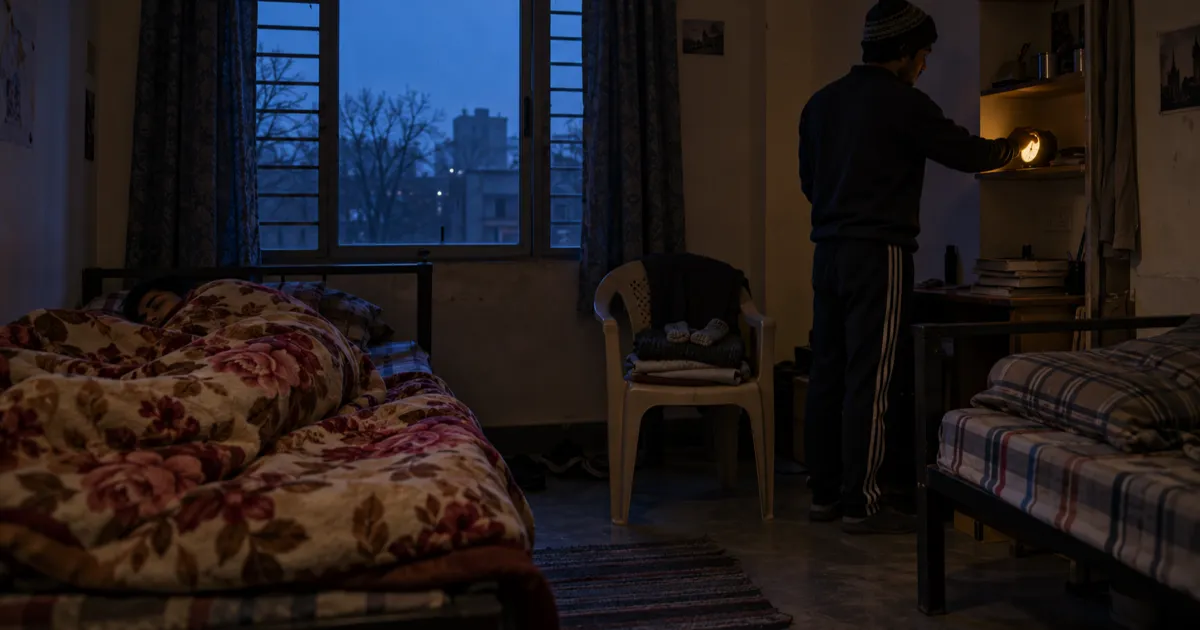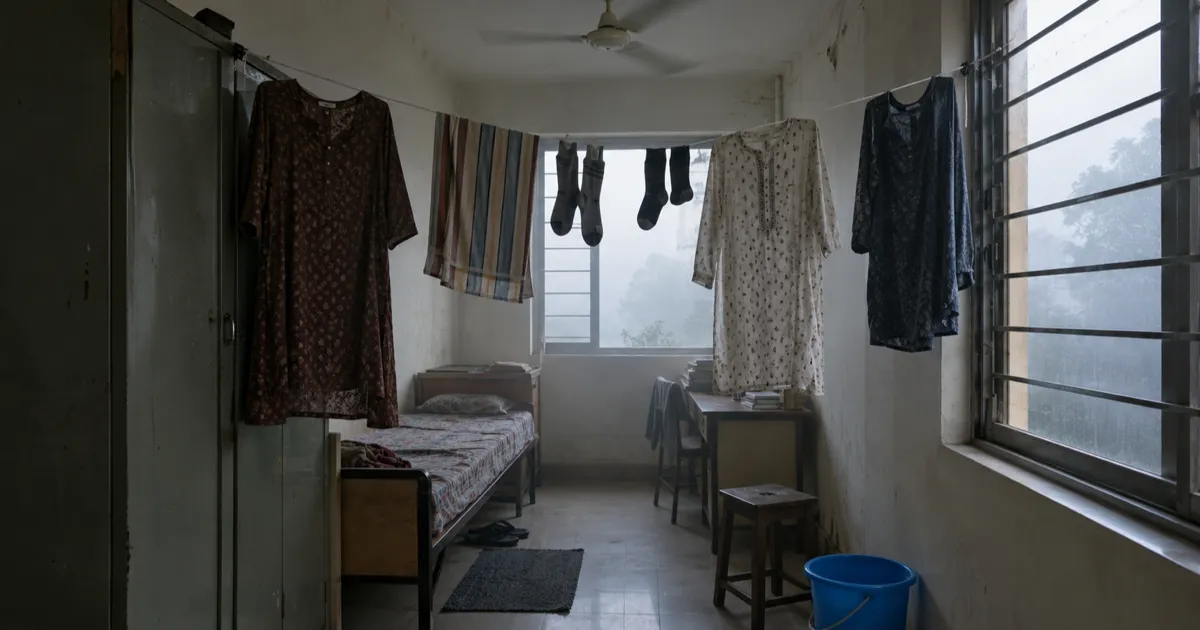
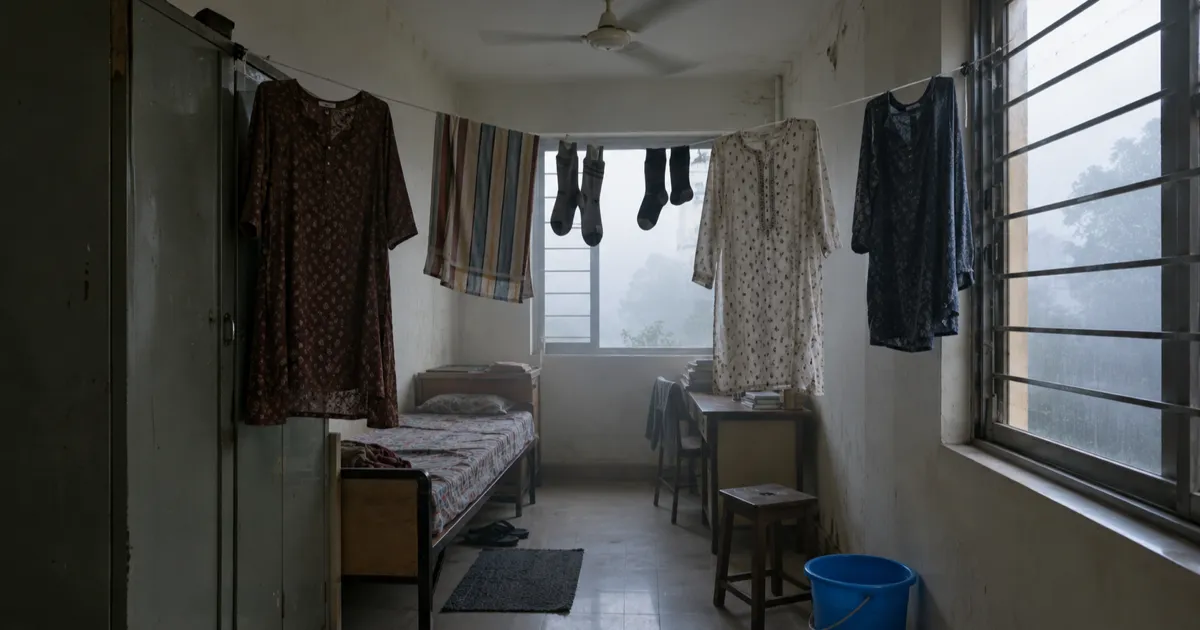
To dry clothes in winter in a hostel room, get as much water out before you hang them, spread them so air reaches every side, and keep air moving past them with a fan. Then use the short dry window in the afternoon, when humidity drops, for anything thick. This guide on how to dry clothes in winter explains why North Indian winters make drying so slow, works out what a fan and a better spin actually do, and covers the sour smell that slow drying leaves behind.
It is part of our winter hostel survival guide, and it starts where washing ends. For detergent, buckets and wash schedules, read our hostel laundry tips for students first.
| Key number | Value | Scope / data checked |
|---|---|---|
| Fog days in Lucknow | 8.5 in December, 9.1 in January | IMD Lucknow, 1981-2010 average |
| Morning humidity in a Lucknow winter | About 85-90% at 8 AM | IMD Lucknow, winter season normals |
| Water left after spin, full load | 53% at 1200 rpm, 50.5% at 1351 rpm | Bosch product sheets, 2022 and 2025 |
| Water left after spin, half load | 38% at 1200 rpm, 27% at 1351 rpm | Bosch product sheets, 2022 and 2025 |
| 32W BLDC fan, 8 hours | 0.256 units = Rs 0.93 to Rs 1.83 a night | Uttarakhand domestic slabs, FY 2026-27 |
Why do clothes take so long to dry in winter?
Because the air is already close to full of water and barely moves. In a Lucknow winter, IMD records humidity above 90% at its daily peak, weak night winds of 4 to 7 km/h, and about nine fog days a month in December and January. Cold, damp, still air pulls moisture out of fabric very slowly.
Lucknow is a fair stand-in for the Indo-Gangetic plain, and the IMD Meteorological Centre Lucknow's climatology lays the problem out clearly. Daily maximum relative humidity stays above 90% through December, January and the first half of February. At 8 AM it is usually around 85-90%. The city averages 8.5 fog days in December and 9.1 in January, and the same report notes that fog lasting many hours is common from 15 December to 20 January.
January in Lucknow also averages 7.5°C at night against 22.5°C by day, per the same IMD tables, and cold air saturates quickly. A shirt hung at 9 PM spends the night in air that can hardly take more moisture.
There is good news in the same data. IMD notes that the sun is often out in the afternoons on most winter days. Humidity falls sharply between 8 AM and 1 PM and keeps easing until about 4 PM, and the wind picks up after 9 AM, peaking at 12 to 14 km/h around 2 to 3 PM for most of the season. That afternoon window is when thick things should be outside.
How to dry clothes in winter in a hostel room
Treat it as an airflow problem. Squeeze or spin out as much water as possible, hang every piece with a gap around it, put the line where the fan or a cross-draught reaches it, and move thick items outside for the afternoon. Thin clothes can stay inside overnight; towels and jeans need the midday window.
- Get the water out first. If you hand-wash, roll heavy items in a dry towel and press before wringing. In a machine, use the highest spin your clothes can take.
- Give every piece space. Clothes that touch trap a wet layer between them. Use hangers for shirts and turn jeans and hoodies inside out.
- Put the line where air moves. Directly under the ceiling fan, not in the corner behind the almirah.
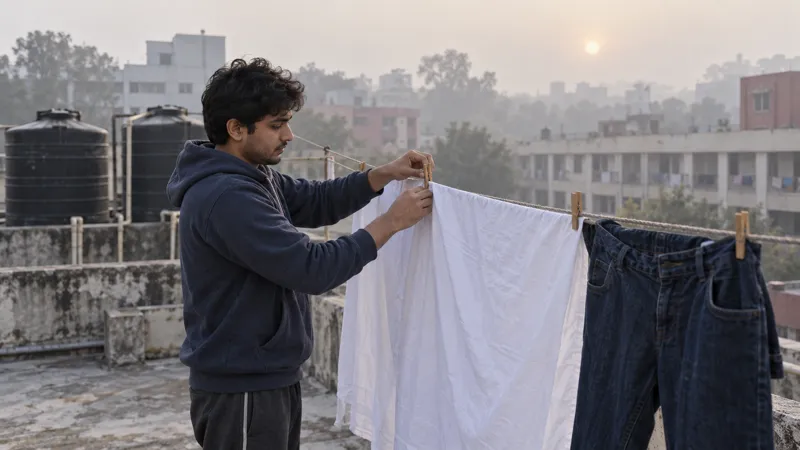
- Split by thickness. Socks, vests and cotton tops can dry indoors under a fan. Towels, jeans, sweatshirts and bedsheets go to the terrace or balcony between late morning and about 3 PM, then come in before the evening damp sets in.
- Wash smaller loads, more often, and dry sweaters flat. Our winter clothes list for North Indian hostels helps you pack enough spares that one slow-drying set never leaves you short.
Two things not to do. Never hang wet clothes on or right next to a room heater: fabric can scorch or catch fire. Many hostels also limit heaters tightly; IIT Mandi's hostel rules allow only one heater of up to 800W per room, on payment, and rule 10.25 bans electric irons outright, so you cannot rely on ironing collars dry either. Our hostel fire and electrical safety guide covers heater placement in detail.
An open window speeds drying but chills the room, so open it only in the warm afternoon hours. Our guide on how to keep a hostel room warm without a heater shows which gaps to seal and which to leave alone.
Does a faster spin or a fan really help?
Load size matters more than spin speed. Bosch's datasheets show a full load keeps 53% of its dry weight in water at 1200 rpm and 50.5% at 1351 rpm, but half loads keep only 38% and 27%. A ceiling fan helps most, and a 32W BLDC fan running all night costs under Rs 2.
Worked example: water left in the clothes
Washing machine makers selling in Europe have to publish "remaining moisture content": the water left in the load after the final spin, as a percentage of the clothes' dry weight. Two Bosch machines show the effect. The 7 kg Bosch WAJ24006GB spins at 1200 rpm and the 9 kg Bosch WGG04409GB spins at 1351 rpm. Taking 1 kg of water as 1 litre:
| Machine and spin | Load | Remaining moisture | Water left in the load |
|---|---|---|---|
| WAJ24006GB, 1200 rpm | Full, 7 kg | 53% | 7 x 0.53 = 3.71 L |
| WAJ24006GB, 1200 rpm | Half, 3.5 kg | 38% | 3.5 x 0.38 = 1.33 L |
| WGG04409GB, 1351 rpm | Full, 9 kg | 50.5% | 9 x 0.505 = 4.545 L |
| WGG04409GB, 1351 rpm | Half, 4.5 kg | 27% | 4.5 x 0.27 = 1.215 L |
Per kg of dry clothes, the extra 151 rpm saves only 0.53 - 0.505 = 0.025 L, about 25 ml, on a full load. These are two different machines, so treat it as a rough guide, but the pattern is clear. Dropping to a half load saves 0.53 - 0.38 = 0.15 L per kg on the slower machine. If you share a machine or use a laundry room, do not stuff the drum in winter. A portable or semi-automatic machine with a separate spin tub can also help; our list of the best portable washing machines for a hostel compares them.
Worked example: what a fan costs to run
Moving air carries the damp layer away from the fabric, so a fan is the cheapest drying tool in the room. Using manufacturer ratings for two Havells 1200 mm ceiling fans, the Supro HS BLDC at 32W and the Enticer HS induction fan at 48W, running 8 hours a night:
- 32W fan: 0.032 kW x 8 hours = 0.256 units a night, or 7.68 units over 30 nights
- 48W fan: 0.048 kW x 8 hours = 0.384 units a night, or 11.52 units over 30 nights
Under Uttarakhand's FY 2026-27 domestic tariff, energy costs Rs 3.65 a unit in the first slab and Rs 7.15 in the 201-400 unit slab. So the 32W fan costs 0.256 x Rs 3.65 = Rs 0.93 to 0.256 x Rs 7.15 = Rs 1.83 a night, or Rs 28.03 to Rs 54.91 for a month of nights. The 48W fan costs Rs 1.40 to Rs 2.75 a night, or Rs 42.05 to Rs 82.37 a month. For comparison, an 800W heater run for just 2 hours uses 1.6 units, which is 6.25 times what the BLDC fan uses all night.
Comparison: drying methods for a hostel room
| Method | What the numbers say | Energy cost | Hostel fit |
|---|---|---|---|
| Terrace or balcony, 10 AM to 3 PM | Humidity falls sharply 8 AM to 1 PM; wind peaks at 12-14 km/h around 2-3 PM (IMD Lucknow) | Rs 0 | Best for towels, jeans and bedsheets |
| Indoors, still air, overnight | Morning humidity about 85-90%; night wind 4-7 km/h outside (IMD Lucknow) | Rs 0 | Slowest; highest smell risk |
| Indoors under a 32W BLDC fan, 8 hours | 0.256 units a night | Rs 0.93 to Rs 1.83 a night | Good for thin clothes |
| Indoors under a 48W induction fan, 8 hours | 0.384 units a night | Rs 1.40 to Rs 2.75 a night | Good for thin clothes |
| Half load instead of full load | Remaining moisture 27-38% instead of 50.5-53% (Bosch) | An extra wash cycle | Works wherever you use a machine |
| Next to an 800W heater, 2 hours | 1.6 units | Rs 5.84 to Rs 11.44 | Avoid: fire risk and hostel rules |
Why do clothes smell after drying indoors?
The sour, wet-cloth smell comes from bacteria, not from the water itself. A 2012 study traced it to Moraxella osloensis, which produces 4-methyl-3-hexenoic acid in laundry hung to dry indoors. The longer clothes stay damp, the longer the bacteria have to work, so faster drying is the main fix.
Researchers writing in Applied and Environmental Microbiology (Kubota and colleagues, 2012) studied this exact complaint among people in Japan who hang laundry indoors. They identified 4-methyl-3-hexenoic acid as the main source of the "wet-and-dirty-dustcloth" or sweaty odour and traced it to Moraxella osloensis. The bacterium also tolerated drying and UV light well, which is one reason a sunny afternoon alone does not always clear the smell.
In practice:
- Hang clothes as soon as the wash ends; never leave a wet bundle in a bucket overnight.
- If something smells after drying, wash it again rather than spraying it.
- Fold clothes into the almirah only when fully dry.
Monsoon brings the same problem with warmer air, and the drying habits in our monsoon hostel survival tips carry straight over to the foggy weeks of December and January.
Set up your drying corner this week
Before the fog season arrives in mid-December, fix a line under your ceiling fan, buy a dozen plastic hangers and a pack of pegs, and find out whether your hostel lets students use the terrace and at what hours. Ask the warden in writing if you can run the fan through the night in winter, and whether the laundry room allows half loads. Then shift your wash day to the morning, so thick clothes catch the afternoon sun the same day. Spin hard, space it out, keep the air moving, and use the afternoon: that is most of how to dry clothes in winter when you share a small room.