An immersion rod for hostel use is safe only when your hostel allows it, the rod carries the ISI mark, and you follow one strict order: water first, plug last, switch off before your hand goes near the bucket. A 1000W to 1500W rod takes at least 17 to 26 minutes to warm a 15-litre bucket and costs roughly Rs 2.40 a bath at Uttar Pradesh's domestic tariff. This guide covers the rules, the safe steps, the real numbers and which rods to look at.
Hot water is one part of getting through the cold months. For heating, clothing and the rest, start with our winter hostel survival guide.
| Key number | Value | Scope / data checked |
|---|---|---|
| Typical immersion rod ratings | 1000W and 1500W | Havells, Bajaj, Crompton, V-Guard product pages, October 2026 |
| Energy to warm 15 litres by 25°C | 0.436 units (kWh) | Calculation, water's specific heat 4186 J/kg K per NCERT |
| Minimum time for that bucket | About 26 minutes at 1000W, 17 minutes at 1500W | Calculation, no heat loss |
| Cost of 30 baths a month | Rs 71.94 to Rs 85.02 | UP urban domestic slabs, FY 2026-27, energy charge only |
| BIS standard for immersion rods | IS 302 (Part 2/Sec 201), compulsory | BIS Scheme-I list, October 2026 |
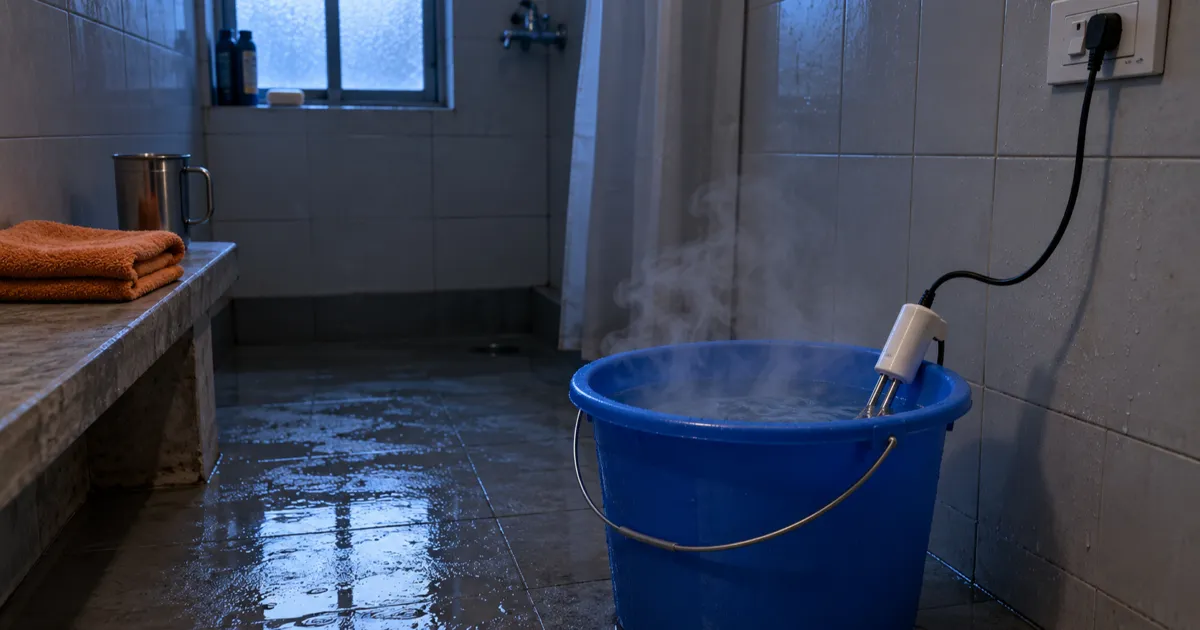
Is an immersion rod for hostel rooms allowed?
In most college hostels, no. Immersion rods sit on the banned list alongside irons and cooking appliances because they draw a lot of current and are easy to misuse. Some hostels fine you, others simply confiscate the rod. Private PGs set their own rules, so the only safe answer is the one your warden or owner gives you in writing.
Three written rule books show how firmly colleges treat them:
- IIT Mandi strictly forbids immersion heaters under rule 10.25 of its hostel rules dated 1 August 2024. Any found are confiscated and the student is fined. The same rule book caps permitted room heaters at 800W (rule 5.3), and even the smallest common rod, at 1000W, is above that figure.
- CSJM University, Kanpur restricts students' own heaters, presses and immersion rods under rule 17 of its general hostel rules, and confiscates any it finds.
- Gangadhar Meher University, Sambalpur strictly prohibits heaters, induction cookers and immersion rods inside its hostels (rule 11).
The reason is load. A 1500W rod at 230V pulls about 6.5 amps (1500 ÷ 230), and several on one wing at 7 AM strain old wiring. Our hostel fire and electrical safety guide covers sockets and extension boards, and our list of appliances allowed in hostel rooms covers kettles, irons and induction plates.
How do you use an immersion rod safely, step by step?
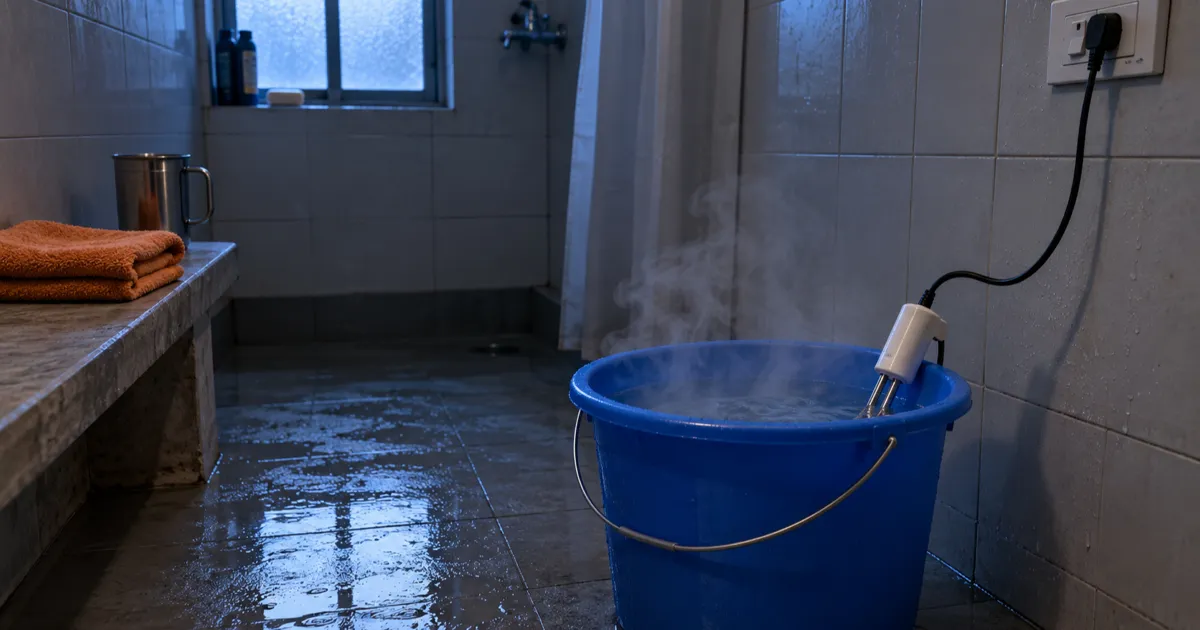
Fill the bucket, lower the rod in until the water is above its marked level, hook it on the rim, and only then plug in and switch on. Stay nearby. When the water is warm, switch off at the socket, pull the plug, wait a few seconds and lift the rod out. Never touch the water while it is live.
This is the sequence Bajaj Electricals' usage guide sets out, and Orient Electric's safety guide gives the same core order:
- Water first. Fill the bucket about three-quarters full before the rod goes anywhere near it.
- Check the mark. Lower the rod by its handle until the water covers the element and sits above the level line on the neck, but well below the handle. Crompton's immersion rod page explains that this marking exists to stop the element overheating in air.
- Hook it. Hang the rod on the rim so the hot element doesn't rest against the bucket's wall or base.
- Plug in last. Use a properly earthed three-pin socket; Orient adds that one protected by an ELCB or RCCB is better.
- Don't wander off. Bajaj points out that most rods have no thermostat, so nothing stops the heating. Don't sleep, shower or leave the floor while it runs. A phone timer helps.
- Switch off, unplug, then lift. Socket switch off first, plug out second, rod out third. Give it a few seconds, because the element stays very hot.
- Store it dry. Wipe it and hang it up. In hard-water cities, Orient suggests soaking the element in equal parts water and white vinegar for 30 minutes to clear scale.
Makers disagree on the bucket. Bajaj recommends plastic because a steel bucket becomes live if the rod's insulation fails; Orient warns that heat can deform plastic. Use the container your rod's manual names, keep the element off its sides, and never touch the bucket while the rod is on. If the water ever gives you a tingle, stop using that rod.
How long does an immersion rod take, and what does a bath cost?
Warming a 15-litre bucket from 15°C to 40°C needs 0.436 units of electricity, whatever rod you use. A 1500W rod does it in about 17 minutes at best, a 1000W rod in about 26. At Uttar Pradesh's FY 2026-27 urban domestic rate of Rs 5.50 a unit, that's about Rs 2.40 a bath.
The energy in one bucket
Heat needed = mass x specific heat x temperature rise. Take a 15-litre bath (about 15 kg of water), a cold winter tap at 15°C and a comfortable 40°C, so a 25°C rise. Water's specific heat is 4186 J per kg per kelvin, per NCERT's Class 11 physics text:
15 kg x 4186 J/kg°C x 25°C = 1,569,750 J = 0.436 kWh (units)
Time is energy divided by power:
- 1000W rod (such as the Havells Zeta): 1,569,750 ÷ 1000 = 1,570 seconds, about 26 minutes
- 1500W rod (such as Bajaj's 1.5 kW model): 1,569,750 ÷ 1500 = 1,047 seconds, about 17 minutes
Those are minimums: an open bucket in a cold bathroom keeps losing heat, so expect longer in January. A higher wattage doesn't use less electricity; it only finishes sooner and pulls more current.
The cost of a month of baths
Thirty baths is 0.436 x 30 = 13.08 units. Under the UPERC-approved rate schedule for FY 2026-27, published by UPPCL, urban metered domestic consumers in Uttar Pradesh pay Rs 5.50 a unit up to 150 units, Rs 6.00 for 151-300 and Rs 6.50 above 300. A PG billed as non-domestic (load up to 4 kW) pays Rs 7.50 a unit up to 300 units.
| UP rate (FY 2026-27) | Per bath (0.436 units) | 30 baths (13.08 units) |
|---|---|---|
| Rs 5.50 (domestic, up to 150 units) | Rs 2.40 | Rs 71.94 |
| Rs 6.00 (domestic, 151-300 units) | Rs 2.62 | Rs 78.48 |
| Rs 6.50 (domestic, above 300 units) | Rs 2.83 | Rs 85.02 |
| Rs 7.50 (non-domestic, up to 4 kW load) | Rs 3.27 | Rs 98.10 |
These are energy charges only, before UP's fixed charge of Rs 110 per kW a month. Two roommates sharing one rod double it: 26.16 units, or Rs 143.88 at Rs 5.50. Which slab you land in depends on everything else on the meter, which in a shared PG is a lot.
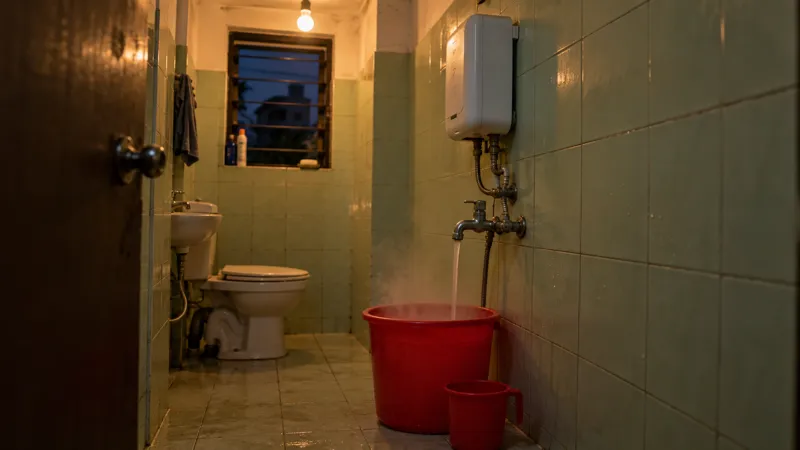
Immersion rod vs bucket heater vs geyser: which is better?
A bucket heater is usually just an immersion rod sold with a bucket hook, so treat the two as the same thing. The real choice is rod versus geyser. Every option needs the same energy to warm the same water; the differences are speed, peak current, plumbing and whether your hostel allows it.
V-Guard, for example, lists its 1500W rod as an "immersion water heater rod for bucket heating". Here is the minimum time to warm the same 15-litre bucket by 25°C at each maker's rated wattage:
| Type (maker's example) | Rated watts | Minimum time, 15 L | Energy per bath | Needs plumbing? | Fits an 800W cap? |
|---|---|---|---|---|---|
| Immersion rod (Havells Zella) | 1000 | About 26 min | 0.436 units | No | No |
| Immersion rod / bucket heater (V-Guard EIMH 150) | 1500 | About 17 min | 0.436 units | No | No |
| 15 L storage geyser (V-Guard Divino) | 2000 | About 13 min | 0.436 units plus standing losses | Yes, wall-mounted | No |
| 3 L instant geyser (V-Guard Zio) | 3000 | About 9 min | 0.436 units | Yes, wall-mounted | No |
Geyser times assume all 15 litres heat at full power; a 3-litre instant unit actually heats small batches as you draw water. The energy column is the point: no appliance makes a bath cheaper. A working common-bathroom geyser is wired in and fixed in place, so if your hostel has one, use it and skip the rod. For hot water without a geyser, a kettle is sometimes tolerated where rods are not; see our guide to electric kettles and cooking appliances for hostel. For warmth in bed, a hot water bag or heating pad draws far less, and our pick of low-watt room heaters for a hostel room covers the room itself.
Which immersion rod should a hostel student buy?
Buy only an ISI-marked rod from a brand that states the mark on its own product page, because immersion water heaters fall under compulsory BIS certification. A 1000W rod is slower but draws less current, and models with auto cut-off add a safety margin that most basic rods lack.
The Bureau of Indian Standards makes certification compulsory for electric immersion water heaters under IS 302 Part 2/Sec 201, and its domestic water heating order of March 2024 also covers instant and storage geysers. These four state the ISI mark or BIS certification on the makers' own pages, checked October 2026:
| Rod | Wattage | Maker's page lists | Hostel-rule fit |
|---|---|---|---|
| Havells Zella | 1000W | ISI marked, automatic cut off, temperature knob, heating indicator | Over an 800W cap; only where rods are allowed |
| Havells Zeta | 1000W | ISI Mark, water level indicator, 3-pin moulded plug | Over an 800W cap; only where rods are allowed |
| Bajaj Water proof Immersion Rod | 1000W or 1500W | BIS approved ISI marking, waterproof sealed terminals | Pick the 1 kW version if you have a choice |
| V-Guard EIMH 150 | 1500W | BIS certified, auto cut-off, shock protection | Highest draw here; check the PG's wiring first |
Check with your warden before you buy any of them. A rod allowed in one PG can be confiscated in the next hostel.
Before you plug one in
Ask the warden or PG owner one direct question: are immersion rods allowed, and if so, in rooms or only in bathrooms? If the answer is no, find out when the common geyser runs and plan your bath around it. If the answer is yes, the sensible immersion rod for hostel use is a 1000W ISI-marked model with auto cut-off. Set a phone timer every time, and read the socket and extension board advice in our electrical safety guide for hostels before the first cold morning.