Yes, you can file a consumer complaint against PG or private hostel owners when they take your money but do not deliver the promised food, Wi-Fi, cleaning or other facilities. Start with the National Consumer Helpline on 1915, then file at the District Commission on e-Jagriti, with nil fee up to Rs 5 lakh paid. This guide shows how to frame it, what it costs and how long you have.
If you are still deciding between the police, the municipal corporation and a consumer forum, read our overview of where to file a PG or hostel complaint in India first. This post covers the consumer route only, and only for service failures. A withheld security deposit is a separate fight with its own tactics, set out in our guide on what to do when a PG owner keeps your deposit.
| Key number | Value | Scope / data checked |
|---|---|---|
| National Consumer Helpline | 1915, 8 AM to 8 PM; WhatsApp 8800001915 | consumerhelpline.gov.in, October 2026 |
| NCH redressal window | 45 days | Department of Consumer Affairs review, January 2026 |
| Filing fee, District Commission | Nil up to Rs 5 lakh paid | Rule 7(2) fee table, amended 17 August 2023 |
| District Commission limit | Up to Rs 50 lakh paid as consideration | Jurisdiction Rules, 30 December 2021 |
| Time limit to file | 2 years from the cause of action | Consumer Protection Act, 2019, section 69 |
What counts as deficiency of service in a PG or hostel?
Any gap between what you paid for and what you get. The Consumer Protection Act, 2019 names boarding and lodging as a service, and defines deficiency as a shortfall in the quality or manner of a service the provider undertook to perform under a contract. Promised meals, Wi-Fi, laundry, housekeeping or hot water that stop arriving all qualify.
Three definitions in the Consumer Protection Act, 2019 (Gazette of India) do the work here:
- Section 2(42), service: includes "boarding or lodging or both". A paying-guest arrangement sits squarely inside it.
- Section 2(11), deficiency: any fault, shortcoming or inadequacy in a service that the provider has undertaken to perform "in pursuance of a contract or otherwise". Deliberately withholding relevant information also counts.
- Section 2(7), consumer: covers the person who pays and any beneficiary who uses the service with that person's approval. If your parent pays the rent, you can still complain as the resident.
Typical cases: "three meals a day" that quietly drops dinner, advertised Wi-Fi dead for weeks, a promised AC that never worked, or housekeeping that stopped after the first month. If the complaint is about stale or unsafe food rather than missing meals, the food safety route can run alongside this one, as explained in our guide to a PG or hostel food quality complaint with FSSAI.
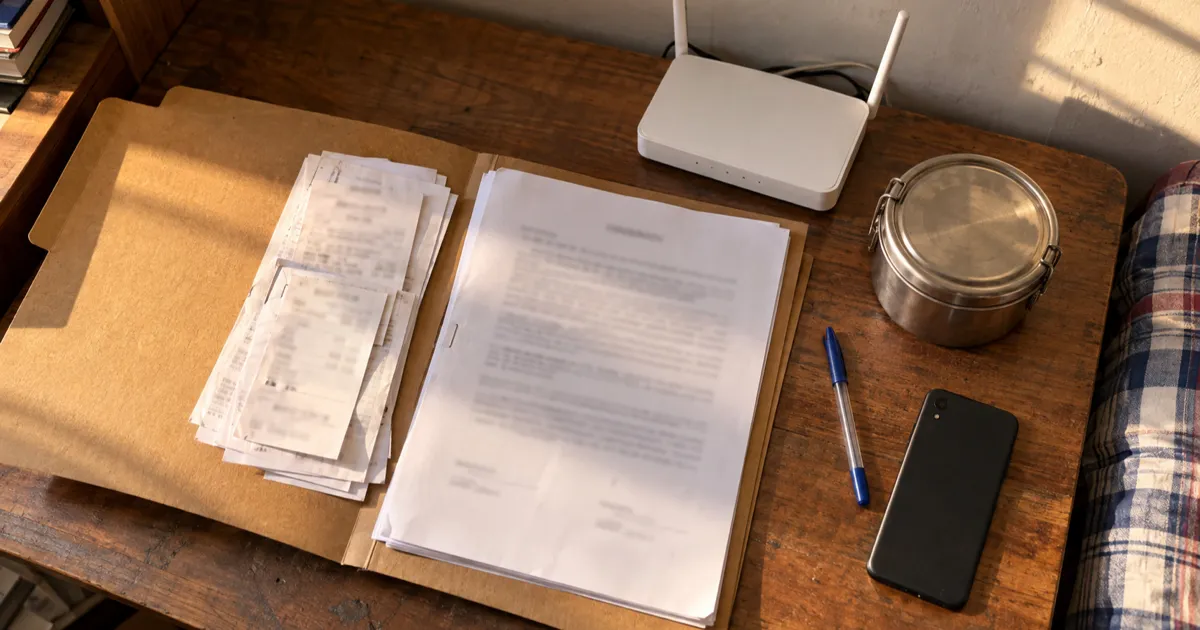
Collect this before you complain to anyone:
- The listing, brochure or WhatsApp message that promised the facility (screenshot with the date visible)
- Your agreement, or any message confirming the monthly charge and what it includes
- Rent receipts, UPI or bank statements showing what you paid and when
- Dated photos or short videos of the problem, taken on more than one day
- Your own written requests to the owner or manager, and any replies
- Names of other residents willing to confirm the same failure
NCH 1915 or the consumer commission: which route fits?
Use the National Consumer Helpline first when the owner might fix things after a nudge; it is free, quick to file and aims to resolve grievances within 45 days. Go to the District Commission when you want a binding order for a refund or compensation, because the helpline mediates but cannot force an owner to pay.
The helpline is described in the Department of Consumer Affairs' 2025 year-end review on PIB as a pre-litigation service: it says grievances are redressed within 45 days, and that consumers whose complaints stay unresolved are encouraged to approach the Consumer Commission. Here is how the options line up for a PG service dispute:
| Route | Best for | Filing method | Fee | Time limit |
|---|---|---|---|---|
| The PG owner (written complaint, then legal notice) | Fixing the facility, a partial refund, a written record | WhatsApp or email, then a notice by registered post | Nil, or a lawyer's fee for a formal notice | No legal deadline; give a short written period, such as 15 days |
| National Consumer Helpline | Mediation before litigation; no power to order payment | Call 1915 (8 AM to 8 PM), WhatsApp or SMS 8800001915, the NCH app, UMANG or consumerhelpline.gov.in | Nil | Grievances redressed within 45 days (PIB review, 2026) |
| District Consumer Commission via e-Jagriti | Binding orders: refund of charges, compensation, removal of deficiency | Online at e-jagriti.gov.in, in the district where you live or work | Nil up to Rs 5 lakh paid | File within 2 years; admission decided in 21 days; target decision 3 months after notice to the owner |
| State Consumer Commission (appeal) | Appeals against a District Commission order | e-Jagriti | Check the appeal fee on e-Jagriti | 45 days from the District Commission order |
The 21-day, 3-month and 45-day figures come from sections 36, 38(7) and 41 of the Act. The 3-month figure is only a target the commission must "endeavour" to meet.
How to file a consumer complaint against PG owners online
Put your complaint to the owner in writing, send a legal notice if that fails, register a grievance with NCH, then file the consumer complaint on e-Jagriti at the District Commission for your area. For a typical PG claim there is no court fee, no lawyer is required, and you have two years from when the service failed.
- Write to the owner. List each missing facility, the date it stopped, what the listing or agreement promised, and what you want: repair by a date, a rent reduction, or a refund for the months affected. Keep it short and factual.
- Send a legal notice. The Act does not require one, but a notice by registered post with acknowledgement due shows the commission you gave the owner a fair chance. It can be your own signed letter; a lawyer's letterhead is optional.
- Register with the National Consumer Helpline. Call 1915 or use the NCH portal or app and note the docket number. If you register on 20 October 2026, the 45-day window runs to 4 December 2026 (11 days left in October, 30 in November, 4 in December).
- Register on e-Jagriti. The PIB review confirms that e-Jagriti, launched on 1 January 2025, absorbed e-Daakhil and the older CONFONET system, and uses OTP-based registration. So a search for an "e-Daakhil complaint against PG" now ends at e-jagriti.gov.in.
- Choose the District Commission. Section 34(2)(d) lets you file where you reside or personally work for gain, so a student who has moved home after leaving the PG can usually file there.
- Draft and upload. State the facts in date order, the deficiency, the amount you paid, and the relief: refund of charges for the affected period, compensation, and costs. Attach the evidence list above as numbered annexures and your NCH docket number.
- Pay the fee, if any, and track the case. For almost every PG claim the fee is nil (worked out below). e-Jagriti supports virtual hearings and digital document exchange; note each hearing date.
Working out the fee and the right commission
Both the fee and the forum depend on the value of the service "paid as consideration", not on the compensation you ask for. Take a sample case: rent of Rs 11,500 a month, with Wi-Fi and dinner missing for the last 10 months.
Rs 11,500 x 10 months = Rs 1,15,000 paid as consideration
- Fee: the 2023 amendment to rule 7(2), G.S.R. 606(E), sets the fee at nil up to Rs 5 lakh, Rs 200 above Rs 5 lakh up to Rs 10 lakh, Rs 400 up to Rs 20 lakh and Rs 1,000 up to Rs 50 lakh. Rs 1,15,000 is in the nil slab. At this rent you would need Rs 5,00,000 ÷ Rs 11,500 = 43.5 months of payments before any fee applied.
- Forum: the Consumer Protection Jurisdiction Rules, 2021 (G.S.R. 912(E)) give the District Commission every complaint up to Rs 50 lakh paid. Rs 1,15,000 is well inside it.
Counting the two-year limit
Section 69 bars a complaint filed more than two years after "the date on which the cause of action has arisen". Suppose the mess stopped serving dinner on 3 February 2026 and the owner refused to restore it:
3 February 2026 + 2 years = 3 February 2028
Do not plan to file near that edge. Under section 69(2), a late complaint is heard only if you show sufficient cause and the commission records reasons for condoning the delay.
If you win, section 39 lets the commission order a refund of charges with interest, compensation and removal of the deficiency. An owner who ignores the order faces section 72: imprisonment of one month to three years, a fine of Rs 25,000 to Rs 1,00,000, or both.
Can a PG owner raise the rent in the middle of your stay?
Not against the terms you agreed. If your agreement or booking message fixes the rent for a period, a mid-stay increase is a change the owner cannot make alone; challenge it as a deficiency or as an unfair contract term under the Consumer Protection Act. If nothing in writing fixes the rent, your position is much weaker.
Section 2(46) of the Consumer Protection Act, 2019 treats as unfair a contract term that imposes "any unreasonable charge, obligation or condition" on the consumer, or lets one party end the contract unilaterally without reasonable cause. A sudden hike paired with "pay or leave" can touch both.
Work out what is at stake. Say your 11-month agreement fixes rent at Rs 9,000 and, with 5 months left, the owner announces Rs 10,500:
Rs 10,500 minus Rs 9,000 = Rs 1,500 a month (16.7 per cent); Rs 1,500 x 5 months = Rs 7,500
That Rs 7,500 is the amount you would claim back. Practical steps:
- Reply in writing that the agreed rent is Rs 9,000 until the term ends, and quote the clause or message.
- If you pay the higher amount to avoid trouble, write "paid under protest" in the UPI note or a same-day message, and get a receipt for each month. Our guide to getting proper PG rent receipts explains what a valid receipt shows.
- Before your next PG, check the rent revision clause using our PG rental agreement checklist.
- If the owner threatens to lock you out over the hike, that is a different emergency; see what to do when you are evicted from a PG without notice.
Your next move this week
Pick the single clearest failure, gather the proof for it, and send the owner a dated written complaint today. If nothing changes in two weeks, register on NCH and keep the docket number; if the helpline window passes without a fix, your consumer complaint against PG management goes on e-Jagriti with that docket attached. Students in a college-run hostel usually have an internal grievance route to try first, covered in our guide to a complaint against a hostel warden or college. Treat this guide as a starting point and not as legal advice: if your claim is large or the owner contests it, a lawyer or your district legal services authority (reachable on NALSA's toll-free helpline 15100) can review your papers.