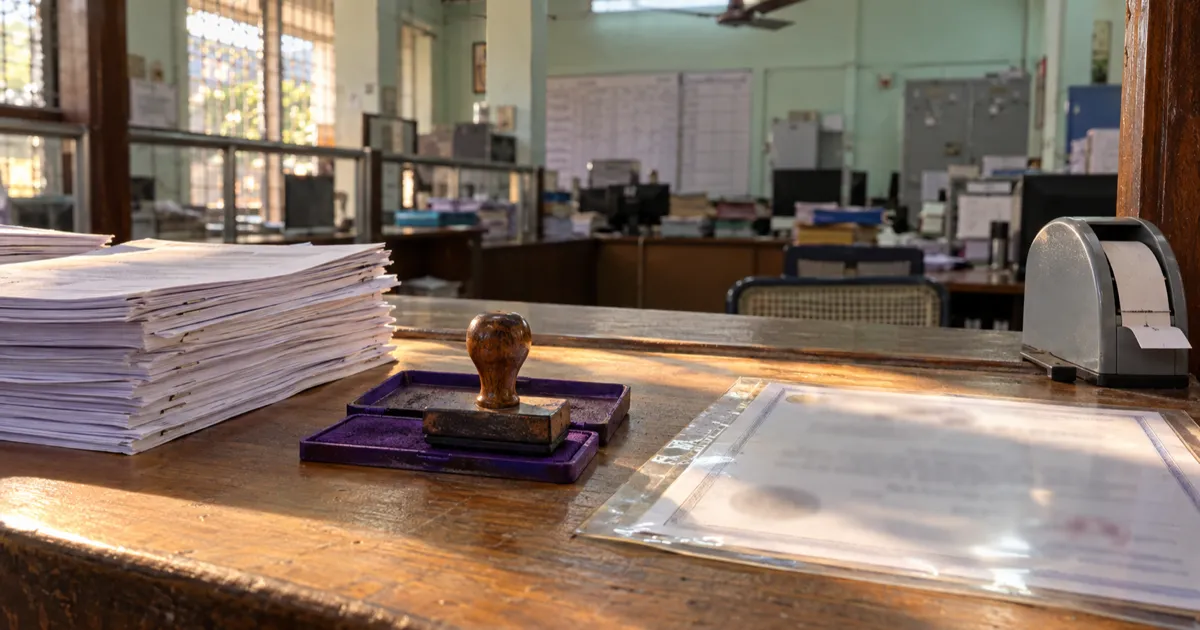
A PG food complaint works in two stages: a dated written complaint to the owner or mess committee, then FSSAI's Food Safety Connect portal, app or 1800112100 helpline if nothing changes. Insects, stale food and dirty kitchens breach the Food Safety and Standards Act 2006, with penalties of up to Rs 1 lakh to Rs 5 lakh. This guide covers the filing steps, whether your mess needs an FSSAI licence, and when a refund claim makes sense.
Food is one slice of a wider set of problems. For deposits, safety, harassment and the rest, start with our guide on where to file a PG or hostel complaint.
| Key number | Value | Scope / data checked |
|---|---|---|
| FSSAI consumer helpline | 1800112100 (toll-free) | FSSAI consumer grievance portal, October 2026 |
| Escalation to the state | After 15 days if the business response is unsatisfactory | FSSAI grievance portal FAQ, October 2026 |
| FSSAI registration limit | Annual turnover up to Rs 1.5 crore (was Rs 12 lakh) | FSSAI order of 13 March 2026, in force from 1 April 2026 |
| Unhygienic processing penalty | Up to Rs 1 lakh | FSS Act 2006, section 56 |
| Consumer commission fee | Nil for claims up to Rs 5 lakh | Consumer Commissions fee rules as amended August 2023 |
What should you do first about bad hostel mess food?
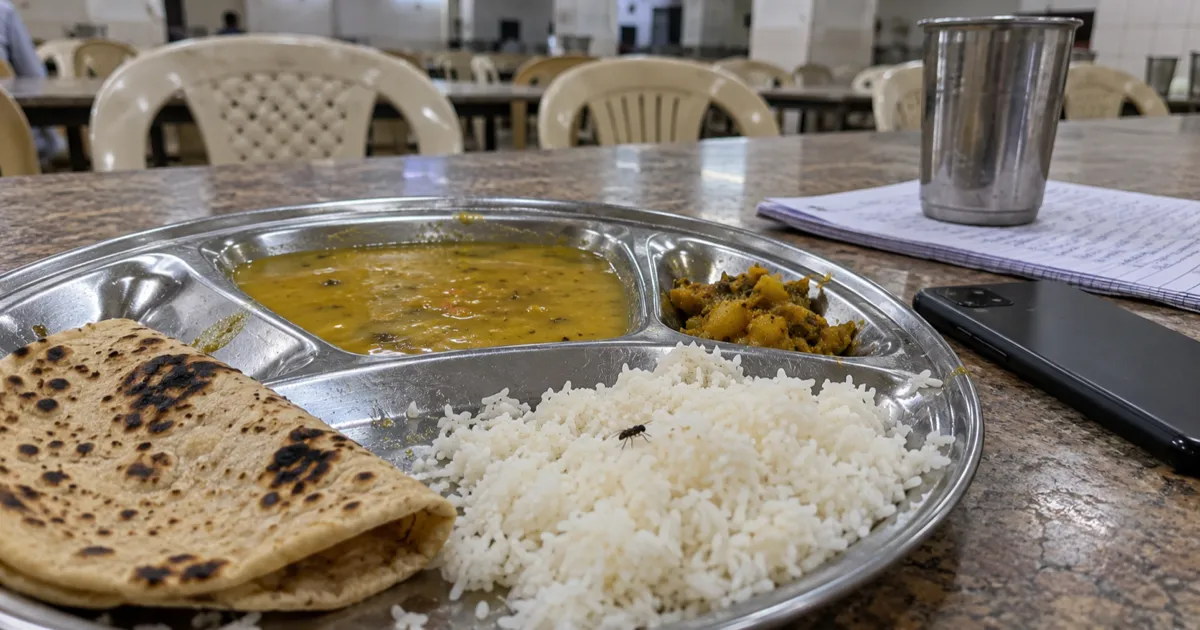
Collect evidence the same day, then put the problem in writing to whoever runs the kitchen: the PG owner, the mess contractor, or the warden and mess committee in a college hostel. A signed complaint from several residents, with photos and dates, is harder to ignore and becomes your proof if you later go to FSSAI or a consumer commission.
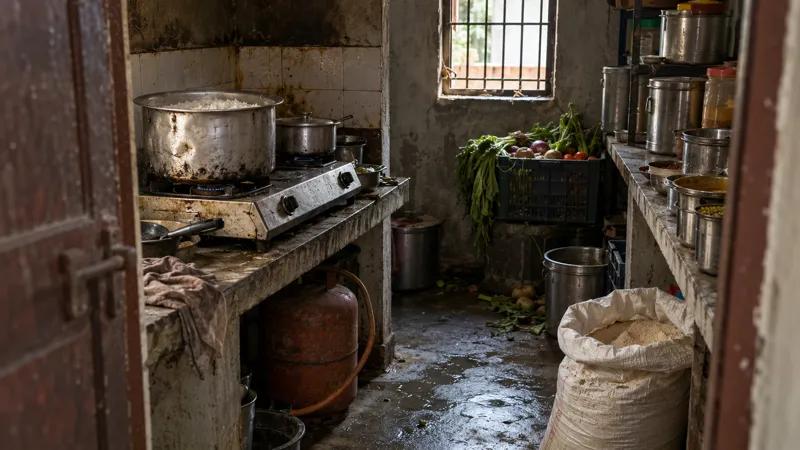
One bad dal is a menu problem. A cockroach in the sabzi or a corridor of residents sick after dinner is a food safety problem, and the law draws that line too: the Food Safety and Standards Act 2006 counts food as unsafe when it is "infested with worms, weevils, or insects", when it contains putrid, rotten or decomposed matter, or when it was processed unhygienically (section 3(1)(zz)).
What to collect as evidence:
- Dated photos and videos of the plate and the serving vessel.
- The menu and your receipts showing what you pay for food.
- Names and short written statements from residents who saw it or fell sick.
- Any doctor's slip or pharmacy bill.
- The FSSAI registration or licence number. Regulation 2.1.1(5) of the FSS Licensing and Registration Regulations requires the registration certificate to be displayed prominently in the premises.
- Copies of every complaint you send, with timestamps.
In the written complaint, list each incident by date, say what you want (pest control, a cleaned kitchen, fresh food) and give a reply date. If the warden in a college hostel brushes it off, our guide to a complaint against a hostel warden in college covers how to escalate inside the institution.
If anyone is sick, treatment comes before paperwork; our guide to staying healthy in a hostel in India covers when to see a doctor.
How do you file a PG food complaint with FSSAI?
Lodge it on the FSSAI consumer grievance portal or the Food Safety Connect app after an OTP login, choose the food premises category, describe the problem and upload your photos. FSSAI sends it to the business, copies your State Food Safety Commissioner, and passes it to the state after 15 days if the reply is unsatisfactory.
The portal accepts complaints about packaged food, food premises and online delivery platforms. A PG mess counts as a food premises, since the Act defines a food business as any undertaking "whether for profit or not" that includes "food services, catering services". The Food Safety Connect app on Google Play does the same job and also verifies licence numbers.
- Check the mess's FSSAI number. Enter it in the Food Safety Connect app's verification tool, which FSSAI's 2021 launch note describes. No number displayed, or one that does not match, belongs in your complaint.
- Log in with your mobile number. The portal sends an OTP by SMS, with an OTP-on-call option if the SMS fails.
- Pick the category and concern. Choose the options that match a food premises complaint and the closest concern: insects, stale food, an unhygienic kitchen.
- Name the place exactly. Put the PG or mess name in the "Product Name/Restaurant Name" field, with the full address and the operator's name.
- Write facts. Dates, meals, what was found, how many fell ill, and what you already told the owner.
- Upload documents. Attach photos, your earlier written complaint and any medical slip.
- Track it. Use "Track Complaint" after logging in. You cannot edit a submitted complaint, so if something new happens, file a fresh one.
The portal sets out three levels: the business's nodal officer, then the state food safety authority, then FSSAI. To write to your state directly, use FSSAI's list of Commissioners of Food Safety. Avoid email or social media complaints; FSSAI processes complaints through the portal.
| Route | What it handles | How to file | Fee | Time limit or response |
|---|---|---|---|---|
| Owner, contractor or mess committee | Menu, quality, cleaning, pest control | Dated written complaint signed by residents | None | No statutory timeline; set a reply date |
| FSSAI Food Safety Connect (portal or app) | Unsafe or unhygienic food at food premises | foscos.fssai.gov.in/consumergrievance or the app | No fee listed | Sent to business; to the state after 15 days if unresolved |
| FSSAI helpline | Consumer grievances by phone | 1800112100 | Toll-free | Not stated |
| Food Analyst (FSS Act section 40) | Lab test of food you bought | Tell the seller at purchase that you will have it analysed | Analysis fee, refunded if the food fails | Report within the period set by regulations |
| District Consumer Commission | Refund or compensation for deficient service | e-Jagriti | Nil up to Rs 5 lakh | Within 2 years of the cause of action |
Section 40 rarely suits a mess, because you must tell the seller at purchase that the food will be tested. Photos and an FSSAI complaint usually work better.
Does a PG or hostel mess need an FSSAI licence?
Every PG or hostel mess needs at least an FSSAI registration, because section 31 of the FSS Act bars running a food business without one. The type depends on annual food turnover: from 1 April 2026, up to Rs 1.5 crore means registration, up to Rs 50 crore a State licence, and above that a Central licence.
The limits come from an FSSAI order dated 13 March 2026; the press release confirms the registration ceiling rose from Rs 12 lakh and that certificates no longer need renewal. A mess with no registration at all is still breaking the law.
A worked example, using assumed figures:
- Small PG mess: 40 residents x Rs 3,500 a month for food x 12 months = Rs 16,80,000 (Rs 16.8 lakh) a year. That is above the old Rs 12 lakh line, so before April 2026 it needed a State licence. It is below Rs 1.5 crore, so today registration is enough.
- Large hostel mess contractor: 400 students x Rs 3,500 x 12 = Rs 1,68,00,000 (Rs 1.68 crore). That is above Rs 1.5 crore, so the contractor needs a State licence.
- Break-even: Rs 1,50,00,000 ÷ (Rs 3,500 x 12 = Rs 42,000 per resident a year) = 357.1, so at that monthly charge a mess crosses into State licensing at about 358 residents.
Hygiene rules apply whatever the turnover. Part V of Schedule 4 to the licensing regulations covers college and institution canteens and sets checkable standards: hot food held at 60°C or above, gravy dishes out at room temperature no longer than 2 hours, reheating to above 74°C, and leftovers never mixed with fresh food. A PG unregistered as a food business may also be dodging other registrations; our guide on how to check whether a PG is registered and report an illegal one covers the municipal side.
What penalties can a mess face under the FSS Act 2006?
Penalties depend on what went wrong. Unhygienic cooking can draw up to Rs 1 lakh, sub-standard food up to Rs 5 lakh, and running without a required licence up to Rs 10 lakh. Unsafe food that causes injury moves into prison terms, from up to 1 year for non-grievous injury to at least 7 years if someone dies.
Sections below are from the FSS Act as published by FSSAI, read with the Jan Vishwas (Amendment of Provisions) Act 2023, which took effect for the FSS Act through a Health Ministry notification of 7 November 2023. The Jan Vishwas (Amendment of Provisions) Act 2026 changes other FSS Act sections, such as 39, 60 and 62, not the ones below.
| FSS Act section | Covers | Maximum |
|---|---|---|
| 50 | Food not of the nature, substance or quality demanded | Rs 5 lakh; Rs 25,000 for petty businesses covered by section 31(2) |
| 51 | Sub-standard food | Rs 5 lakh |
| 54 | Food containing extraneous matter | Rs 1 lakh |
| 56 | Unhygienic or unsanitary processing | Rs 1 lakh |
| 59(i) | Unsafe food, no injury | 3 months and Rs 3 lakh fine |
| 59(ii) to (iv) | Unsafe food causing non-grievous injury, grievous injury, or death | 1 year and Rs 3 lakh; 6 years and Rs 5 lakh; at least 7 years (up to life) and at least Rs 10 lakh |
| 63 | Running a food business without a required licence (not businesses that only need registration) | Rs 10 lakh penalty |
For a small PG mess that counts as a petty business under section 31(2), section 50 caps the penalty at Rs 25,000, against Rs 5 lakh for others. These are maximums; the authorities, not you, set the amount.
Can you get money back for bad mess food?
An FSSAI complaint can bring an inspection and penalties, but it does not refund you. For money, file a consumer complaint for deficiency in service. The Consumer Protection Act 2019 covers boarding and lodging as a service, the time limit is two years, and claims up to Rs 5 lakh carry no filing fee.
Under the Consumer Protection Act 2019, "service" includes "boarding or lodging or both" (section 2(42)), and a deficiency is any shortcoming in the quality of what was promised (section 2(11)). A sample case:
- Fee: Rs 3,500 a month for 10 months is Rs 35,000 paid. Under the fee table amended in August 2023, anything up to Rs 5 lakh is Nil, so the filing fee is Rs 0.
- Deadline: section 69(1) allows two years from the cause of action. If the food poisoning happened on 12 October 2026, file by 12 October 2028. A late complaint needs the commission to accept "sufficient cause" for the delay.
Talk to the National Consumer Helpline first (1915, 8 am to 8 pm) for mediation. Our guide to filing a consumer complaint against a PG or hostel online walks through e-Jagriti, the drafting and the hearing.
Your next step after a bad meal
Photograph the next bad meal, get a few residents to sign a dated note to the owner or mess committee, and note the FSSAI number on the wall. If a week passes with no change, file on Food Safety Connect. A clear record turns a PG food complaint from an argument into a case. If the mess is beyond fixing, our hostel food survival guide covers tiffins and cooking alternatives. If the matter turns into a money claim or a court case, get advice on your own facts from a lawyer or from your district legal services authority via NALSA; this guide is general information only.