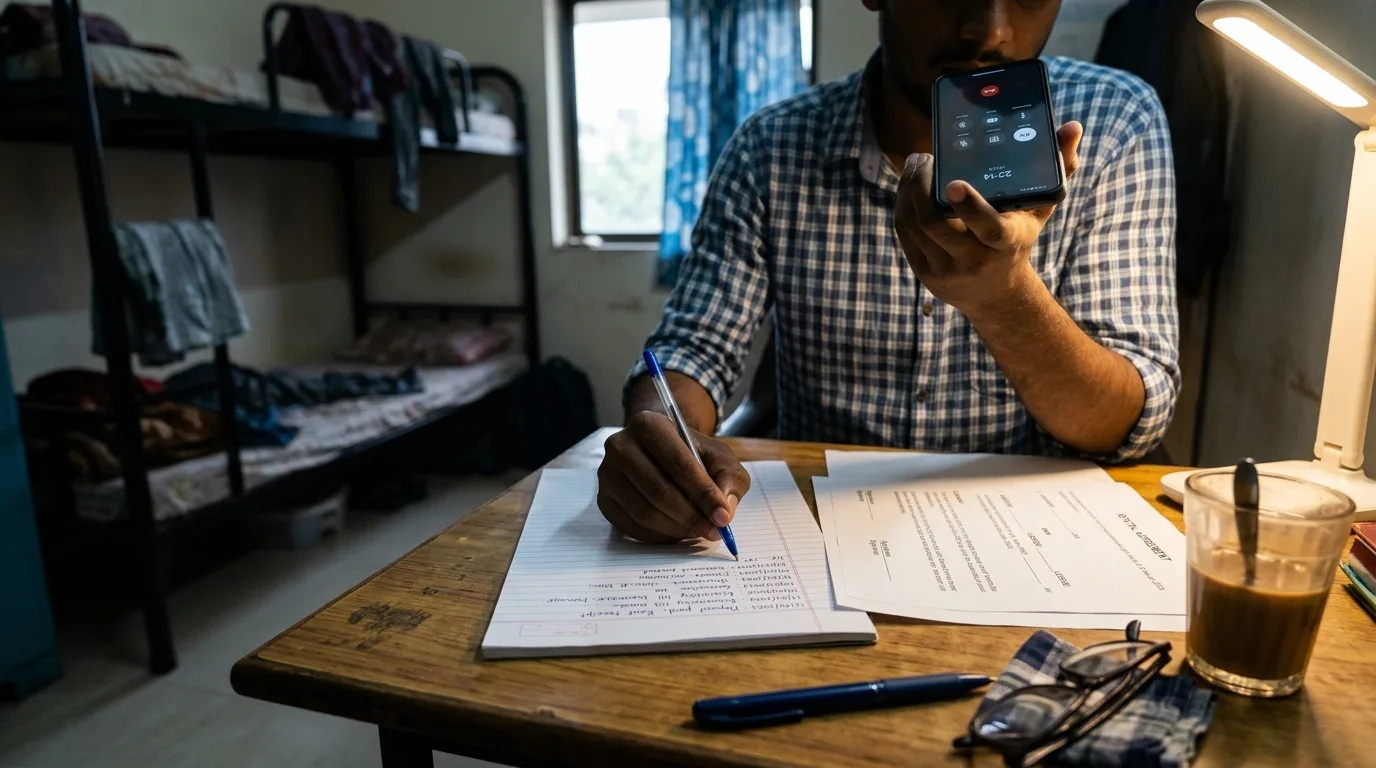
Short answer: there is no PG regulator in India and no single number to call, so the skill is routing. Immediate danger goes to 112. Harassment and safety go to the local police, with 181 for women. Overcrowding, an unsafe building or an unlicensed PG goes to the municipal corporation and the fire service, the most underused route by a distance. Money and broken service promises go to the consumer commission. If you are a student, your institution's anti-ragging committee and Internal Complaints Committee have reach that the municipal system does not.
Send the wrong complaint to the wrong body and it dies quietly. This is the routing map, in escalation order. For the background on why no single regulator exists, see PG and hostel laws and tenant rights in India.
The escalation order
- Write to the owner or warden first, unless there is immediate danger, in which case skip to step 2. A dated written complaint costs nothing and is the foundation every later step is built on.
- Emergency: 112. The pan-India emergency number covering police, fire and health.
- Police station with jurisdiction for anything criminal, theft, intimidation, trespass, assault, harassment.
- Municipal corporation and fire service for the building itself: overcrowding, no fire clearance, unlicensed kitchen, no licence at all.
- Consumer route for money and service failures: National Consumer Helpline first, then a formal complaint.
- Institution, if you are a student: anti-ragging committee, Internal Complaints Committee.
- Free legal aid if you need help and cannot pay for it.
Match the problem to the body
| Problem | Who to go to | What they can actually do |
|---|---|---|
| Immediate danger, violence, fire | 112 | Dispatch police, fire or medical response |
| Harassment, stalking, unsafe conduct by staff or residents | Local police + 181; 14490 for the NCW line | Register a complaint or FIR; counselling and referral support |
| Theft, belongings or original documents withheld, threats | Local police station | FIR or non-cognisable report |
| Overcrowding, no fire equipment, blocked exits, unlicensed PG | Municipal corporation (trade licence wing) + fire service | Inspection, notice, penalty, licence suspension, sealing |
| Unhygienic mess or food poisoning | Municipal health wing + FSSAI | Inspection; action on food licence |
| Deposit withheld, promised services not delivered | National Consumer Helpline 1915, then District Consumer Commission | Mediation; then a binding order for refund and compensation |
| Ragging in a private PG used by students of one college | Institution's anti-ragging committee; 1800-180-5522 | Disciplinary action against students; police referral |
| Sexual harassment involving members of your institution | Institution's ICC; SHe-Box; police | Inquiry and penalties under the UGC regulations; criminal process in parallel |
| Cannot afford a lawyer | NALSA 15100 / District Legal Services Authority | Free legal advice and representation if you qualify |
The police: what they will and will not do
112 is the number that matters in an emergency; it is the single pan-India emergency response number and it covers police, fire and health. For non-emergencies, go to the police station with jurisdiction over the PG's address, in writing, with a copy for yourself that you get stamped or acknowledged.
A few practical points that people learn the hard way:
- A Zero FIR can be registered at any police station regardless of where the offence took place, and is then transferred to the station with jurisdiction. You should not be turned away because "this is not our area".
- If they decline to register an FIR, ask for the complaint to be entered as a non-cognisable report and get a written acknowledgement. It is a dated official record and it costs nothing.
- Money disputes will be called civil matters. That is usually correct, take those to the consumer route described in the deposit recovery guide instead.
On women's helplines, be precise rather than repeating what circulates online. The National Commission for Women lists 112 for emergencies, 181 as the national women helpline for women facing violence, 1098 for children (now integrated with 112), 1930 for cyber and financial fraud, and its own 24x7 line on 14490. The widely quoted 1091 is operated as a women's helpline by several state and city police forces but is not a uniform national number, check what your city actually uses and save it before you need it. The girls' hostel safety checklist covers what to verify before you move in.
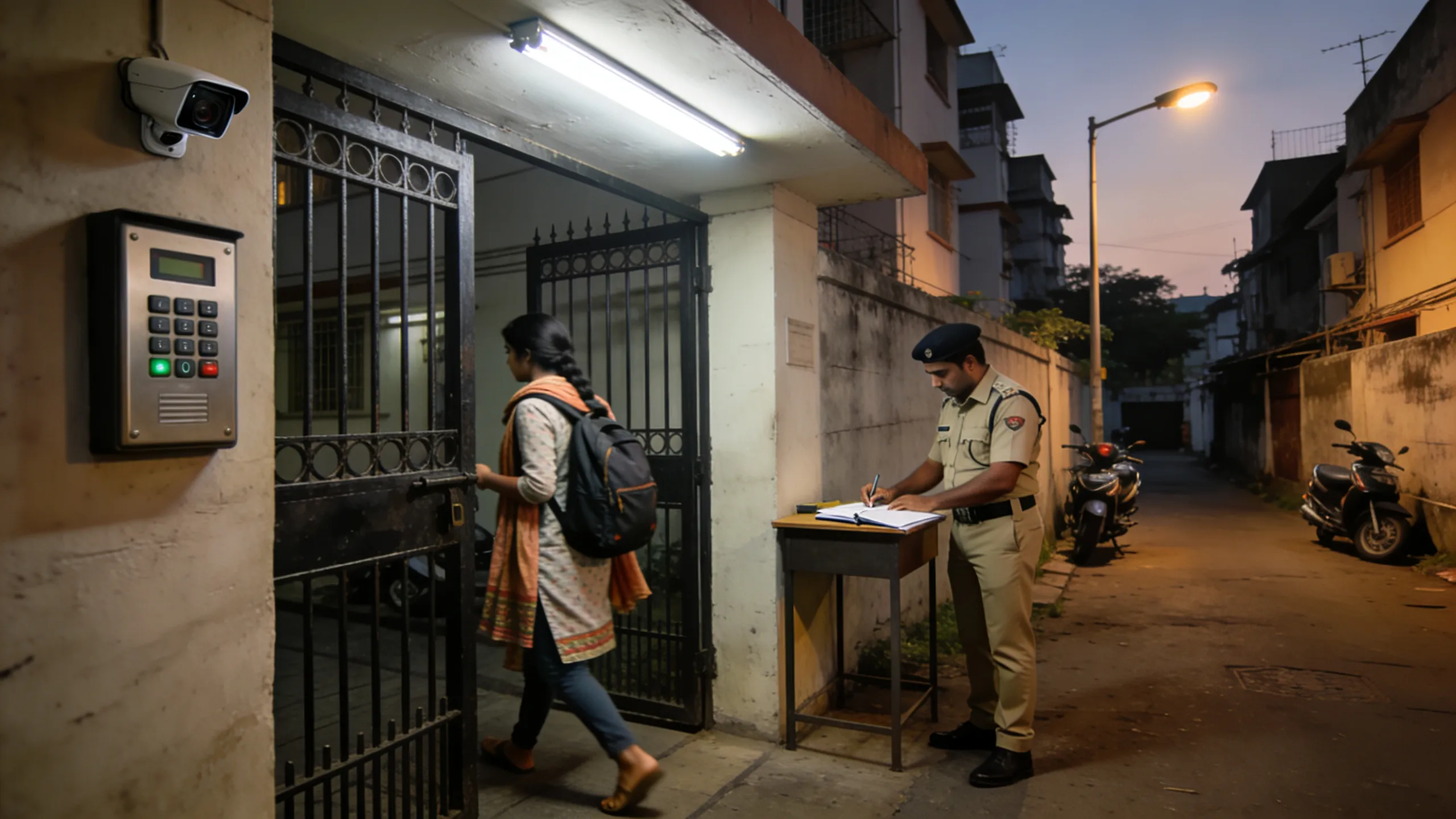
Some cities are also building registration systems that give the police a list of who runs what. In July 2026 Hyderabad Police and GHMC launched a framework requiring women's hostels and PGs in the city commissionerate to register with the jurisdictional police station, after a survey of 447 women's hostels found only 43% had compound walls and under 39% had fire safety systems. Where such a scheme exists, asking whether your PG is registered is a fair question with a checkable answer.
The municipal corporation: the most underused lever
A PG cannot legally operate without a municipal licence, and that licence carries conditions. This is the pressure point that actually moves owners, because a civil claim threatens their money while a licence complaint threatens their business.
- Delhi: Section 421 of the Delhi Municipal Corporation Act, 1957 prohibits keeping a lodging house, hotel or boarding house without a licence from the Commissioner. Complaints go to the corporation's licensing wing for the zone.
- Bengaluru: BBMP attached ten conditions to PG trade licences in August 2024, reported to include a minimum of 70 sq ft of personal space per occupant, CCTV at entry and exit points, a fire safety clearance, a 24-hour security guard and an FSSAI licence where a mass kitchen operates. The Karnataka High Court has been supervising inspections of PG accommodation in the city, and inspections in 2026 turned up overcrowding below the 70 sq ft norm, missing fire clearances and uncertified kitchens. If you are in Koramangala or any other dense PG belt, a licence-conditions complaint has real teeth right now.
- Hyderabad: commercial hostels need a GHMC trade licence, with fire NOC handled separately.
What to include: the exact address, what you say is being breached (occupants per room, blocked staircase, no extinguishers, kitchen without a food licence), photos with dates, and the number of residents affected. A complaint naming a specific breach gets inspected. A complaint saying "this PG is bad" does not.
Fire safety
Fire clearance is a state subject handled by the state fire service, and in most cities it is a precondition to the municipal licence rather than an optional extra. Blocked or locked emergency exits, a single staircase serving several floors, no extinguishers, and cooking on unauthorised LPG in rooms are all reportable to the fire service directly as well as to the corporation. Do not wait for the owner's response on this one, a locked exit is not a negotiation.
Money and broken promises: the consumer route
Start with the National Consumer Helpline on 1915 (8 a.m. to 8 p.m. daily, also on WhatsApp at 8800001915). Understand what it is: a grievance mediation and advisory service, not an adjudicating body. It cannot order anyone to refund you. It can, and often does, get a call made that resolves the matter.
If that fails, file at the District Consumer Commission through e-Jagriti, the unified portal that replaced e-Daakhil. The filing fee is nil for the values involved in a PG dispute, and you do not need a lawyer. The framing matters a great deal, file it as a deficiency in the services you paid for, not as a landlord dispute. The full mechanics, including limitation and what the owner will argue, are in the deposit legal action guide.
If you are a student: two routes nobody else has
Anti-ragging
The UGC Regulations on Curbing the Menace of Ragging in Higher Educational Institutions, 2009 reach off-campus accommodation, but through your institution rather than against your PG owner. Regulation 6 requires the head of the institution to give local police and local authorities the details of privately, commercially managed hostels and lodges used by its students, and to ensure the anti-ragging squad maintains vigil there; students must declare at registration where they are living, specifically including a private commercially managed lodge or hostel.
So the complaint goes to your institution's anti-ragging committee or squad, and to the national anti-ragging helpline on 1800-180-5522, which is toll-free and operates round the clock. If you are not enrolled anywhere, this machinery is not available to you and you are back to ordinary criminal law.
Internal Complaints Committee
Every higher educational institution must have an Internal Complaints Committee under the University Grants Commission (Prevention, Prohibition and Redressal of Sexual Harassment of Women Employees and Students in Higher Educational Institutions) Regulations, 2015. Two timelines to know: a complaint should be filed within three months of the incident, and the inquiry is to be completed within ninety days.
The reach of an ICC over an incident in a private PG is not perfectly settled. The regulations are generally read as extending institutional responsibility beyond the physical campus where the person is acting as a member of the institution, so an incident between two enrolled students in a PG is plausibly within reach, but where the person complained against is PG staff or the owner, and not a member of your institution, the ICC route is doubtful. In that case use the police, and consider the District Local Committee constituted under the Sexual Harassment of Women at Workplace (Prevention, Prohibition and Redressal) Act, 2013, which exists precisely for workplaces too small to have an internal committee. Complaints can also be lodged on the government's SHe-Box portal.
What to put in any complaint
- Dates and times. Vague chronology is the most common reason complaints stall.
- The specific breach, named. "Eleven residents in a room with four beds", not "overcrowded".
- Timestamped photos or video, and the original files rather than forwarded compressions.
- Copies of your agreement, receipts and payment references.
- Your earlier written complaint to the owner or warden, with proof of delivery.
- How many residents are affected. A pattern gets inspected; an individual grievance gets filed.
Most of this is easier if you never end up in a bad PG in the first place, the red flags guide covers what to look for on a visit, and the police verification guide explains why a PG that never asks for your ID is telling you something.
This is general information for residents, not legal advice. Rent, licensing and police rules differ from state to state and change often, check the position in your own city, and speak to a lawyer or your District Legal Services Authority before you act on anything that matters.