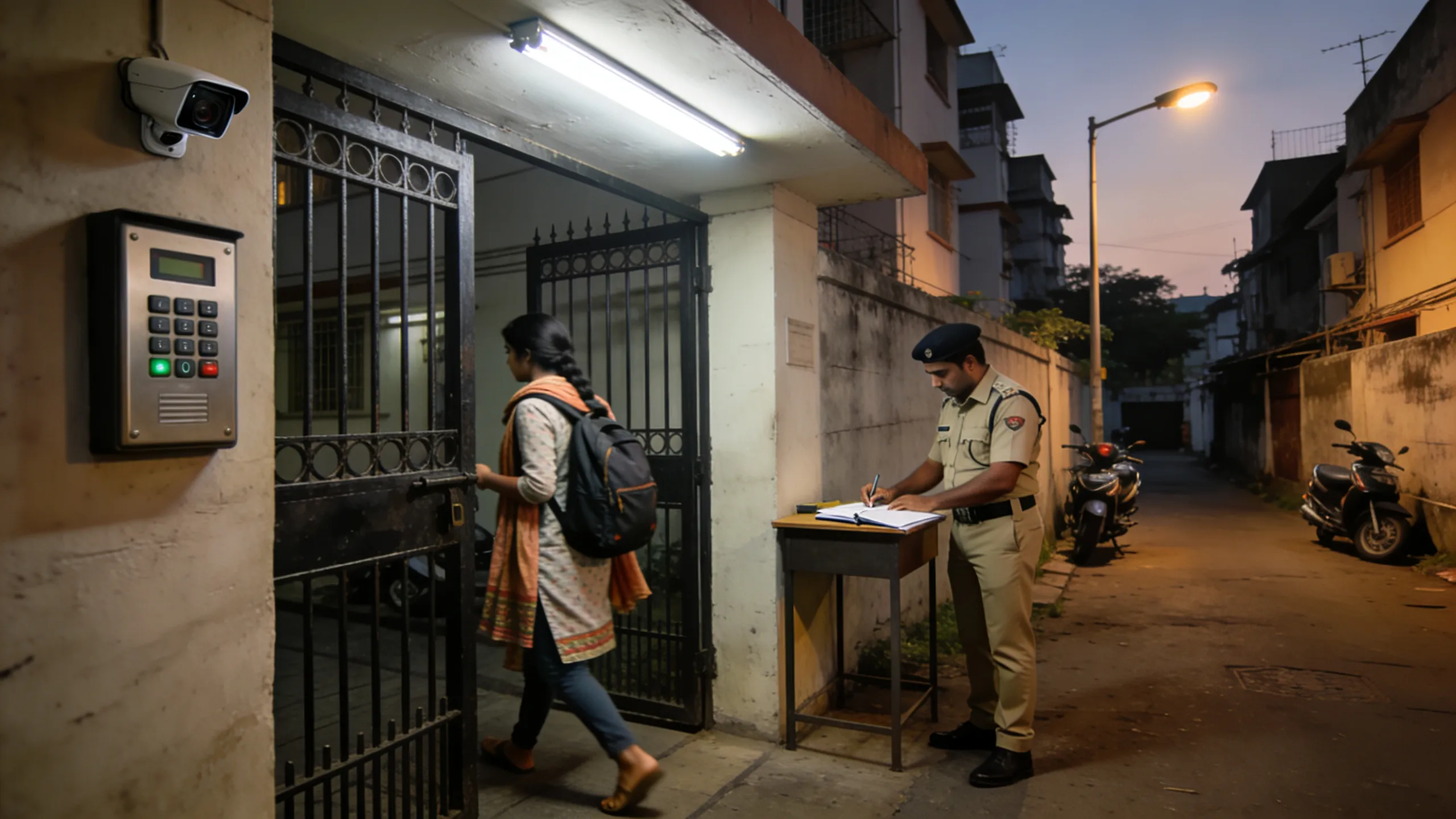

Short answer: the duty is on the PG owner, not on you, and it does not come from any central law. Tenant and PG verification is imposed city by city, through a prohibitory order issued by the Commissioner of Police or a District Magistrate under Section 163 of the Bharatiya Nagarik Suraksha Sanhita, 2023 (the provision that replaced Section 144 of the old Criminal Procedure Code). Ignoring such an order is punishable under Section 223 of the Bharatiya Nyaya Sanhita, 2023. Which means a PG that never asks for your ID is not being relaxed about paperwork. It is very likely operating outside its own licence conditions, and it has no record that you ever lived there.
That last point is the one worth internalising. This guide sits alongside our explainer on PG and hostel laws and tenant rights in India, and it matters for the same reason: when the law gives you few structural protections, documentation is most of what you have.
Where the duty comes from
There is no all-India tenant verification statute, and blogs that tell you otherwise are guessing. What exists is a local order. Section 163 BNSS carries forward the machinery of Section 144 CrPC almost verbatim, a District Magistrate, Sub-Divisional Magistrate or empowered Executive Magistrate can issue a written order directing a person to abstain from an act or to take certain action, on public-order grounds, and the order stays in force for a maximum of two months. City police forces use it to require every person providing accommodation to furnish occupant details to the jurisdictional police station, and they renew the order as it lapses.
The consequence of ignoring it sits in Section 223 BNS, which replaced Section 188 IPC when the new criminal codes came into force on 1 July 2024. Two tiers: disobedience causing or tending to cause obstruction, annoyance or injury to persons lawfully employed carries simple imprisonment up to six months, or a fine up to ₹2,500, or both; disobedience causing or tending to cause danger to human life, health or safety carries up to one year, or a fine up to ₹5,000, or both. No intent to cause harm needs to be proved, knowledge of the order plus likely harm is enough.
This is not theoretical. In July 2026 Pune City Police ran a drive under a Special Branch order and booked four PG operators in Chandan Nagar under Section 223 BNS for failing to submit tenant details, with action reported against 41 landlords and tenants in the same drive. Police cited the large student, working-professional and migrant population as the reason it matters.
What you have to supply, and what you should not
Across the city portals and forms in use, the information asked for is broadly the same:
- A recent photograph.
- A government-issued photo identity document.
- Your permanent address and your previous address.
- Your employer or educational institution.
- Dates of occupancy and the room or bed allotted.
- An emergency contact, usually a parent or guardian, with phone number.
- A copy of the rent or licence agreement.
Note the wording: a government-issued photo ID, not specifically Aadhaar. Different forces accept different documents, commonly a passport, driving licence, voter ID or Aadhaar. Where you have a choice, a passport or driving licence discloses less about you than an Aadhaar copy does.
Three things to hold the line on:
- Never hand over an original document permanently. There is no legal basis for a PG holding your original Aadhaar, passport, marksheet or degree certificate, not as security for rent, not for "safekeeping", not at all. Show the original, give a copy.
- Self-attest and annotate every copy. Sign across it and write the purpose and date, "for police verification, [PG name], July 2026", so it cannot be recycled for a loan application or a SIM card.
- Ask for an acknowledgement. A reference number, a stamped form copy or even a WhatsApp confirmation that the submission was made. It is your proof of residence at that address on those dates.
City by city: what actually exists
This is where honesty is more useful than tidiness. The picture is uneven, and several widely repeated claims do not survive checking against the police forces' own websites.
| City | Position |
|---|---|
| Delhi | Delhi Police runs a tenant registration service through its citizen services portal, and a downloadable tenant information form is published on the same site. We could not locate a currently published Commissioner's order making it a prosecutable duty, so treat it as an established practice that police stations expect rather than a confirmed prosecutable obligation. |
| Bengaluru | The Bengaluru City Police citizen services page does not list a tenant verification service, despite many blogs claiming one exists. Verification is done through the jurisdictional police station. Separately, the BBMP conditions attached to PG trade licences in August 2024 are reported to require operators to have residents' antecedents verified with the area police station. |
| Pune and Mumbai | The strongest enforcement in the country right now. Maharashtra Police run a citizen services portal with a downloadable tenant and temporary resident information form, and Pune has prosecuted operators. If you are moving into a PG in Pune, expect to be asked, and be concerned if you are not. |
| Hyderabad | Telangana Police citizen services do not list a standalone tenant verification service. What does exist, from July 2026, is a police and GHMC framework requiring women's hostels and PGs in the city commissionerate to register with the jurisdictional police station and maintain complete resident records. |
| Jaipur | Tenant and domestic-help verification is reported to be available through the Rajasthan Police citizen portal and the RajCop Citizen app. We could not confirm a Jaipur Commissionerate order making it mandatory, so ask at the local police station rather than assuming. |
If you are a foreign national, the law changed in 2025
This is the part most content online gets wrong, because it still describes a repealed framework. The Immigration and Foreigners Act, 2025 came into force on 1 September 2025 and, by Section 36, repealed the Foreigners Act 1946, the Registration of Foreigners Act 1939, the Passport (Entry into India) Act 1920 and the Immigration (Carriers' Liability) Act 2000. References to Rule 14 of the Registration of Foreigners Rules, 1992 are obsolete.
The operative duty is now Section 8, headed "Obligation of keeper of accommodation and others to furnish particulars". The keeper of any accommodation must submit prescribed information about foreigners accommodated there to the Registration Officer; the obligation does not apply to residential premises of a non-commercial nature, which means hotels, hostels, paying guest houses, lodges and guest houses are squarely covered. The foreigner must in turn furnish the particulars the keeper requires. Reporting is within 24 hours of arrival, and again on departure, through the e-FRRO system at indianfrro.gov.in. What used to be filed as Form C is now filed under the forms notified with the 2025 rules; educational institutions file a separate form for foreign students.
The penalty for an accommodation provider who does not comply falls under the Act's residual penalty provision, Section 23, imprisonment up to three years, or a fine up to ₹3 lakh, or both. If you are an international student, the practical consequence is simple: a PG that shrugs and says it does not bother with the FRRO filing is exposing you as well as itself, because your lawful stay depends on a paper trail it is not creating.
What happens if the owner skips it
The owner's exposure is the prosecution above plus, more seriously for their business, the municipal trade licence. Your exposure is quieter and easy to miss:
- No record you ever lived there. That weakens a deposit claim, because the first thing an evasive owner argues is that your version of the dates and terms is invented. See the deposit recovery guide for how much the paper trail matters.
- No usable address proof. Bank KYC, a local SIM, a driving licence transfer, all easier with a registered agreement and an acknowledged police submission behind you.
- Nobody knows you were in the building. If there is a fire, an accident or a crime, the police have no list of occupants. In a building with a single staircase and no fire clearance, that is not an abstraction.
- You have no idea who else is living there. Which is the real point.
If the PG flatly refuses to register anyone and you suspect it is running without a trade licence or a fire clearance either, the municipal corporation is the body that can act on that, the complaint routing guide sets out who to tell and what to include.
Why "no ID needed" is a red flag, not a convenience
It feels like a kindness when the owner waves off the paperwork and says just move in. It rarely travels alone. A PG that does not collect identity documents overwhelmingly tends to be a PG that also has no written agreement, no receipts, cash-only payment, no visible trade licence and no fire clearance, because all of those come from the same decision to stay off the record. The residents around you were admitted on the same basis, with the same absence of checks.
Treat it as a diagnostic question on your visit, alongside the others in the red flags guide: "What do you need from me for police verification?" A well-run operator answers immediately and hands you a form. A poorly run one tells you not to worry about it. The how to choose the right PG checklist covers the rest of what to ask on that visit.
The asymmetry: you cannot verify the owner
Worth naming plainly, because nobody else does. Every police verification service in every state we checked runs in one direction: the accommodation provider reports the occupant to the police. There is no reverse lookup, no mechanism for a resident to have a PG owner verified, and no statutory duty on an owner to show you any identification at all. The law protects the state's interest in knowing who you are. It gives you no equivalent tool.
What you can do instead:
- Insist on a registered agreement. Registration requires both parties' government identity documents, which is the one moment in the process where you legitimately see the owner's ID.
- Ask to see the municipal trade licence. It is a public licensing document and it names the licensee. If they cannot produce it, that answers a different question.
- Check ownership independently through your state's land records or encumbrance portal, particularly if you are being asked for a large deposit.
- Pay by bank transfer. The beneficiary name on the transfer is a record of who actually took your money, which matters more than it sounds when the person collecting rent turns out not to be the owner.
If you are still comparing options, listings across Delhi and other metros vary enormously on exactly this kind of compliance, and the ones that ask for your documents properly are usually the ones that also have the licence and the fire clearance.
This is general information for residents, not legal advice. Rent, licensing and police rules differ from state to state and change often, check the position in your own city, and speak to a lawyer or your District Legal Services Authority before you act on anything that matters.