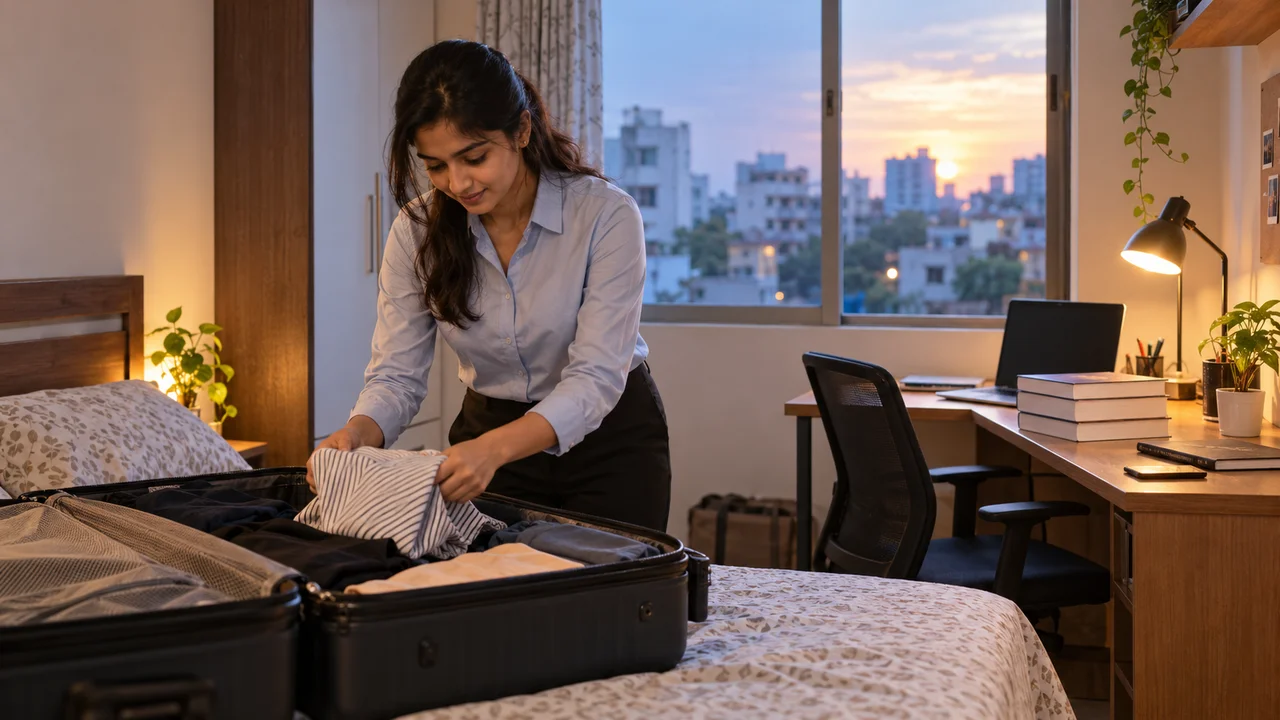
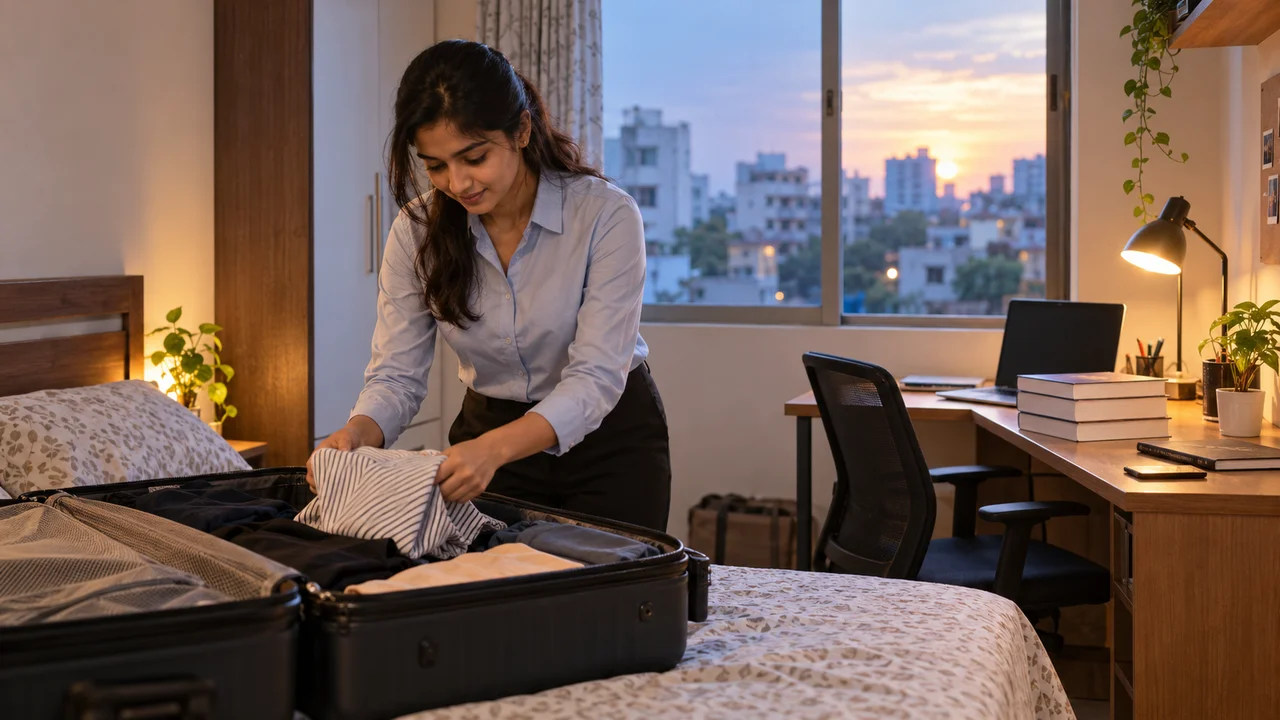
To find CA articleship accommodation in a new city, fix your firm's exact address first, budget on income you can confirm, and choose a room within an easy commute that still works for evening study. Under ICAI's New Scheme, practical training runs for two years, so treat this room as a two-year base, not a stopgap. Plenty of students take the first spare bed a senior offers and then spend months on a long commute, eating irregularly and studying in a room that's too noisy after a full workday. Moving for articleship in another city is different from moving for college: you're working office hours, studying in whatever time is left, and living on a stipend that may not cover much.
This guide walks you through the move step by step, from reading your firm's offer to settling in during the first month. If you're comparing CA life with other exam paths, the wider guide to accommodation for UPSC aspirants, SSC candidates and CA students covers the safety and study basics that all three groups share.
Key Takeaways
- Lock your firm's address and working pattern before you look at a single room, since you'll make that trip on almost every working day for two years.
- Budget on confirmed income. ICAI's higher stipends were still proposals as of its July 2026 announcement, ranging from Rs 3,000 to Rs 6,000 a month by city size and training year.
- A PG or hostel with meals usually protects evening study time better than a flat you have to run yourself.
- Visit every room in person, avoid basement living or study spaces, and get rent, deposit and notice terms in writing.
- Plan your first month around a fixed routine: commute, meals, study block and sleep.
Before you start: what to have ready
You'll make better decisions if a few things are settled before you start searching. Gather these first:
- Your firm's offer letter, with the office address and your joining date.
- The stipend amount written in the offer, or a clear answer from the firm if it isn't there.
- A rough idea of your working hours and whether you'll travel to client sites.
- Your exam plan: which attempt you're preparing for and whether you'll join classes or study on your own.
- Savings or family support you can count on for the deposit and the first few months.
Step 1: Confirm your firm's address and working pattern
By the end of this step, you'll know the one location your room has to serve. Many firms have more than one office, and some trainees spend much of their week at client premises. Your room search should centre on wherever you'll actually report most days.
- Ask HR or your principal which office you'll report to.
- Ask seniors in the firm how often trainees work at client sites and where those clients usually are.
- Check whether the firm expects late evenings during busy periods, and roughly when those fall.
- Mark the office on a map and note the main train, metro or bus lines that serve it.
You've finished this step when you can name your reporting office and the transport line you'd use to get there.
Step 2: Build a budget around confirmed income
Your budget should rest on the stipend in your offer letter, not on rates that haven't been finalised. In July 2026, ICAI announced a draft amendment on stipends, with the draft published in the Gazette on 25 June 2026. The proposed monthly amounts, as reported by CAclubindia, depend on city population and training year:
| City population | Year 1 (proposed) | Year 2 (proposed) |
|---|---|---|
| 20 lakh and above | Rs 5,000 | Rs 6,000 |
| 5 lakh to 20 lakh | Rs 4,000 | Rs 5,000 |
| Below 5 lakh | Rs 3,000 | Rs 4,000 |
These are proposals, not final rates. Check ICAI's announcements for the outcome, and use whatever your firm has actually committed to in writing.
Rent and living costs vary too much between cities and areas to give fair figures here, so fill in the table below with quotes you collect yourself.
| Line item | How to estimate it | Your figure |
|---|---|---|
| Monthly rent | Collect quotes from at least three places near your office for the same room type (single or shared). | Rs ____ |
| Security deposit (one-time) | Ask each landlord how many months' rent they hold and when it's returned. | Rs ____ |
| Food | If meals are included, note which ones. If not, price a month of the meals you'll buy or cook. | Rs ____ |
| Electricity and water | Ask whether they're in the rent or metered separately, and what recent residents have paid. | Rs ____ |
| Internet | Check if Wi-Fi is included and fast enough for online classes; if not, price a personal plan. | Rs ____ |
| Commute | Multiply the daily return fare by your working days in a month, plus some client-site travel. | Rs ____ |
| Laundry and toiletries | Ask if laundry is included; add a monthly allowance for basics. | Rs ____ |
| Study costs | Add classes, test series, books and any library membership. | Rs ____ |
| Trips home | Price the trips you expect over the year and divide by twelve. | Rs ____ |
| Buffer | Set aside a small monthly amount for repairs, medicine and surprises. | Rs ____ |
You've finished this step when you know the gap between your stipend and your total, and who's covering it.
Step 3: Choose between a PG, a hostel and a shared flat
For most trainees, a PG or student hostel with meals is the easiest fit, because it hands back the time a flat would take. Articleship days are long, and every hour spent cooking, chasing a plumber or splitting bills is an hour you don't study.
| Option | Works well if | Watch out for |
|---|---|---|
| PG with meals | You want food, cleaning and bills handled and you're happy with house rules. | Entry timings that clash with late office days; meal times you can't make. |
| CA student hostel or aspirant hostel | You'd like to live around others studying the same syllabus. | Shared rooms that get noisy; check study space and quiet hours. |
| Shared flat | You want independence and have flatmates you trust. | Cooking, bills, repairs and agreements all fall on you. |
You've finished this step when you've picked one or two room types to search for, so your shortlist compares like with like.
Step 4: Shortlist rooms by commute and study conditions
Shortlist only rooms with a direct, predictable trip to your office and a quiet place to study after work. A short commute matters more for trainees than for college students, because you make it every working day and still need energy for evening study.
- Draw a search zone around your office along the transport line you noted in Step 1.
- If you'll attend classes or a library, favour rooms on a direct route between them and the office.
- Check each room for daylight, airflow, a proper desk and chair, power backup and stable internet.
- Decide whether you'll study in your room or at a library. The trade-offs are laid out in this comparison of self-study library vs room study.
City choice shapes your shortlist too. If you're heading to Mumbai, this area guide to hostels in Mumbai for CA students looks at where trainees tend to look. You're done when you have three to five rooms worth visiting.
Step 5: Inspect every room in person
Visit every shortlisted room before paying anything, and walk away from basement living or study spaces. On 27 July 2024, three aspirants died when a basement in Old Rajinder Nagar, Delhi, flooded, as The Week reported. The Tribune reported that the building's papers allowed the basement only for parking or storage, yet it was running as a library. So before you take a room or a study seat near your firm, ask what that space is actually approved for.
On each visit, check:
- The room is above ground and has a window that opens.
- There are two ways out of the building, and corridors and stairs aren't blocked.
- Fire extinguishers are visible, and the wiring and sockets look safe.
- The entry timing fits your latest likely return from the office.
- Current residents, if you can talk to them, are happy with food, water and noise.
Do the commute once at office time if you can. You've finished this step when you've ruled out any room that fails a safety check.
Step 6: Get the terms in writing before you pay
Don't hand over a deposit until rent, deposit, notice period and refund terms are written down. Rules differ from landlord to landlord, and a verbal promise is hard to rely on if you have to move when your training ends or your firm changes your office.
- Ask for a written agreement or receipt that states the rent, what it includes and the due date.
- Get the deposit amount and the conditions for returning it in writing.
- Confirm the notice period on both sides.
- Pay through a traceable method and keep every receipt.
You've finished this step when you have a document that answers all four points.
Step 7: Set up your first month
Use the first month to build a routine that fits work, study and sleep, before busy periods test it. Fix your commute, meal times and a daily study block, and adjust them after your first week at the firm. Many of the habits in this first month coaching checklist apply to trainees as well.
A new city, long days and exam pressure can pile up. If it starts to feel heavy, Tele-MANAS takes calls on 14416 or 1800-89-14416 and covers exam stress.
Common mistakes when moving for articleship
The most common mistake is choosing a room before knowing where you'll work. It happens because a cheap bed comes up early. Confirm your reporting office first.
Budgeting on proposed stipends. News of higher rates spreads fast. Plan on the figure in your offer letter until ICAI finalises the change.
Ignoring entry timings. A PG curfew that's fine for college students may clash with late office days. Ask before you sign.
Skipping the in-person visit. Photos don't show noise, damp or blocked exits. Visit, or book a short stay first.
Bottom line
Good CA articleship accommodation serves your office first, your study second and your budget throughout. Settle the firm's address, budget on confirmed income, choose a room type that saves time, inspect in person and get terms in writing. Then give yourself a month to build the routine that'll carry you through two years of training.
Take the Basement Rooms and Libraries: A Safety Checklist for Aspirants with you on room visits, and if you're unsure whether to share with another trainee, Single or Sharing Room for Exam Preparation? walks through the trade-offs.