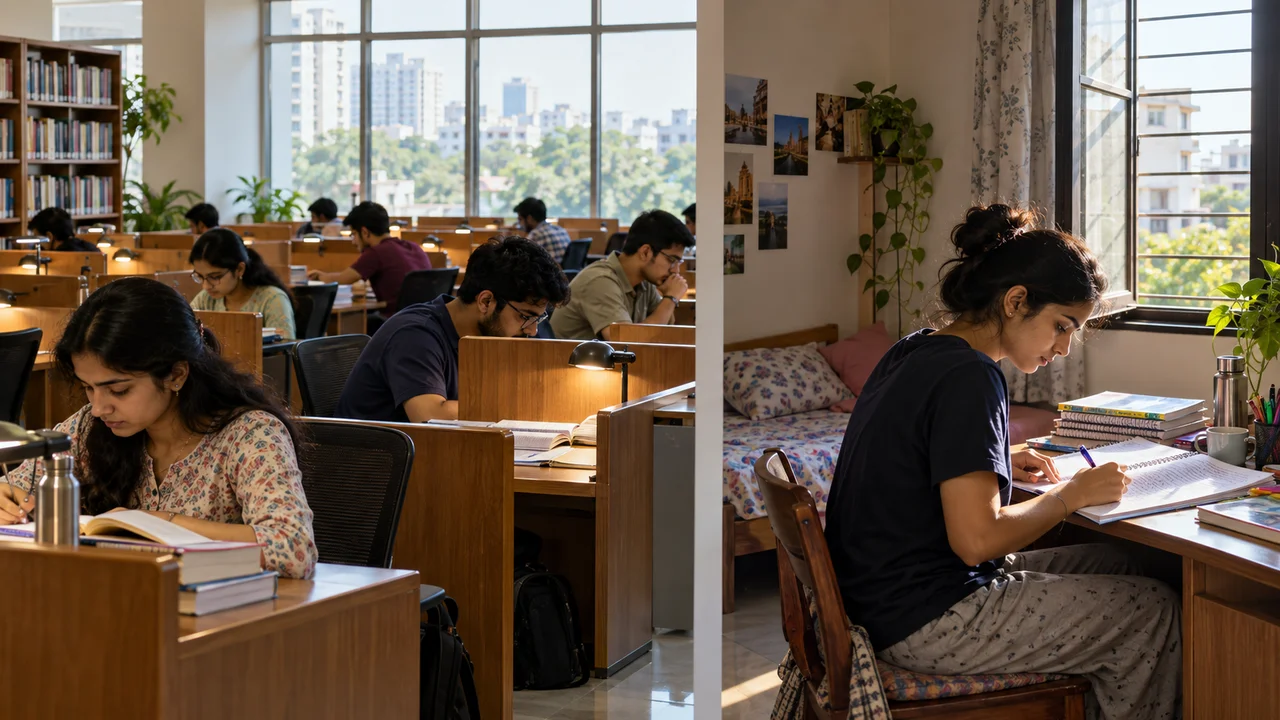
Before you rent a basement room or join a basement library, check four things: what the space is approved for, whether it floods, how many ways out it has, and whether fire safety basics are in place. If the owner can't give clear answers on all four, walk away, however cheap or convenient the seat is. Basement rooms and reading halls are common in coaching hubs because they're quiet and usually cost less. This guide turns that decision into a step-by-step check you can finish during a single visit.
It sits alongside our broader guide to accommodation for UPSC aspirants and other exam candidates, which covers location, budget and room type. Here, the focus is narrow: staying safe below ground.
Key Takeaways
- Ask what the basement is officially approved for. In the 2024 Old Rajinder Nagar case, a basement approved for parking or storage was being used as a library.
- Check for flood risk on the ground: entrance height compared with the road, seepage marks, and what happened during the last monsoon.
- Count the exits yourself and make sure none are locked, blocked or dependent on electricity.
- Look for fire extinguishers, clear wiring and a fire NOC, and note how crowded the room gets at peak hours.
- Plan your own way out on day one, and leave if the answers change or the space gets worse.
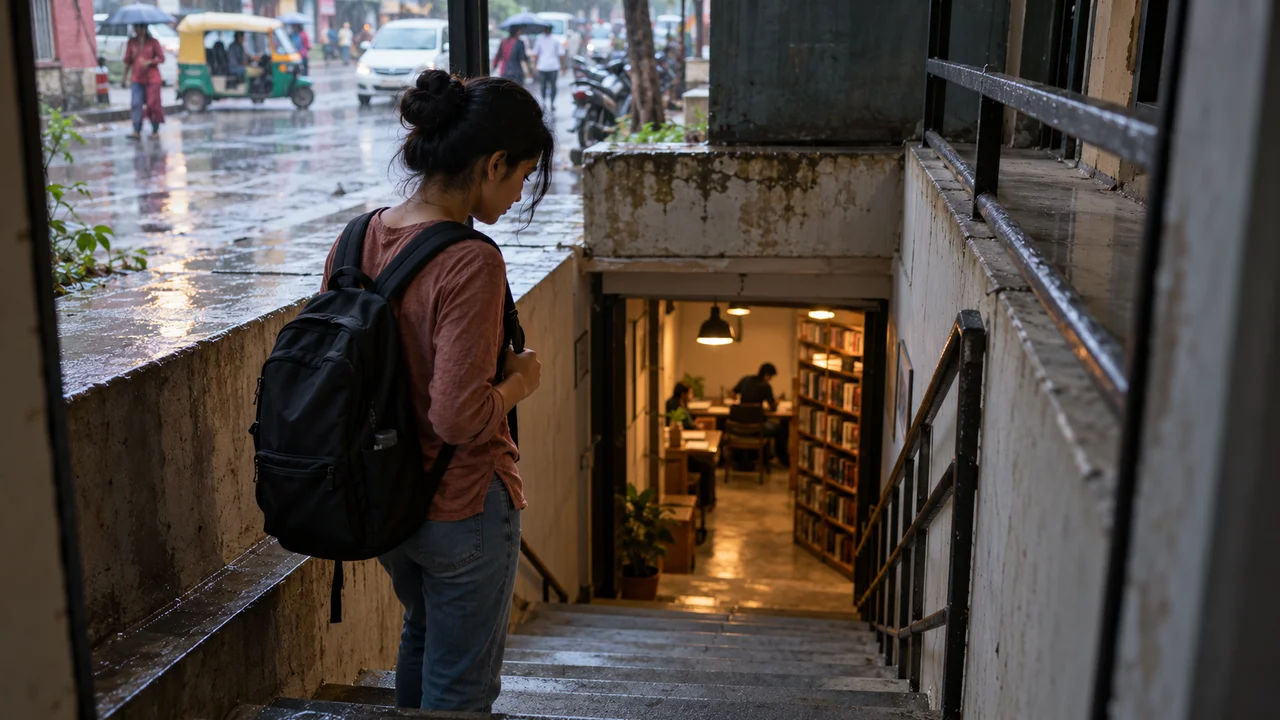
Why basement rooms and libraries need their own safety check
Basements carry risks that upper floors don't: water collects there first, and smoke and crowds have fewer ways out. Two incidents in Delhi's coaching belts show what that looks like in practice.
On 27 July 2024, three aspirants died when the basement of a civil services coaching centre in Old Rajinder Nagar flooded, as reported by The Week. The Delhi High Court transferred the probe to the CBI. According to The Tribune, the basement was approved for parking and storage but was being run as a library. The MCD then sealed the basements of 13 coaching centres in the area, All India Radio News reported, and the Supreme Court took suo motu cognisance, calling such spaces "death chambers" (Careers360).
Fire is the other risk. On 15 June 2023, a fire broke out at Bhandari House, a coaching building in Mukherjee Nagar. Students climbed down ropes to escape and 61 were treated in hospital, according to The Tribune. That wasn't a basement, but it shows how fast a packed study building becomes hard to leave.
Before you begin: what to bring to the visit
You can run this whole checklist in one visit if you go prepared. Plan for about half an hour on site, and try to visit at the time of day you'd actually use the space.
- Your phone, charged, for photos of documents, exits and any damp patches.
- A written list of the questions in Steps 1 to 5, so you don't skip any under pressure.
- A friend or parent on a call or with you, if possible. A second pair of eyes catches more.
- If you can, a rainy day or the day after rain. It tells you more about drainage than any promise will.
Step 1: Confirm what the basement is approved for
By the end of this step, you'll know whether the room or library is officially meant for people to sit, study or sleep in. This matters because the Old Rajinder Nagar basement was reportedly listed as parking or storage while it was being run as a library.
- Ask the owner or manager directly: "What is this basement approved for?"
- Ask to see the document that shows it, such as the sanctioned building plan or an occupancy paper. Rules and document names differ between cities, so ask your municipal body what applies locally.
- Check that the address and floor on the document match the space you're standing in.
Verification: you've seen a paper that covers this floor, or you've decided to walk away. A vague "everything is legal" doesn't count.
Step 2: Check how water gets in and out
By the end of this step, you'll have a rough sense of whether the space could flood. Water is the basement-specific risk, and you can spot many warning signs without any expertise.
- Compare the basement entrance with the road outside. If the entry sits at or below street level with no raised step or barrier, rainwater has an easy path in.
- Look at the lower walls, corners and floor for tide marks, peeling paint, mould or a musty smell.
- Ask what happened during the last heavy monsoon. Then ask a neighbouring shopkeeper or a student who already uses the space. Their answers are often more candid.
- Ask whether there's a pump and who switches it on at night.
Verification: you've seen the entrance and walls yourself and heard about past rain from someone other than the owner.
Step 3: Count the exits yourself
By the end of this step, you'll know how you'd get out if the main stairs were blocked. One narrow staircase is the most common weakness in a basement, whether it's water coming down or smoke going up.
- Walk from the farthest seat or bed to every exit. Note how many there are and how long it takes.
- Check that each exit is unlocked during the hours you'll be there and isn't stacked with bags, cycles or furniture.
- Ask how the entry door opens if the power fails. Biometric or electronic locks are common in student buildings, so confirm there's a manual release.
- Check for emergency lighting on the stairs.
Verification: you've physically walked at least two routes out. If there's only one, that's a red flag on its own.
Step 4: Look for fire safety basics
By the end of this step, you'll know whether the building takes fire seriously. The Ministry of Education's 2024 Guidelines for Regulation of Coaching Centres include fire and building safety requirements, and Kota's hostel reforms list a fire NOC among the expected documents, as ThePrint reported in February 2025.
- Ask whether the building has a fire NOC, and ask to see it.
- Find the fire extinguishers and check the refill date on the tag.
- Look for overloaded sockets, loose wiring, extension boards running under carpets, and AC units or inverters packed into small corners.
- Note any gas cylinders or cooking in or near the basement.
Verification: you've seen extinguishers with a readable tag and asked about the NOC. If the answer to either is no, factor that into your decision.
Step 5: Judge crowding and air
By the end of this step, you'll know whether the space gets packed beyond what it can safely hold. The MoE guidelines set a minimum of 1 square metre per student in coaching centres (Business Today). That rule is written for classrooms, but it's a useful yardstick for any study hall.
- Visit at peak hours and count seats against the room size.
- Check whether aisles stay clear when every seat is taken.
- Notice the air. Stuffiness, no windows or vents, and a single exhaust fan suggest poor ventilation.
If a basement room feels cramped for one person, it'll feel worse with roommates. Our guide on single vs sharing room for study can help you weigh that trade-off.
Step 6: Make your own exit plan
By the end of this step, you'll have a personal plan that works even if the building's own systems don't.
- Pick a seat or bed closer to an exit, not the far corner.
- Save local emergency numbers and the building manager's number on your phone.
- Agree with a friend that you'll check on each other during heavy rain.
- Decide in advance: if water reaches the stairs or you smell smoke, you leave immediately, without packing up.
| Check | What to ask or look for | Red flag |
|---|---|---|
| Approved use | Sanctioned plan or occupancy document for this floor | Listed as parking or storage, or no document shown |
| Flooding | Entrance height, damp marks, monsoon history | Entry at road level, tide marks, past water entry |
| Exits | Two or more routes, unlocked, manual door release | Single staircase, locked or blocked exit |
| Fire safety | Fire NOC, tagged extinguishers, tidy wiring | No NOC, empty or missing extinguishers |
| Crowding and air | Seats vs space at peak hours, ventilation | Blocked aisles, no vents, stuffy air |
Common mistakes to avoid
Trusting a verbal "it's legal." Owners have every reason to say yes. Ask for paper, and check that it covers the basement.
Visiting only in dry weather. A basement can look spotless in March and take water in July. Ask about past monsoons, or visit after rain.
Choosing on price and quiet alone. Basement seats are often cheaper and quieter, which is exactly why students overlook the risks. Savings don't offset a single exit.
Checking once and never again. Furniture gets added, exits get blocked and seats get squeezed in. Re-check every few weeks, especially before the rains.
Next steps
If a basement room or library passes all six steps, you've lowered the biggest risks this kind of space carries. If it fails on approved use, exits or flooding, keep looking. A slightly longer commute is a fair trade.
These checks travel well beyond UPSC hubs. If you're relocating for training, the same questions apply to CA articleship accommodation in a new city. And if a place makes you anxious or the pressure of preparation is building, Tele-MANAS (14416 or 1800-89-14416) offers free support, including for exam stress, as listed by the Karnataka Department of Health.
If a safer room stretches your rent, the UPSC Aspirant's Monthly Budget in Delhi helps you see where the money can come from, and Your First Month in a Coaching Hub: A Checklist covers what else to check before you settle in.