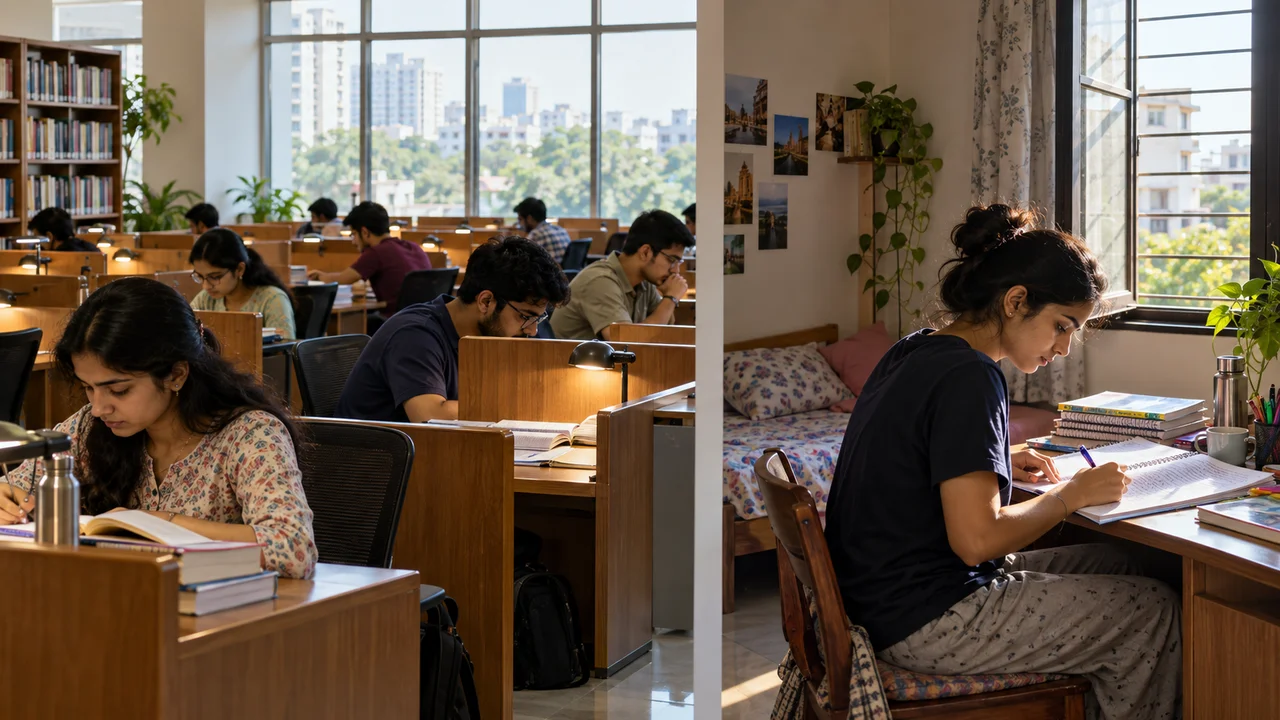
The right accommodation for UPSC, SSC and CA aspirants is a safe, above-ground room that's quiet, well lit, well ventilated and a short, predictable trip from your coaching centre or library. Choose for safety first, then for the conditions that let you study for long stretches every day, and only then for extras. Aspirants often pick a room in a rush, because a batch is starting or a friend has a spare bed. That's how people end up in a dark room with no backup power, a long commute, or, worst of all, a basement space that was never meant for people.
This guide covers what an aspirant needs from a room, the safety lessons Delhi's coaching hubs taught the hard way, how to time your move around the exam calendar, what CA articleship students should plan for, and a checklist you can carry to every visit. For money questions, there's a separate breakdown of UPSC preparation cost in Delhi, so you won't find invented rent figures here.
Key Takeaways
- Rank rooms on safety first: above ground, two ways out, working fire equipment and a window that opens.
- After safety, the daily study basics matter most: quiet, daylight, airflow, reliable food, stable internet and power backup.
- The 2024 Old Rajinder Nagar basement flooding and the 2023 Mukherjee Nagar fire show why you should ask what a space is approved for and how you'd get out.
- Time your move around official dates. Reported UPSC CSE 2027 prelims fall on 23 May 2027; confirm on upsc.gov.in.
- CA articleship lasts 2 years under the New Scheme, and ICAI's higher stipends are still proposed, so budget on what's confirmed.
What does an aspirant need from a room?
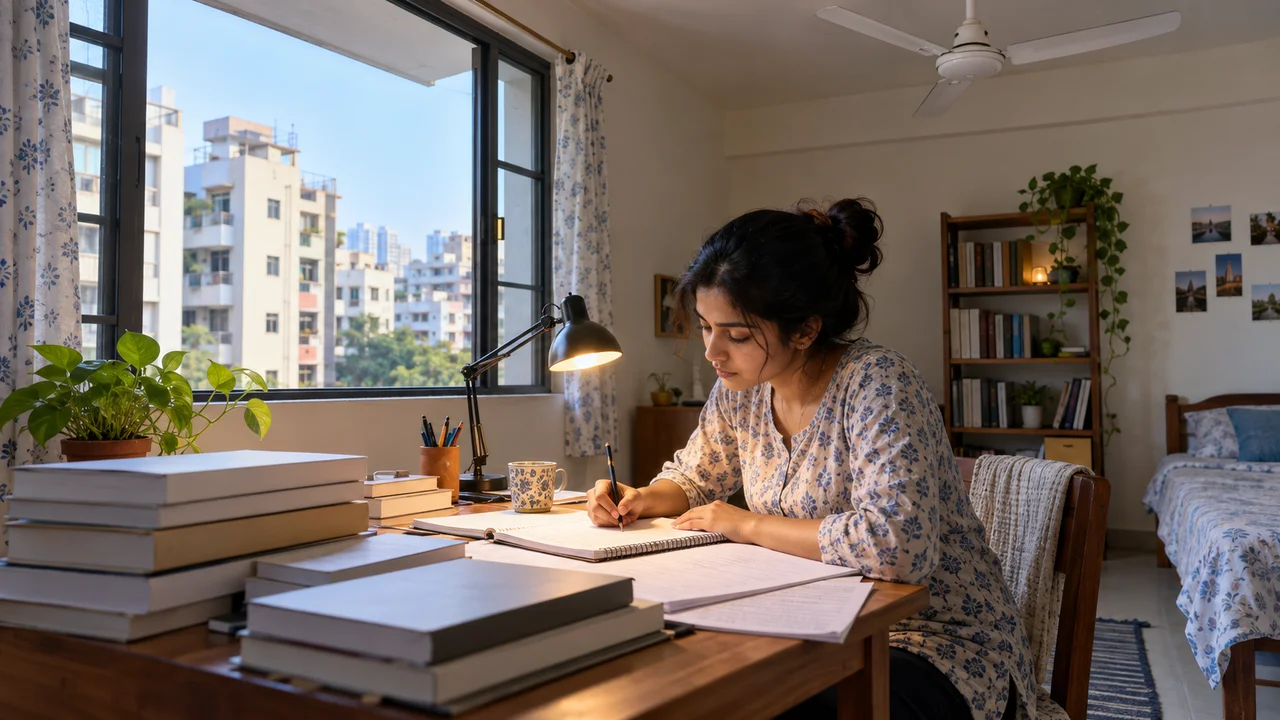
An aspirant needs a room that supports long, repeated study days without wearing you down: quiet, natural light, fresh air, food you can rely on, a short commute, steady internet and power that doesn't cut out mid-mock. A tourist can put up with a noisy room for a few nights. You'll be living and working in this space for months, maybe years, so small problems compound.
Here's how to think about each need, and what to test on a visit rather than take on trust.
Quiet you can count on
Quiet isn't just a silent room at 11 am when the owner shows it to you. Ask what the building sounds like in the evening and early morning, which is when most aspirants revise. Rooms facing a main road, a shared kitchen or a common TV area tend to be louder. Stand in the room with the door closed for a few minutes and listen.
Roommates change the picture too. A sharing room can work well if your schedules match, and badly if one person studies at night while the other sleeps. The trade-offs are covered in detail in this guide to choosing a single or sharing room for study.
Light and ventilation
Daylight and airflow do more for long study days than most furniture. A window that opens to the outside, not into a corridor or shaft, gives you both. Check whether the window gets direct light at any point in the day and whether the fan and any exhaust work.
Rooms without an outside window also raise a safety question we'll come back to: if the only way air gets in is through the door, that's also likely the only way you get out.
Food that won't derail your routine
Reliable meals at fixed times protect your study schedule more than any app. If the PG offers a mess, ask for the weekly menu, the meal timings and whether meals can be packed when you have a test. If it doesn't, find out where you'd eat and how long that takes each day. Eating out three times a day adds both cost and lost hours.
Commute to coaching and libraries
A short, predictable trip beats a slightly bigger room every time. Walk or ride the route at the hour you'd travel, not on a quiet afternoon. Count the trip to your coaching centre and the trip to wherever you'll self-study, because many aspirants spend more hours in a reading room than in class.
Whether you need a paid library at all depends on your room and your habits. This comparison of a self-study library versus studying in your room walks through when each one makes sense.
Internet and power backup
Online test series, recorded lectures and current affairs all depend on a stable connection. Ask whether Wi-Fi is included, how many people share it and whether you can run a speed test during your visit. Then ask about power backup: does it cover just the lights, or fans and sockets too? A power cut during a timed mock is a lost practice session.
Safety lessons from Old Rajinder Nagar and Mukherjee Nagar
Two recent incidents in Delhi's coaching areas point to the same rule: never assume a space is safe because students already use it. Ask what the space is approved for and how people get out when something goes wrong. Both incidents happened in coaching buildings rather than residences, but the questions they raise apply just as much to where you sleep and study.
The basement flooding, 27 July 2024
Three aspirants died when the basement of a civil services coaching centre in Old Rajinder Nagar flooded on 27 July 2024. The Delhi High Court later transferred the investigation to the CBI, as reported by The Week.
The detail that matters most for anyone choosing a room is this one. According to The Tribune, the basement was approved for parking or storage but was being used as a library. A space's approved use isn't visible from the inside, which is why you have to ask.
The official response was wide. The MCD sealed the basements of 13 civil services coaching centres in the area, according to News On AIR. The Supreme Court took suo motu cognisance and described such coaching centres as "death chambers", as reported by Careers360.
The Mukherjee Nagar fire, 15 June 2023
A year earlier, on 15 June 2023, fire broke out at a coaching institute in Bhandari House, Mukherjee Nagar. Students climbed down the building on ropes, and 61 people were treated in hospital, according to The Tribune. The Delhi High Court then directed a review of fire safety, a separate Tribune report said.
The images of students on ropes are a reminder that a single staircase is a single point of failure. If smoke fills it, there's nowhere else to go.
What these incidents mean for your room
You can't inspect wiring or read a building plan on a short visit. You can ask direct questions and watch how the owner answers them:
- What is this floor approved for? Be wary of any basement room, basement library or converted storage space.
- How do I get out? Look for a second exit or staircase, and check that it isn't locked, blocked or used for storage.
- Is there fire equipment? Look for extinguishers you can see and reach, and ask when they were last checked.
- Do the windows open? Grilles that can't be opened from inside trap people during a fire.
- Where does water go in heavy rain? Ground-level and below-ground rooms are the first to flood.
For a full walk-through of the questions and red flags, use this basement room safety checklist before you pay a deposit anywhere.
Where aspirants look: Delhi and Hyderabad
Delhi and Hyderabad both offer a wide choice of rooms, with Delhi slightly ahead on listing count. As of September 2026, there were 2,007 listings on Hostel360 in Delhi and 1,955 in Hyderabad. These are counts of active listed properties, so they tell you how much choice you have, not what anything costs or how many beds are free.
Delhi's coaching hubs
Delhi's coaching activity is spread across several neighbourhoods rather than one district, so the right area depends on which institute and which library you'll use. Among the Delhi areas in the data, these had the following listing counts as of September 2026:
| Delhi area | Listings on Hostel360 (as of September 2026) |
|---|---|
| Rohini | 75 |
| Mukherjee Nagar | 74 |
| Kamla Nagar | 67 |
| Laxmi Nagar | 55 |
A higher count means more rooms to compare, which helps you walk away from a place that fails the safety questions. It doesn't mean an area is safer or better value. Pick the area by your commute first, then compare rooms within it. You can browse student accommodation listings across Delhi and filter by area.
Hyderabad
Hyderabad's supply is close to Delhi's in raw numbers, with 1,955 listings as of September 2026. The same method applies: fix your coaching centre or workplace, check the real commute at peak hours, and only then shortlist rooms. CA students heading there for articleship should start from the firm's address. Browse student accommodation listings in Hyderabad to see what's available near your route.
Plan your move around the exam calendar
Book your room so you're settled well before your most important study months, not in the middle of them. Moving costs more than money. It eats days of preparation, and a bad room found in a hurry costs even more.
UPSC CSE 2027 dates
An India TV report on the UPSC calendar gives these Civil Services Examination 2027 dates:
- Notification: 13 January 2027
- Preliminary examination: 23 May 2027
- Main examination: from 20 August 2027
Dates can change, so always confirm them on the official UPSC exam calendar. Once you have them, work backwards. If you're shifting cities, aim to arrive with enough time to settle, test your commute and find your library before revision intensifies. Don't plan a move in the weeks just before prelims or between prelims and mains.
SSC and other exams
SSC aspirants should follow the same approach using the commission's own official calendar, because dates differ between exams and change from year to year. Note your tier dates, then fix the latest date by which you want to be fully settled.
Your first weeks in a new hub
The first month sets the routine you'll keep, so treat it as part of preparation. Test the room under real conditions, learn the food timings, register at a library if you need one and keep your documents in order. This first-month checklist for a coaching hub lays it out week by week.
CA articleship accommodation basics
CA students in articleship need a room planned around a workplace, not a classroom, and for a longer, fixed stretch. Under ICAI's New Scheme, practical training runs for 2 years, according to an ICAI announcement dated 6 July 2026. That makes your commute to the firm and your evening study conditions the two things to get right.
The proposed stipend increase
ICAI has published a draft amendment that would raise articleship stipends; the same announcement refers to a Gazette draft dated 25 June 2026. These rates are proposed, not final. As reported by CAclubindia, the proposed minimum monthly stipends are:
| City population | Proposed stipend, Year 1 (per month) | Proposed stipend, Year 2 (per month) |
|---|---|---|
| 20 lakh and above | Rs 5,000 | Rs 6,000 |
| 5 lakh to 20 lakh | Rs 4,000 | Rs 5,000 |
| Below 5 lakh | Rs 3,000 | Rs 4,000 |
Don't sign a room agreement on the assumption that these numbers are already in force. Budget on what's confirmed, and treat any increase as a bonus if and when ICAI finalises it.
What CA students should look for
- Commute to the firm at office hours. Articleship days are long, and audits can mean travel or late finishes.
- Flexible meal timings. A mess that closes early won't suit late office days.
- A desk and good light for evening study. You'll be preparing for exams after work.
- Clear notice terms. Firm postings and audit schedules can change, so know how much notice you must give.
For more on firm locations, notice periods and sharing with other articles, read the full guide to CA articleship accommodation.
How UPSC, SSC and CA needs differ
All three groups need a safe, quiet room, but they weigh the other factors differently. UPSC aspirants usually anchor on a coaching centre and library, SSC aspirants on a coaching centre and test practice, and CA students on an office. Use this table to set your priorities before you start visiting.
| Factor | UPSC aspirants | SSC aspirants | CA articleship students |
|---|---|---|---|
| Main anchor for location | Coaching centre and self-study library | Coaching centre and practice centre | Firm's office |
| Hours spent in the room | Often long, especially in self-study phases | Varies with coaching schedule | Mostly evenings and weekends |
| Food priority | Fixed, reliable meals that fit a study routine | Fixed, reliable meals that fit class timings | Flexible timings for late office days |
| Internet need | Lectures, test series, current affairs | Online mocks and practice tests | Study material and some work tasks |
| Planning horizon | Built around the UPSC calendar | Built around the SSC calendar | Built around the 2-year training period |
Budgeting without guesswork
Set your budget from confirmed costs you collect yourself, not from figures passed around in group chats. Rents, deposits, mess charges and library fees vary by area, building and season, and listing counts tell you nothing about price. Ask every owner for the full monthly amount in writing, including electricity, Wi-Fi, food and any one-time charges.
If your coaching institute bundles a hostel or mess, read the refund terms closely. The Ministry of Education's 2024 guidelines for regulation of coaching centres call for a pro-rata refund within 10 days, including hostel and mess fees, if a student leaves mid-course, as summarised by Business Today. How that's applied can vary, so get the terms in writing before you pay. The budget spoke linked in the introduction walks through each cost line for Delhi.
The aspirant PG checklist
Carry this checklist to every visit and fill it in on the spot, while you can still see the room. If a place fails any safety row, move on, however good the rest looks.
| Area | What to check | Red flag |
|---|---|---|
| Floor and approval | Room is above ground; owner can say what each floor is approved for | Basement room or basement library; vague answers about approvals |
| Exits | Second exit or staircase that is open and clear | One narrow staircase; exits locked or used for storage |
| Fire safety | Extinguishers visible and reachable; owner knows when they were checked | No equipment; tangled or exposed wiring |
| Windows | Opens to the outside; grilles can be opened from inside | No outside window; fixed grilles |
| Water | No damp, seepage or water marks on lower walls | Signs of past flooding at ground or basement level |
| Quiet | Calm with the door shut; away from road, kitchen and TV area | Constant noise in evenings or early mornings |
| Light and air | Daylight at some point in the day; working fan and exhaust | Dark room that needs lights all day; stale air |
| Food | Written weekly menu and meal timings; packed meals possible | No fixed timings; no menu on request |
| Commute | Route tested at your real travel time | Long or unpredictable trip to coaching, library or office |
| Internet | Speed test run during the visit; number of users known | Owner won't let you test; frequent drops reported by residents |
| Power backup | Backup covers fans and sockets, not just lights | No backup, or lights only |
| Study space | Proper desk and chair; reading lamp or good overhead light | Bed is the only place to sit |
| Agreement and money | All charges, notice period and refund terms in writing | Cash-only with no receipt; terms only given verbally |
| Wellbeing | Warden or owner reachable; residents seem settled | No one responsible on site; high resident turnover |
Preparation is hard on the mind as well as the body, and the room you choose is part of how you cope. If exam stress becomes too much, Tele-MANAS, the national tele mental health programme, takes calls on 14416 and 1800-89-14416, according to the Karnataka mental health department. Save the number before you need it.
Bottom line
The best room for exam preparation is the one that's safe first and makes long study days easier after that. Check what each floor is approved for and how you'd get out, then judge quiet, light, air, food, commute, internet and power. Fix your move around confirmed exam or articleship dates, collect real costs in writing, and walk away from any place that fails a safety question.
Start with your anchor, whether that's a coaching centre, a library or a firm, shortlist rooms within an easy commute of it, and take the checklist above on every visit.