If you're preparing for your child's move to a hostel, you're carrying two emotions at once: pride and worry. That combination is normal in almost every Indian family, and it doesn't go away just because the admission letter says everything is fine.
For Indian parents, this shift is bigger than a room change. Your child goes from a full home setup to managing meals, laundry, money, routines, safety, and emotions on their own, often in a city they've visited twice.
This parents guide sending child hostel India gives you a practical system instead of vague reassurance: choose the place carefully, verify safety in person, set a money structure, and stay connected without over-controlling.
If you're finalising options this week, start with this detailed PG selection checklist for parents and students, then come back here for the parent-specific layer.
Key Takeaways
- Budget ₹10,000 to ₹22,000 per month all-in for a metro city, and ₹7,000 to ₹14,000 in Jaipur, Kota, Indore, or Bhopal. Rent alone is never the real number.
- Visit the hostel twice, once in daylight and once after 8 pm. Night visits reveal lighting, street activity, and warden presence that photos hide.
- Insist on a written agreement with rent, deposit amount, notice period, and refund conditions. Deposits are usually one to two months' rent, and vague terms are where money disappears.
- Talk to two current residents privately. Their answers about food consistency and complaint response are more reliable than any brochure.
- Set a communication rhythm before move-in: daily contact in weeks one and two, then three to four meaningful calls a week. Frequency isn't the same as closeness.
- Keep an emergency fund of ₹8,000 to ₹15,000 separate from monthly pocket money, and agree in advance on what counts as an emergency.
- Not every problem is a relocation problem, but harassment, safety breaches, and unresponsive management are non-negotiable reasons to move.
Parents Guide Sending Child Hostel India: Start With Systems, Not Panic
The most useful thing you can do in the first month is replace anxiety with structure. Worry that produces a checklist helps your child; worry that produces six missed calls a day doesn't.
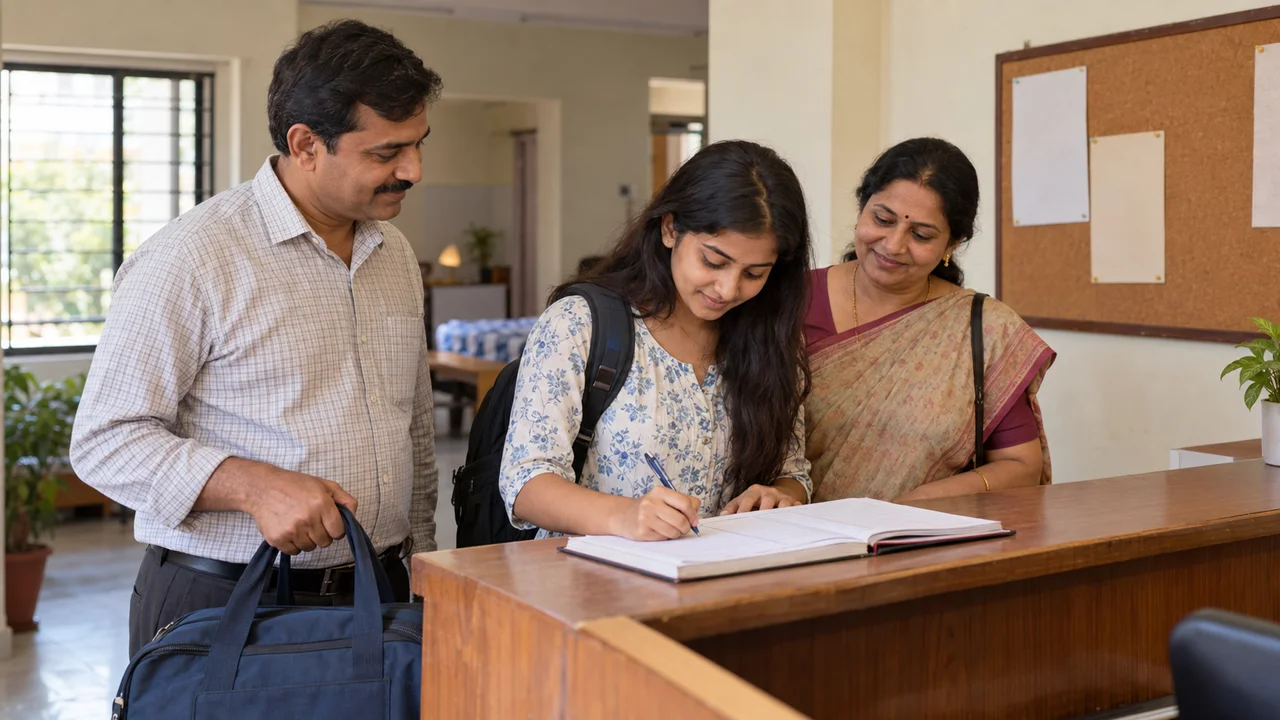
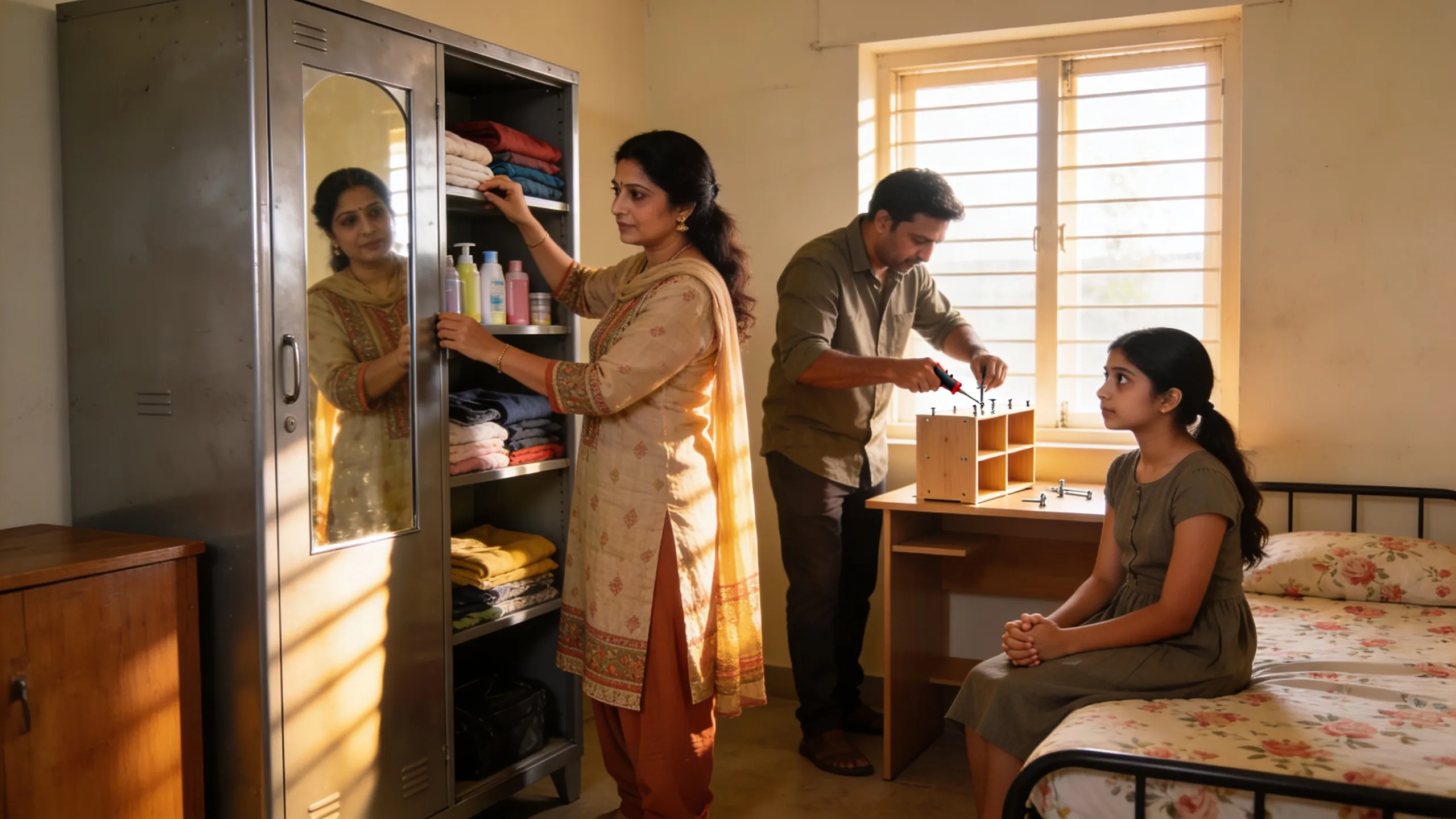
When Sharma uncle dropped Ananya at her Pune PG last July, he looked calm in front of everyone. He arranged her bedsheet, checked the cupboard lock, and said, "Take care, beta."
On the drive back, he called her three times in two hours, then felt guilty for disturbing her. This pattern is common in week one, and it's not a character flaw.
When you're sending a child to a hostel for the first time, your mind jumps to worst-case scenarios: will she eat properly, will he choose good company, and if the phone is unreachable for an hour, is something wrong?
Hold on to four things during this phase:
- Worry is a sign of love, not weakness.
- Your child can struggle and still be completely safe.
- Adjustment is rarely smooth in the first two weeks, even for confident kids.
- Independence grows in small steps, not in one dramatic moment at the gate.
Takeaway: ask yourself a better question. Not "how do I stop worrying?" but "what system removes this specific worry?" Food worry becomes a mess-menu question. Safety worry becomes a night visit. Money worry becomes a fixed transfer date.
What It Actually Costs to Send Your Child to a Hostel in India
Plan for a total monthly outgo of ₹7,000 to ₹22,000 depending on the city, not just the advertised rent. Most parents underestimate by ₹3,000 to ₹5,000 a month because food, transport, and top-ups are quoted separately.
| City / area type | Shared room rent | Single room rent | Realistic monthly total |
|---|---|---|---|
| Jaipur (Mansarovar, Vaishali Nagar, Malviya Nagar) | ₹5,000 to ₹8,000 | ₹9,000 to ₹13,000 | ₹8,000 to ₹15,000 |
| Pune (Kothrud, Karvenagar, Viman Nagar) | ₹6,500 to ₹10,000 | ₹11,000 to ₹16,000 | ₹11,000 to ₹19,000 |
| Bangalore (Koramangala, BTM, Marathahalli) | ₹8,000 to ₹12,000 | ₹13,000 to ₹20,000 | ₹13,000 to ₹24,000 |
| Delhi NCR (North Campus, Laxmi Nagar) | ₹7,000 to ₹11,000 | ₹12,000 to ₹18,000 | ₹12,000 to ₹22,000 |
| Kota, Indore, Bhopal (coaching belt) | ₹5,500 to ₹9,000 | ₹9,000 to ₹14,000 | ₹9,000 to ₹16,000 |
On top of the monthly figure, the one-time move-in cost usually lands between ₹15,000 and ₹40,000. That covers the security deposit (typically one to two months' rent), the first month's rent, and setup purchases like bedding, a bucket, a sturdy lock, an extension board, and a basic medicine kit.
Takeaway: before you compare two hostels, ask both for an all-inclusive monthly number in writing. If one quotes ₹7,000 and adds electricity, laundry, and mess separately, it may cost more than the ₹9,500 place that includes everything.
The Parent Checklist for Choosing a Hostel or PG
Your child will judge the place on Wi-Fi speed, room aesthetics, and where their friends are staying. Your job is to add a second layer that they won't think about: reliability.
Run through this before finalising anywhere:
- Management reliability: is there a fixed warden or manager on site every day, or only a phone number that someone answers sometimes?
- Resident profile: mostly students, mostly working professionals, or mixed? Ask for floor-wise details, since a floor of night-shift workers changes the sleep environment.
- Rules clarity: gate timings, visitor policy, late-entry process, and how complaints are logged and closed.
- Meal consistency: "food included" means nothing on its own. Ask for meal timings, the weekly menu pattern, and what happens on days the cook is absent.
- Utilities stability: water supply schedule, inverter or generator backup, Wi-Fi uptime, and whether laundry is machine access or a paid service.
- Commute practicality: the actual walking route to college or office, evening transport availability, and street lighting on that route.
- Medical access: the nearest clinic, the nearest hospital with an emergency department, and a pharmacy that stays open past 10 pm.
- Paperwork: a written agreement, a receipt for every payment, and clearly stated deposit refund terms.
If your child is moving to a major student city, look at neighbourhood-level supply before you lock a budget. Start with hostels in Pune for students to see how rent shifts between areas in the same city.
These area listings are useful benchmarks when you want to sanity-check a quoted rent:
- student-friendly PGs in Malviya Nagar, Jaipur
- shared stay options in Koramangala, Bangalore
- Tulip Girls Hostel in Karvenagar, Pune
- PG and hostel options in Mansarovar, Jaipur
Takeaway: shortlist on price, but decide on management quality. A well-run ₹9,000 hostel beats a badly run ₹13,000 one every single month.
How to Verify Safety Before You Pay the Deposit
Visit twice, once in daylight and once after 8 pm, because the two visits show you completely different buildings. Brochures and WhatsApp photos are marketing, and a video call walkthrough hides exactly the things you need to see.
Observe the building, not just the room
- Staircase and corridor lighting at night
- Condition of the entry gate, the main door lock, and individual room locks
- Fire extinguishers, and whether the service tag is current or five years old
- Cleanliness of bathrooms, water points, and the water tank area
- Ventilation in the room and in common areas, which matters a lot in Chennai, Hyderabad, and Jaipur summers
Ask management specific questions, not polite ones
Generic questions get generic answers. Use these instead:
- "If my child falls sick at 11 pm, what exactly is your process?"
- "How many staff members stay on the premises overnight?"
- "How quickly do you fix a broken lock, a plumbing leak, or an electricity fault?"
- "What happens if a resident misses gate timing because of a late lab or a delayed train?"
- "Can you share the written fee and refund policy right now?"
If the answers are vague, defensive, or change between the first and second visit, treat that as data. Management that improvises answers in front of a paying parent will improvise during an emergency too.
Talk to two current residents privately
Step away from the owner and ask two residents three questions: is the food quality consistent, does management respond on time, and do the rules apply equally to everyone?
Most parents skip this step because it feels awkward. It's the single highest-value five minutes of the visit, because residents describe the ordinary week rather than the sales pitch.
Check the neighbourhood after 8 pm
- Is the street active or completely deserted?
- Are there shops, a chemist, or a tea stall still open?
- Is an auto or cab available without a twenty-minute wait?
- Would you feel comfortable if your child walked this stretch alone at 9:30 pm after library hours?
Core safety checks that apply to every child
- CCTV covering entry points and common areas, never inside rooms or bathrooms
- Trained warden presence with genuine night supervision
- A visitor logbook that's actually being filled in, not lying blank
- Biometric or register-based entry tracking
- An emergency contact board displayed where residents can see it
- Basic fire safety readiness and a clear exit route
- Distance to the nearest police station and hospital
Use this broader hostel safety guide for students as a second pass so nothing gets missed during an emotional visit.
Additional checks when your daughter is moving
- Women-only premises, or clearly segregated floors with genuinely controlled access
- A female warden available at night, not just during office hours
- A well-lit approach road from the nearest bus stop, metro station, or auto stand
- Trusted late-evening commute options, ideally a known cab or auto driver
- A documented escalation process for harassment complaints, with a named person responsible
Run the girls hostel safety checklist during the visit itself rather than from memory afterwards. If your daughter is moving to Jaipur, compare PGs and hostels in Vaishali Nagar first, then verify warden and entry policies in person.
The emergency triangle most parents forget
Save three contacts in both your phone and your child's phone before you leave the city: the warden or manager, the nearest police station, and one local guardian or trusted relative if you have one.
Takeaway: safety isn't a single feature you can tick off. It's a chain of small things, and one weak link is enough to break the whole arrangement.
Agreement, Deposit, and Paperwork Parents Should Insist On
Never pay a deposit without a written agreement, however friendly the owner seems. Deposit disputes are the most common financial conflict in Indian PGs, and almost all of them start with "we don't need paperwork, we're like family."
The agreement doesn't need to be a long legal document. One page covering these points is enough:
- Monthly rent, and exactly what it includes
- Deposit amount and the refund timeline after vacating
- Conditions under which deductions can be made
- Notice period, usually 30 days
- Amenities promised: meals, Wi-Fi, laundry, power backup, water
- Electricity billing method, whether it's shared, metered, or included
Pay by UPI or bank transfer, not cash, so there's a trail for every rupee. Photograph the room on move-in day, including existing scratches, stains, and broken fittings, and keep those timestamped photos until the deposit is refunded.
Also make sure your child carries digital copies of their Aadhaar, college ID, health insurance policy, and blood group information in a folder they can reach without your help.
Takeaway: the paperwork takes twenty minutes and protects ₹15,000 to ₹30,000. That's the best hourly rate you'll earn all year.
Money Systems: Budget, UPI Discipline, and the Emergency Fund
Financial stress turns into emotional stress faster than most parents expect, so set a predictable money system before move-in day rather than after the first crisis.
One-time costs before move-in
- Security deposit, usually one to two months' rent
- First month's rent
- Registration or documentation charges, if any
- Setup purchases: bedding, bucket, lock, extension board, basic medicines, ₹3,000 to ₹6,000 typically
- Travel and local setup expenses
The hostel packing list is worth going through before departure so your child arrives with essentials sorted instead of spending the first weekend shopping in an unfamiliar market.
Monthly fixed costs
- Rent
- Mess or food charges, ₹3,000 to ₹5,500 if not included in rent
- Commute pass or daily travel budget, ₹600 to ₹2,500 depending on city
- Mobile and data recharge
- Laundry and daily essentials
Variable costs parents routinely forget
- Occasional tiffin or outside meals when the mess is closed
- Exam printouts, lab materials, and project costs
- Medicines and doctor visits
- Emergency cab rides late at night
- Festival travel home, which spikes during Diwali, Holi, and semester breaks
The emergency fund rule
Keep ₹8,000 to ₹15,000 in a separate account or wallet that isn't mixed with monthly pocket money. Decide together, in advance, what qualifies as emergency use, and give your child one fallback payment method beyond UPI, such as a debit card or a small cash reserve in the cupboard.
UPI discipline that avoids monthly arguments
Instead of random transfers whenever your child asks, use a fixed structure: one transfer on the same date every month, one small mid-month top-up rule if genuinely needed, and one calm spending review every 30 days without a scolding tone.
For deeper habit-building, walk through this student budget planning guide for hostel life together before the first transfer goes out.
Takeaway: predictable money reduces the number of stressful calls. Unpredictable money creates them.
A Communication Rhythm That Builds Trust Instead of Pressure
Agree on a call schedule before move-in day, because an undefined rhythm is what causes both distance and resentment. Too few calls feel like abandonment; too many feel like surveillance.
A rhythm that works for most families:
- Weeks 1 and 2: one fixed daily call plus one short check-in message
- Week 3 onwards: three to four meaningful calls per week at times that don't clash with classes
- Emergency rule: if there's no response beyond an agreed window, use the backup escalation contact rather than calling twenty times
During calls, ask about energy and routine rather than performance. "How's your sleep and food this week?" and "any practical problem I can help solve?" get real answers. Listen fully before advising.
Avoid interrogation-style question chains, comparisons with cousins or siblings, and threat-based language like "if marks drop, come back home." Those three habits reliably reduce how much your child tells you.
Khan saab from Lucknow was calling his daughter six to eight times a day during her first week in Bangalore. She started silencing calls during lectures, and both sides felt hurt. They reset to one morning message and one evening call, tension dropped, and she began sharing more on her own.
Takeaway: connection is measured by what your child volunteers, not by how many times the phone rings.
When to Coach, When to Intervene, and When to Act Immediately
Sort every problem into one of three buckets before you react, because treating a minor issue like a crisis teaches your child to hide the real ones.
Let them handle it, with your guidance
- Minor roommate disagreements about noise, light, or cleanliness
- Time-management problems and missed deadlines
- Homesickness with no safety risk attached
- One-off skipped meals or a disrupted sleep week
Your role here is coach, not controller. Ask what they've already tried before offering a solution.
Intervene collaboratively
- Repeated bullying, exclusion, or intimidation
- Persistent eating or sleep problems that are affecting health
- Repeated financial misuse despite a clear plan
- Ongoing academic disruption clearly linked to living conditions
Your role here is to bring together your child, the management, and any local support, ideally in one conversation rather than five separate ones.
Act immediately, without waiting for the next call
- Any physical safety threat
- Harassment or stalking concerns
- Serious medical or mental health episodes
- Evidence of substance pressure in the living environment
- Management refusing to respond to a serious complaint
Ritika's son Aarav moved to Kota for coaching. In week one he called home saying he wanted to come back. Instead of reacting, she asked three questions: are you unsafe, are you unwell, are you overwhelmed?
It was overwhelm, not danger. She helped him run a seven-day reset with a fixed wake-up time, one evening walk, consistent meals, and one daily call. By week three he had stabilised, and by month two he was arguing with her about coming home too often.
Takeaway: ask the three-question filter before deciding anything. Unsafe, unwell, or overwhelmed lead to completely different responses.
Red Flags That Justify Moving Out Quickly
Some situations don't deserve a second chance, no matter how much deposit is at stake. Move your child out if you see any of these:
- Repeated safety breaches at the entry or access level
- Harassment incidents with no formal response from management
- Chronic water, hygiene, or electricity failures affecting health
- Warden or management behaving threateningly or dismissing an emergency
- Clear mental-health deterioration linked to the living environment
- Hidden charges, deposit coercion, or a pattern of financial misconduct
If relocation is needed, do it in order: document the issues with dates, messages, and photos; escalate once formally in writing; arrange a temporary safe stay with a relative, friend, or a hotel; then shift essentials first and sort paperwork afterwards.
Takeaway: a calm, structured exit over three days beats three months of hoping things improve.
Parents Guide Sending Child Hostel India: The First-Month Routine
If you want one simple plan to follow instead of the whole guide, use this five-step rhythm.
- Before move-in: verify the agreement, the safety chain, local emergency contacts, and payment rules
- First 7 days: focus entirely on routine stability, not performance lectures
- Weeks 2 and 3: review food, sleep, commute, and spending patterns together
- Week 4: decide what genuinely needs fixing and what to leave alone
- Monthly: one scheduled visit, or a video walkthrough if the distance is long
- Festival planning: book travel early for Diwali, Holi, and semester breaks, when tickets vanish weeks in advance
For a mid-month reset checklist and a realistic picture of what week one looks like from your child's side, read what to expect in the first week in a hostel.
Takeaway: consistency beats panic. The parents whose children settle fastest aren't the ones who call most, they're the ones who set up good systems and then trusted them.