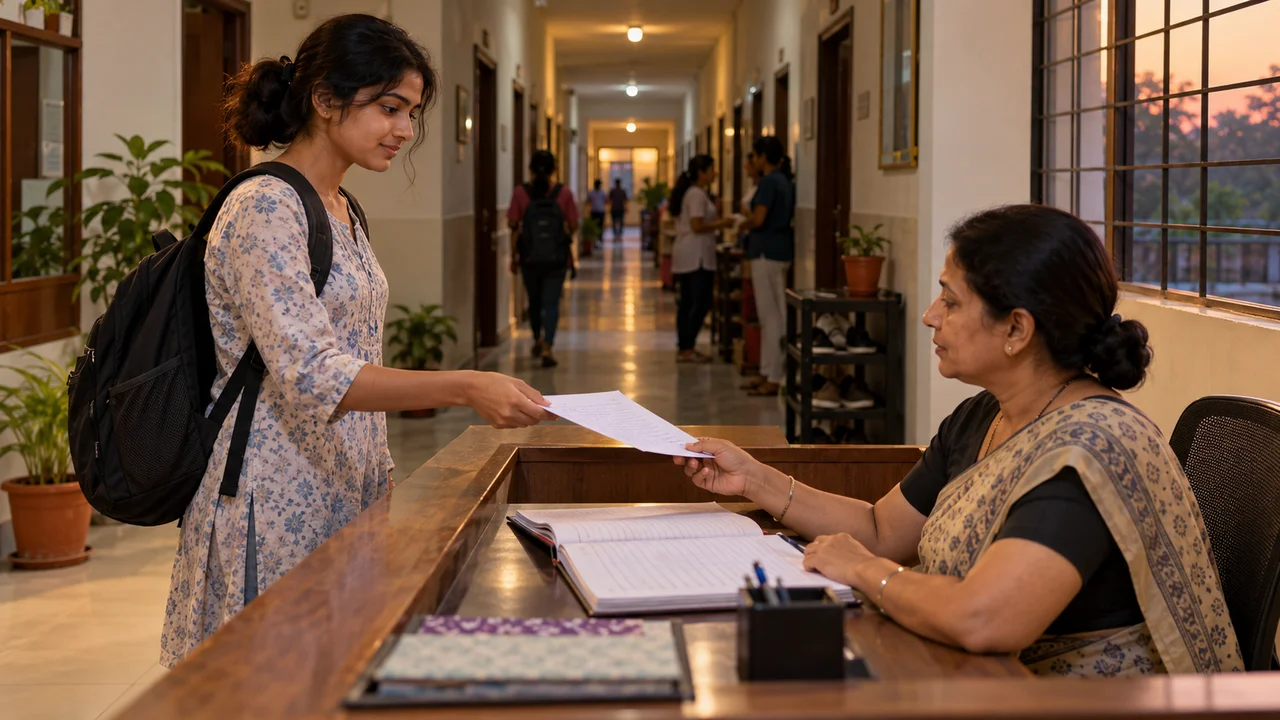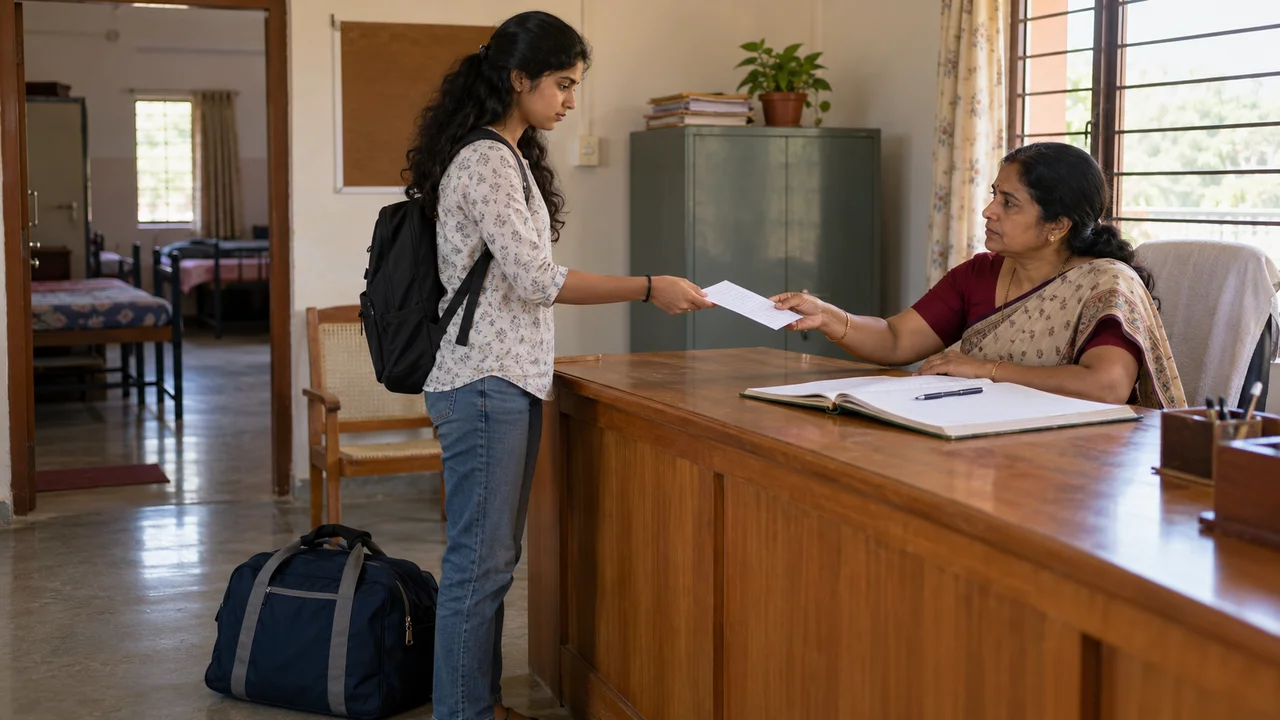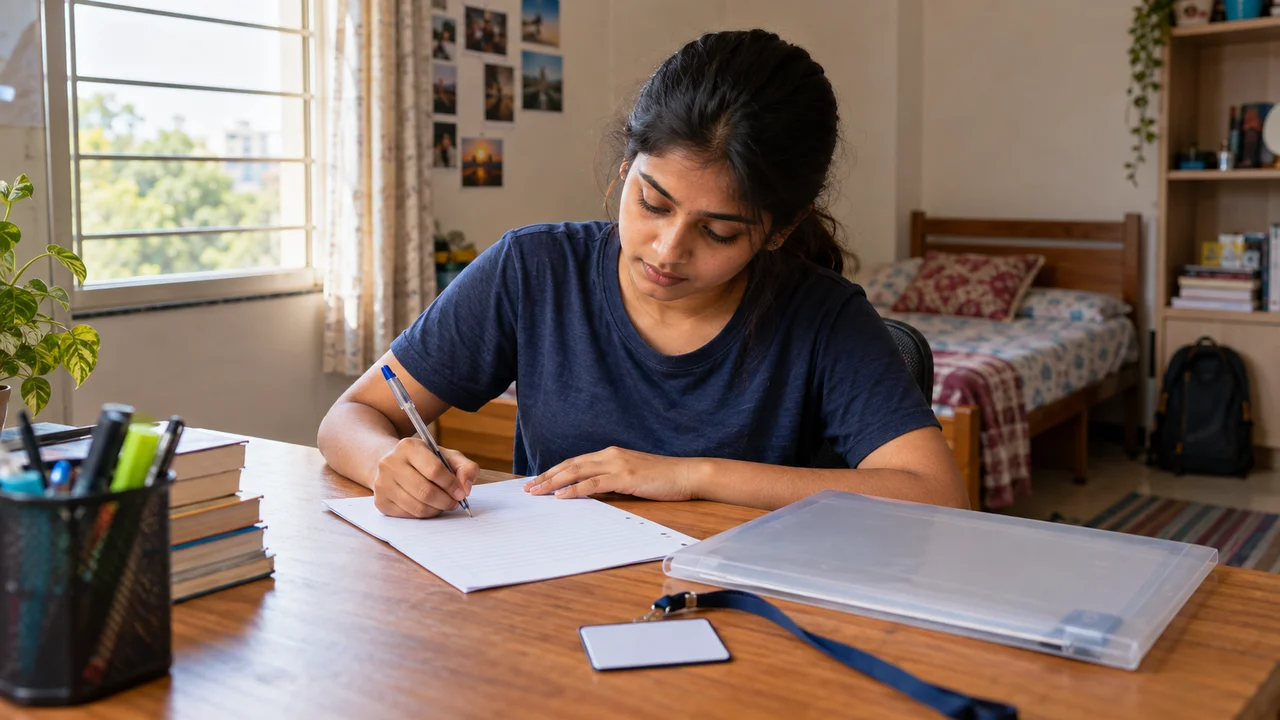
A hostel application is a short formal letter, addressed to the warden or hostel authority, that asks for one specific thing and gives a clear reason. Every type of hostel letter, from a leave request to a refund claim, uses the same basic structure, so once you learn the format you only need to change the subject, the body and the attachments. This guide sets out that shared format, gives a short sample for each letter a student in a school, college, university or private hostel is likely to write, and links to a full guide for each one.
Formats and approvers vary from one institution to the next. Treat the samples here as starting points, and always check your hostel handbook, notice board or office for any prescribed form before you submit.
Key Takeaways
- Every hostel letter uses one structure: To block, date, subject, salutation, body, closing, signature block with roll and room number, and enclosures.
- Keep each application to one request, state the reason in the first lines, and give exact dates.
- The right addressee and attachments depend on the letter type and on your institution's rules, so confirm them with the hostel office.
- Leave, night out and undertaking letters often need a parent's countersignature; check before you submit.
- Keep a copy or a sent email of every application, so you can follow up with a polite reminder if there's no reply.
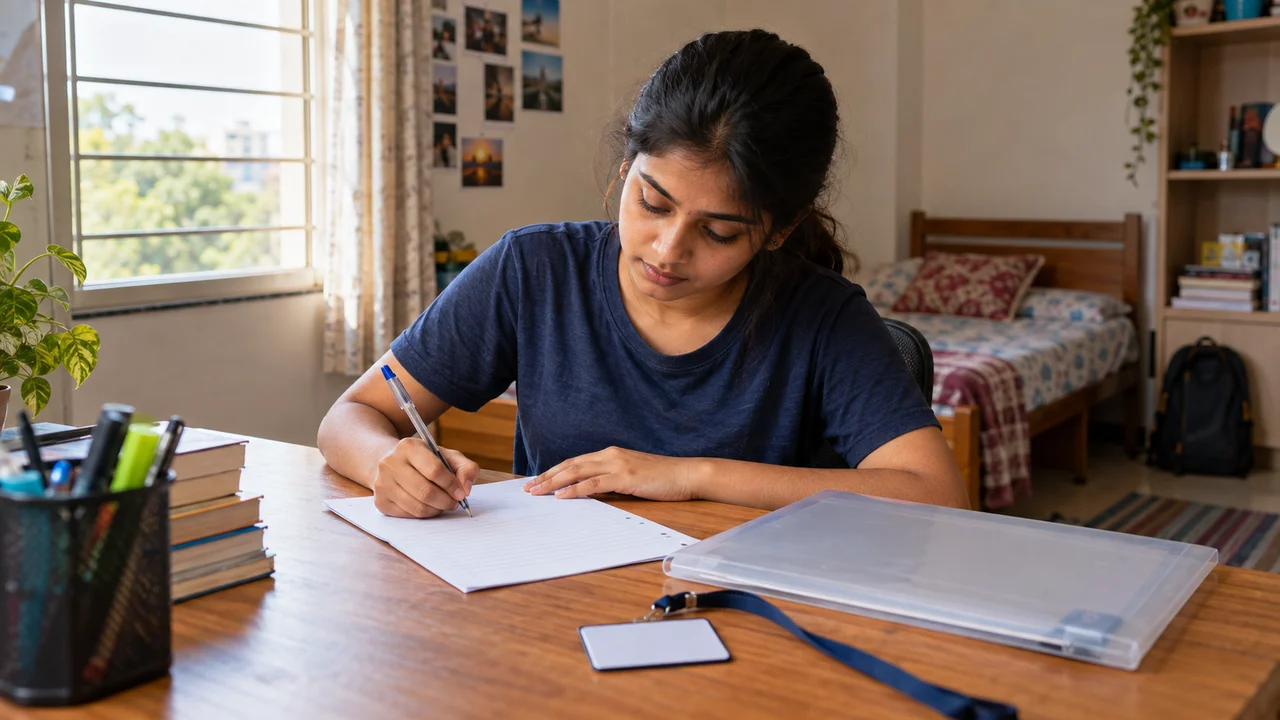
What is a hostel application?
A hostel application is any written request a resident or applicant sends to the people who run the hostel. It can ask for permission, report a problem, request a document or claim money back. What makes it an application, rather than a casual message, is that it creates a record the hostel can act on and file.
Students write these letters for different reasons at different stages of hostel life:
- Before moving in: applying for a seat or room.
- During the stay: leave, night out permission, room change, complaints and undertakings.
- For outside purposes: a hostel certificate for a scholarship, a bank or another office.
- When leaving: getting the caution deposit or security deposit back.
The audience also changes. In a school or college hostel, you'll usually write to a warden, a chief warden or the principal. In a private hostel or PG, the letter may go to the manager or owner. If you're new to hostel living in general, our guide to hostel life in India covers the routines and rules these letters sit inside.
The universal hostel application format
Every hostel application format follows the standard Indian formal letter: an addressee block, date, subject, salutation, body, closing and signature block, plus an enclosures line when you attach anything. Get these parts right and the letter looks correct whatever you're asking for.
The parts of the letter, in order
- To block. Write "To", then the designation (The Warden, The Chief Warden, The Hostel Manager), the hostel name, and the institution and city on separate lines. Use the designation rather than a person's name unless your hostel asks for names.
- Date. Put the date you're submitting the letter. Some students place it above the To block, others below it. Either works if you're consistent.
- Subject. One line that names the request: "Application for leave from [date] to [date]". The warden should know what you want before reading the body.
- Salutation. "Respected Sir/Madam" is the safe default in Indian institutions. "Dear Sir/Madam" is fine for private hostels.
- Body. Two or three short paragraphs. State the request in the first sentence, give the reason and the exact dates next, then mention any attachments or arrangements.
- Closing. A polite request line ("Kindly grant me permission...") followed by "Thanking you" and "Yours sincerely" or "Yours obediently".
- Signature block. Your signature, full name, course and year, roll or registration number, room number and hostel block, and a phone number.
- Enclosures. A numbered list of attached documents, such as an ID card copy or a medical certificate.
A blank template you can copy
To
The Warden
[Hostel name]
[Institution name], [City]
Date: [DD/MM/YYYY]
Subject: Application for [request]
Respected Sir/Madam,
I am [your name], a student of [course and year], residing in Room [number], [block] of [hostel name]. I am writing to request [request] because [reason].
[Dates, arrangements or details the warden needs to decide.]
I request you to kindly consider my application. Thanking you.
Yours sincerely,
[Signature]
[Full name]
Roll No.: [number]
Room No.: [number]
Phone: [number]
Enclosures: 1. [Document] 2. [Document]
A common mistake is writing a long backstory before the request. Wardens read many letters, and the ones that put the request first tend to be easier to approve.
Which letter do you need, and who receives it?
The letter you need depends on the situation, and each situation has a usual addressee and set of attachments. The table below is a general guide. Your hostel may name a different approver or ask for different documents, so confirm with the hostel office.
| Situation | Letter | Who to address (usually) | Typical attachments |
|---|---|---|---|
| Going home or away for some days | Leave application | Warden | Parent consent, travel details, medical certificate if ill |
| Applying for a hostel seat | Admission application | Chief warden, hostel superintendent or principal | Admission proof, ID, photos, address proof, fee receipt |
| Problem with your room or roommate | Room change application | Warden | Supporting note or medical certificate if relevant |
| Staying out overnight | Night out permission letter | Warden | Parent consent, host's address and phone number |
| Food, water, cleanliness or safety issue | Complaint letter | Warden, then chief warden if unresolved | Photos, dates of the problem, earlier complaint copies |
| Scholarship needs proof of hostel stay | Request for hostel certificate | Warden or hostel office | Scholarship notice, ID card, fee receipt |
| Joining the hostel or a new session | Undertaking | Warden or chief warden | Parent signature, ID copy |
| Leaving the hostel | Caution deposit refund application | Warden, hostel office or accounts section | Deposit receipt, no-dues form, bank details |
The samples below follow the same order. Each one is deliberately short. Follow the link under each sample for the full version with variations.
Hostel admission application
An application for a hostel seat asks the authority to allot you a room and shows you're eligible. Many institutions use a printed or online form, in which case the letter becomes a cover note. Where no form exists, the letter itself is your application.
Subject: Application for hostel accommodation for the session [year]
Respected Sir/Madam,
I have taken admission to [course], [year], with enrolment number [number]. My home is in [city], which is too far to travel daily. I request you to allot me a seat in the [boys'/girls'] hostel for the session [year]. I am ready to follow all hostel rules and pay the fees as required.
Enclosures: Admission receipt, ID proof, [number] photographs
Mention distance from home, your course and any category or priority your institution recognises, but only if it applies to you. Our guide on the application for hostel admission has versions for school, college and university hostels.
Hostel leave application
A leave application asks the warden's permission to be away from the hostel for one or more days. It's the most common hostel letter, and the one where exact dates matter most.
Subject: Application for leave from [date] to [date]
Respected Sir/Madam,
I request leave from [date] to [date] to go home to [city] for [reason]. I will travel by [mode] and return to the hostel by [time] on [date]. My parent, [name], is aware of this and can be reached at [phone].
Parent's signature: [signature]
Give a departure date, a return date and a contact number. Vague phrases such as "for a few days" are a common reason for letters coming back. For sick leave, festival leave and leave extensions, see the full hostel leave application guide.
Night out permission letter
A night out letter asks to stay outside the hostel for one night, past the in-time. Hostels treat it carefully because the warden is responsible for knowing where residents are.
Subject: Request for night out permission on [date]
Respected Sir/Madam,
I request permission to stay at [host's name and relation], [full address], on the night of [date] for [reason]. I will leave after [time] and return by [time] on [date]. My host can be contacted at [phone]. My parents have given their consent.
Parent's signature: [signature]
The host's full address and phone number are the details wardens most often ask for. The night out permission letter guide covers family functions, events and late returns.
Room change application
A room change application asks to move to a different room or block, and gives a reason the warden can act on. Keep the tone factual, especially when the reason involves a roommate.
Subject: Request for change of room from Room [number]
Respected Sir/Madam,
I am currently in Room [number], [block]. I request a change of room because [reason, such as a health need, a maintenance problem or study timings]. If possible, I would prefer Room [number] or any room in [block]. I will shift on a date convenient to the hostel office.
Describe the problem, not the person. A letter that blames a roommate by name can turn a simple request into a dispute. More versions are in the room change application guide.
Complaint letter to the warden
A complaint letter reports a problem the hostel should fix: poor mess food, no water, broken fittings, cleanliness or a safety issue. It works best when it names what's wrong, since when, and what you'd like done.
Subject: Complaint regarding [issue] in [block/floor]
Respected Sir/Madam,
I wish to bring to your notice that [describe issue] in [location] since [date]. This has caused [effect on residents]. I request you to [specific action] at the earliest.
Enclosures: Photographs dated [dates]
A group complaint signed by several residents usually carries more weight than one person's letter, but keep it polite. Sample formats for mess, water, electricity and harassment issues are in the guide to writing a complaint letter to the hostel warden.
Hostel certificate request for a scholarship
A certificate request asks the hostel to confirm in writing that you live there. Scholarship portals and offices often ask for it as proof of residence or to calculate hostel-related allowances.
Subject: Request for hostel residence certificate for scholarship
Respected Sir/Madam,
I have been a resident of [hostel name], Room [number], since [date]. I am applying for the [scholarship name], which requires a certificate confirming my hostel stay [and the fees paid]. I request you to issue the certificate at the earliest, as the last date is [date].
Enclosures: Scholarship notice, ID card copy, fee receipt
Check the exact wording the scholarship needs before you write. Some schemes provide their own certificate format for the warden to sign. The full guide to the hostel certificate for scholarship explains what to ask for.
Hostel undertaking
An undertaking is a signed promise rather than a request. You agree to follow the hostel's rules, and the hostel keeps it on file. Most hostels give you a printed version, so you only write one yourself when no form exists.
Subject: Undertaking to abide by hostel rules
I, [name], son/daughter of [parent's name], a student of [course], residing in Room [number], undertake that I will follow all rules of [hostel name], respect the in-time, take care of hostel property and not take part in ragging in any form. I understand that breaking these rules may lead to action as per hostel regulations.
Student's signature: [signature] Parent's signature: [signature]
Many institutions also ask for an anti-ragging undertaking. In colleges that follow the national system, it's completed through the Anti-Ragging portal, so ask your hostel office whether you need it. The hostel undertaking format guide covers rule, property and parent undertakings.
Caution deposit refund application
A refund application asks the hostel to return the caution or security deposit you paid at admission, after you've cleared any dues. Submit it when you vacate, while the details are fresh.
Subject: Application for refund of caution deposit
Respected Sir/Madam,
I was a resident of Room [number], [hostel name], from [date] to [date]. I have vacated the room, returned the keys and cleared all dues. I request you to refund my caution deposit of Rs. [amount], paid vide receipt no. [number], to the bank account given below.
Bank details: [account holder], [account number], [IFSC]
Enclosures: Deposit receipt, no-dues certificate, cancelled cheque
The deposit receipt and the no-dues clearance are the two documents a refund usually depends on, so keep both safe from the day you move in. See the caution deposit refund application guide for versions for private hostels and delayed refunds.
Email or handwritten: which should you send?
Send your application the way your hostel asks for it. If there's no stated rule, email suits routine requests, while signed paper copies suit anything that needs a parent's signature or goes into a permanent file.
- Email works well for complaints, certificate requests, refund follow-ups and private hostels where the manager handles requests by email. Use your institutional address if you have one.
- A handwritten or printed letter works better for leave, night out permission and undertakings, where the hostel often wants an original signature on paper.
- Doing both is sensible when a deadline matters: submit the signed copy at the office and email a scan so you have a time-stamped record.
For an email, the subject line does the job of the letter's subject: "Leave application, [name], Room [number], [dates]". Keep the same structure in the body, and attach documents as PDFs rather than phone photos where you can.
When a parent countersignature is needed
A parent or guardian countersignature is commonly asked for when the letter involves your safety or the family's money. That usually means leave, night out permission, undertakings and sometimes refunds paid to a parent's account. Some hostels also ask for it from all minor residents, which is more common in school hostels.
If your parent can't sign in person, ask the warden whether a signed scan or an email from the parent's registered address is acceptable. Don't sign on a parent's behalf. If it's discovered, it can turn a routine request into a disciplinary matter.
Common hostel application mistakes
Most rejected or delayed hostel applications fail for simple reasons: missing details, the wrong addressee, or more than one request in one letter. All of them are easy to fix before you submit.
- No roll or room number. The office can't match the letter to you. Always fill in the full signature block.
- Vague dates. "Next week" or "a few days" can't be approved. Write exact dates and times.
- Several requests in one letter. A leave request and a room change need different decisions. Write two letters.
- Wrong addressee. Sending an admission letter to a floor warden can delay it. Check who decides.
- Missing attachments. List every enclosure and attach it. A refund without the receipt often waits.
- Emotional or accusing tone. State facts. Firm and polite gets further than angry.
- No copy kept. Photograph or scan the signed letter before you hand it in.
How to follow up when there's no reply
If your application gets no response, send a short, polite reminder that refers to the original letter, then escalate in writing one level at a time. Keep the tone neutral, because the reminder becomes part of the record.
- Wait a reasonable time. Allow for the warden's schedule and the urgency of the request. A leave request before travel needs a faster nudge than a certificate due next month.
- Ask in person or by phone first. Often the letter is still waiting in a pile, and a polite word at the office solves it.
- Send a written reminder. Quote the original date and subject, attach a copy, and repeat the request in one line.
- Ask for an acknowledgement. Request that the office stamp or sign your copy, or reply to your email, so you can show when you submitted it.
- Escalate to the next level. If there's still no response, write to the chief warden, the hostel superintendent or the dean of students, depending on how your institution is organised. In a private hostel, the next level is usually the owner or management.
Subject: Reminder: [original subject], submitted on [date]
Respected Sir/Madam,
I had submitted an application on [date] regarding [request]. A copy is attached for reference. As [reason for urgency], I request you to kindly consider it at the earliest and let me know if any further document is needed.
Next steps
Start with the blank template above, pick the sample that matches your situation, and then open the full guide for that letter before you submit. Check three things each time: the right addressee, exact dates, and every attachment listed in the enclosures line.
Because formats and approvers differ between institutions, your hostel handbook or office always has the final word. If it provides a form, use the form. If it doesn't, the structure in this guide gives you a clear, polite letter that a warden can read in a minute and act on.